
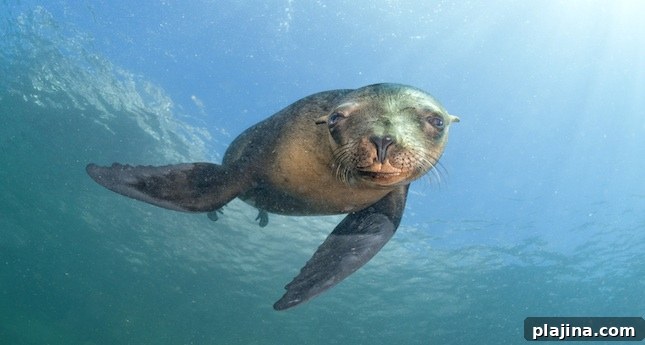
From March 18–28 this year and March 17–27, 2017, One Ocean Expeditions offers a specialized cruise centered on active scientific research conducted by an on-board team of marine mammal scientists. Guests will have the chance to observe research in real time, including underwater views of marine mammals made possible by the new GoPro app that streams unique footage of animals in their natural habitat beneath the sea surface. Leading the scientific program is Dr. Ari Friedlaender, a researcher and professor from Oregon State University, who will direct a team collecting data on the foraging ecology of marine mammals and studying how climate change is influencing their behavior.
The voyage also features Chad Nordstrom, a research and environmental biologist from the Vancouver Aquarium, who brings expertise in marine mammal feeding behavior and species distribution in polar ecosystems. Author and naturalist Brian Keating, known for his work with the Canadian Broadcasting Corporation, will join the cruise to share decades of experience guiding wildlife and nature expeditions. The Marine Mammals Voyage sails aboard the Akademik Sergey Vavilov, one of One Ocean Expeditions’ two purpose-built, ice-class Canadian expedition vessels. Both ships are rated for polar conditions and offer modern cruise comforts for small groups, accommodating up to 98 guests per departure.
This expedition is designed for travelers who want more than passive observation: it provides an immersive, science-focused experience where participants can learn directly from researchers, witness data collection, and gain a deeper understanding of polar marine ecosystems. Emphasis on real-time research and high-quality underwater imaging makes the voyage valuable for photographers, naturalists, students, and anyone interested in the effects of changing climates on marine life.
By combining expert-led fieldwork with comfortable expedition cruising, the trip balances educational opportunities and adventure. Passengers can expect lectures, guided outings, and the possibility of close encounters with seals, whales, and other marine mammals while specialists document behavior and feeding patterns. The onboard team’s research contributes to broader scientific knowledge about how marine species adapt to shifting prey availability and environmental conditions in polar regions.
Small group sizes enhance the experience, allowing for personalized interpretation and better access to the scientific team. The Akademik Sergey Vavilov is equipped to support field research in cold-water environments while providing safe, stable accommodations for guests. Overall, the Marine Mammals Voyage offers a meaningful way to see polar wildlife responsibly while supporting and learning from active scientific research.