
Delhi is not a single city but many — layered in history, administration, culture, economy and society. The present metropolis is widely regarded as the eighth urban settlement to occupy this strategic stretch of northern plains. For centuries the region served as a crossroads for traders and armies, and each earlier city has left visible traces in the modern landscape. Here and there you can find remnants of the 10th-century Qila Rai Pithora, the 13th-century Mehrauli, and the 17th-century Shahjahanabad. Around every corner, Delhi reveals another layer of its long and complex history.
Modern Delhi often feels as though it is bursting at the seams — and that impression is accurate. The metropolis has expanded beyond its historic limits and spawned four major satellite cities: Gurgaon, Faridabad, Noida and Ghaziabad. Together the National Capital Region is home to about 22 million people and sprawls across nearly 13,000 square miles.
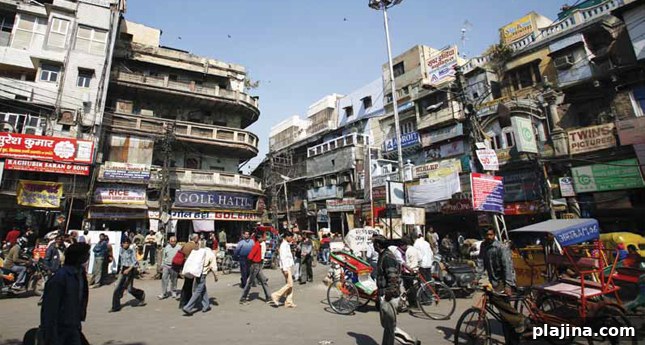
Beyond the historical and geographic divisions, Delhi contains distinct social layers that coexist in a chaotic, vibrant mix. The city houses both extreme poverty and great wealth. You can leave a state-of-the-art, climate-controlled IT office and step within minutes into streets that have changed little for decades — or even centuries. Modern SUVs fight for space with hand-pulled carts; taxis compete with cycle rickshaws; cows sift through garbage at busy intersections while children beg under giant billboards advertising the latest smartphones.
On Delhi’s streets, past and present, poverty and prosperity, tradition and technology collide more dramatically than in most other cities.
Historically, rulers faced with major change often moved and founded new urban centers, which explains the succession of cities through time. Today, however, there is no such luxury: even the expanding satellite towns struggle to absorb Delhi’s breakneck growth. As India emerges as an economic power, city planners are working to modernize an immense, aging metropolis and equip it for the 21st century.
The scale of the challenge is illustrated by the Yamuna River. Originating from a Himalayan glacier, the river runs clear through the foothills but becomes heavily polluted by the time it passes through Delhi, carrying industrial effluent and sewage. Numerous municipal efforts over the years failed to reverse the decline, but current initiatives aim to address the root causes.
An extensive drainage system is under construction with the goal of cutting pollution by as much as 70 percent in three years. Beyond that, the Yamuna Action Plan proposes converting a 1,000-acre riverside stretch into an ecopark featuring bird-rich wetlands, formal gardens and walking trails.
India’s strong economic performance over the past two decades has fostered a problem-solving mindset and renewed confidence in tackling issues that once seemed intractable.
Traffic remains one of Delhi’s greatest challenges. First-time drivers or passengers experience the city’s roads as an initiation: lanes blur, vehicles press three or four abreast on two-lane roads, and overtaking can be a matter of split-second judgement. For many, the chaos is intimidating rather than enjoyable.
The Delhi Metro, inaugurated in 2002, offers a reliable alternative. The network has steadily expanded line by line and station by station, already carrying over two million passengers daily. Ambitious plans include advanced technologies such as magnetic-tracked, wheel-less trains, which could make the Metro both one of the fastest-growing and most advanced rapid-transit systems in the world.
The 2010 Commonwealth Games spurred a wave of infrastructure investment. Indira Gandhi International Airport received a major upgrade with Terminal 3, a large and technologically advanced facility, and the Delhi Airport Metro Express established a rapid connection between downtown and the airport.
However, infrastructure vulnerabilities remain. Large-scale power failures in recent years highlighted the need for resilient systems. As Delhi embarks on broader development plans, the city aims to upgrade transport, regenerate slum areas and attract major infrastructure investment to stimulate economic growth.
Numbers and scales in India can be bewildering, and the local numbering system is another cultural nuance to note: lakh equals 100,000 and crore equals 10 million. Business visitors should be familiar with these terms to interpret local reports and media.
The sensory impact of Delhi is strong, particularly in Old Delhi. Connaught Place, a major colonial-era traffic circle framed by colonnaded buildings, serves as a focal point where routes converge. The bustle of pedestrians, hawkers, carts, livestock, private vehicles, rickshaws, taxis, buses and Metro trains creates a constant ebb and flow. Delhi remains, and will likely remain, many cities in one.
Diversions
Some tourists hesitate in hotel lobbies before stepping into the city; Delhi is not a place for quiet promenade. On the streets, your personal space will be challenged by offers of rides, bargain goods and, at times, street scams targeting newcomers. Yet many visitors find the intensity exhilarating rather than off-putting.
A practical approach is to dive in gradually: take a taxi to Shahjahanabad (Old Delhi) and walk along Chandni Chowk. If your senses hold up, you’ll start to adapt to Delhi’s rhythms.
Poverty in the old town can be shocking. The Salaam Baalak Trust offers guided city walks led by former street children, providing local perspective while supporting a charitable program.
Adjacent to Old Delhi is the Red Fort, a vast 17th-century Mughal complex. Its expansive grounds provide a peaceful refuge, especially in the morning. Notable structures include the Pearl Mosque, the marble-adorned Diwan-i-Khas and the emperor’s private apartments. Unusual vendors near the entrance sometimes sell odd souvenirs, a small example of the city’s many curiosities.
Nearby is Raj Ghat, a simple black-marble memorial on trimmed lawns marking the cremation site of Mahatma Gandhi in 1948.
Humayun’s Tomb in New Delhi is a 16th-century Mughal masterpiece whose symmetry and dome anticipated the Taj Mahal. Southwest of the center, Mehrauli’s archaeological remains include the Qutb Complex, dominated by the 239-foot Qutb Minar, a brick minaret built between the 12th and 14th centuries.
Delhi is also the starting point for the Golden Triangle tourist circuit: from Delhi to the Taj Mahal in Agra and onward to Jaipur with its hilltop forts and palaces. The typical circuit can be completed in about a week.
Lodging
Hotel Diplomat
A contemporary, minimalist interpretation of British colonial style offers 25 individually designed guestrooms in the heart of New Delhi. 9 Sardar Patel Marg, Diplomatic Enclave, Chanakyapuri. $$$
The Imperial New Delhi
Restored to British Raj splendor, the Imperial is more than accommodation; it remains an influential part of Delhi’s heritage. Janpath. $$$$
The Park New Delhi
Close to Connaught Place, this trendy hotel includes The Residence, a luxury hotel-within-a-hotel offering super-deluxe rooms and private lounges. 15 Parliament St. $$$
Dining
Indian Accent
Recipient of numerous awards, Indian Accent offers an inventive menu that blends Indian and international influences. Manor Hotel, 77 Friends Colony (West). $$$–$$$$
Moti Mahal
Essential for lovers of traditional Indian cuisine, the original Moti Mahal is famed for its tandoori specialties; seek the original location rather than later franchises. 3704 Netaji Subhash Marg, Daryaganj. $$
Oh! Calcutta
Decor inspired by colonial-era dining clubs; the menu focuses on Bengali specialties. International Trade Tower, E-Block, Ground Floor, Nehru Place. $$
Checking In With Sajid Desai
Group Director of United Business Media India and organizer of SATTE
What Are The Key Opportunities In Delhi For American Investors?
Delhi offers diverse investment opportunities across surface transport, aviation, logistics, power and energy, nanotechnology, biotechnology, homeland security, software and hardware manufacturing, education and healthcare. The hospitality and tourism sector is especially promising: the Northern Capital Region needs tens of thousands of new hotel rooms.
What Cultural Differences Should Foreign Investors Be Aware Of When Doing Business In India?
Indian business culture places strong emphasis on authority and status, and communication between senior and junior staff is often formal. Constructive feedback is important, as criticism should avoid damaging an individual’s dignity. Though formal rules exist, inconsistent adherence can present challenges for organizations.
How Important Is The Business Sector To Delhi’s Tourism Industry?
Business travel remains a major driver of inbound arrivals, accounting for roughly 75–80 percent of visitors to Delhi. Many star hotels fill 80–85 percent of their rooms from business travelers.
What Are Your Expectations For SATTE?
SATTE, South Asia’s major B2B travel and tourism event, regularly attracts growing participation. Organizers anticipate continued growth and strong engagement from both domestic and international exhibitors and partners.
Which Local Attractions Do You Recommend For Visitors?
Key historic sites include the Red Fort, Qutb Minar and Humayun’s Tomb. For shopping, Dilli Haat showcases artisans from across India; Shantushti features renowned designers; and the Cottage Emporium, run by the government, offers a wide selection of handicrafts. Delhi blends traditional and modern India and offers lively nightlife alongside its rich cultural heritage.
Weblinks
Cottage Emporium
Delhi Tourism
Salaam Baalak Trust