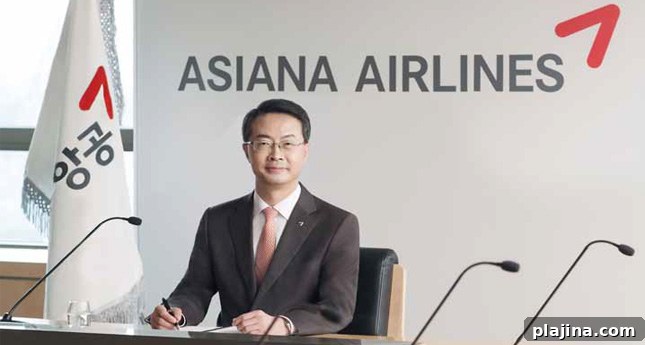
Name: Kim Soo Cheon
Title: President and CEO
Company, city: Asiana Airlines; Seoul, South Korea
Number of employees: About 12,000 globally
Recent project: Launch of Air Seoul, Asiana Airlines’ second low-cost carrier subsidiary
First job: Responsible for new business development at SamCheok Coal Co. (acquisition of pharmaceutical company)
Little-known fact about you: I am a huge fan of Korean and Chinese classics and novels.
Your Business
Essential business philosophy: Always place customer satisfaction first by delivering the highest standards of safety and service.
Best way to keep a competitive edge: Maintain relentless focus on customer-centered, premium service through continuous improvement.
Yardstick of success: Building a sustainable company that earns customer trust and inspires pride and satisfaction among employees.
Kim Soo Cheon as a Traveler
What is the most important item you take when traveling? A book.
How do you spend your time on board? Resting and recharging. I use flight time to refresh myself.
What is your favorite restaurant in the world? The HyangYeon in central Seoul, known for its authentic and flavorful traditional Korean cuisine.
What is your favorite destination in the world? Jeju Island, Korea’s largest island, southwest of the peninsula and recognized for its exceptional natural beauty.
About Asiana Airlines
Asiana Airlines recently finalized an order of 25 Airbus A321-200neo aircraft. Tell our readers about the new aircraft.
Asiana currently operates A321-200 aircraft on many short-haul routes across China, Japan and Southeast Asia. The A321neo, with initial deliveries beginning in 2019, will gradually replace the older A321-200 fleet. As part of a broader fleet strategy, Asiana plans to deploy A380 and A350 aircraft on long- and medium-haul routes while using the A321neo for regional services within Asia.
The A321neo introduces a revised cabin layout and increases capacity to 180 seats compared with the existing A321-200’s 171 seats. Thanks to advanced engines and aerodynamic improvements, the A321neo achieves about 20 percent lower fuel consumption, improving operational efficiency and reducing environmental impact.
What can premium travelers expect from the 2016 Asiana Airlines experience, particularly in North America?
Asiana continues to operate its flagship Airbus A380 on routes to Los Angeles and New York, offering First Suite, Business Smartium and economy-class cabins. The First Suite includes sliding doors, a fully flat bed approximately 80 inches long and a 32-inch HD screen, delivering enhanced privacy and comfort for long-haul travelers.
Asiana’s culinary program is a highlight: award-winning meals and curated wine selections enhance the onboard dining experience. Business-class passengers enjoy Western dishes developed in collaboration with a top Korean Italian restaurant, while first-class travelers can sample traditional Korean royal cuisine, a refined menu inspired by historic royal meals.
To further improve the door-to-door journey, Asiana offers complimentary limousine service for first-class passengers arriving from the United States and Europe. Chauffeurs provide direct transfers between Incheon International Airport and destinations across the Seoul metropolitan area.
Asiana announced plans to launch its second budget carrier; what will Air Seoul offer intra-Asian travelers?
Air Seoul will operate many of Asiana’s short-haul international routes that are currently less profitable, with Incheon International Airport as its primary hub. The carrier aims to increase accessibility to smaller cities and leisure destinations across Asia by offering competitively priced seats. Together with Air Busan, Asiana’s existing low-cost subsidiary based at Gimhae Airport, Air Seoul will leverage Asiana’s global network to expand route options. This new low-cost airline is positioned to support Asiana’s long-term growth and contribute to more sustainable operations.