For centuries Riyadh served as the historic gateway to the holy cities of Mecca and Medina, drawing millions of pilgrims each year. Jeddah, Saudi Arabia’s second-largest city and the kingdom’s primary port on the Red Sea, has grown into an important commercial center in the Middle East, attracting international business and visitors from around the world.
Although fires destroyed much of the ancient settlement that dates back to 522, modern Jeddah is a thriving metropolis of roughly 4.3 million residents. Known for a more liberal atmosphere than some other Saudi cities, Jeddah actively encourages trade and industry. Government initiatives have focused on developing science and engineering capabilities, and the city ranks highly for innovation within the region.
Jeddah has a cosmopolitan vibe, but visitors should still respect local business and social etiquette. Western business attire is generally acceptable for men, but excessive long hair and facial piercings may be frowned upon. Women should be aware of local regulations: while the rules have evolved, conservative dress is appreciated in many settings. Avoid critical remarks about the royal family or political institutions. Foreign investors should note that local partnership rules often require a Saudi partner who may retain certain rights over the business.
Because tourism outside the pilgrimage sector is regulated, most non-pilgrim international arrivals come for business. Many arrive at King Abdulaziz International Airport, the country’s busiest airport located about 15 miles north of the city. The North Terminal serves international carriers; travelers whose hotels do not offer airport transfers can use shuttle buses from the lower floor outside baggage claim, which typically charge around $15 for the roughly 45-minute ride into town. Metered taxis take about 30 minutes to the city center and commonly cost around $50, though within the city drivers sometimes require a reminder to engage the meter.
Jeddah expanded rapidly after the 1940s and now stretches about 17 miles north along the Corniche to the Abhor beach area. King Abdulaziz Street is a principal north–south artery, while many corporate offices and commercial developments concentrate along Prince Saud al-Faisal Street. Tahlia Street is the fashion and shopping thoroughfare, lined with boutiques and department stores. Numerous modern malls offer dining and shopping options as well as climate-controlled relief from the heat; the yacht-themed Mall of Arabia even includes an indoor Snow Village attraction.
Because traffic can be heavy, many business travelers choose hotels closer to the airport or major office districts. The Rosewood Jeddah is often praised for its convenient location, quality dining and fitness facilities; its high-rise guestrooms offer Corniche views. The Jeddah Hilton, about 20 minutes from the airport, provides beachfront vistas, a large conference center, recreational facilities and reliable guest services. The Park Hyatt Jeddah – Marina, Club and Spa attracts business travelers with white, contemporary guestrooms accented by Arabian textiles, meeting rooms that face the sea and extensive wellness facilities including a ladies’ spa, tennis and squash courts, and a traditional hammam. The InterContinental Jeddah, though older, remains centrally located on the Corniche and is noted for an efficient staff and a well-regarded health club.
Dining options in Jeddah reflect its international population. Upscale hotels typically offer several restaurants, while neighborhoods around the Corniche and main business streets provide many independent choices, with seafood prominent on many menus. Park Hyatt’s Nafoura serves an à la carte lunch popular with business visitors, and its ladies-only Dardasha offers traditional afternoon tea.
Italian restaurants such as Margherita and Il Gabbiano are favorites for classic fare. For Indian cuisine try Zaika on Prince Saud al-Faisal Street. That same street hosts Turkish options such as Köşebaşı and popular steakhouses like The Butcher Shop & Grill. Sushi and sashimi are available at venues such as ZN in Roshan Mall on Tahlia Street. Al Nakheel on the North Corniche specializes in traditional Hijazi cuisine with Red Sea views. Lebanese restaurants like Yonine on Malik Road and Byblos are well known for refined interpretations of regional dishes, while other owners operate Chinese and Asian outlets such as Toki and Indian venues like Bharat in Stars Avenue Mall.
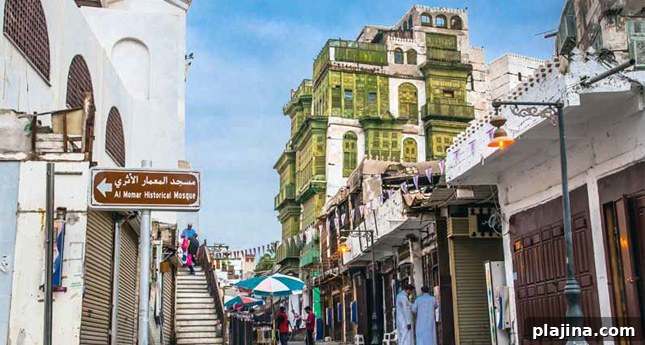
Old Jeddah (Al-Balad) is a UNESCO World Heritage site well worth visiting. Souq al-Alawi remains a bustling market frequented by pilgrims and traders. Al-Balad’s historic quarter features coral-built houses with ornate carved wooden balconies; several of these structures now host museums, including the Jeddah Museum and the Regional Museum of Archaeology and Ethnology, once the Khuzam Palace of King Abdul Aziz.
Public art and sculpture, funded during the oil boom of the 1970s and 1980s, make Jeddah one of the world’s largest open-air art galleries. Works by internationally known artists and striking contemporary pieces appear in roundabouts and along the Corniche. Two of the city’s most visible landmarks are King Fahd’s Fountain—one of the tallest water jets in the world—and the enormous Saudi flag hoisted on a very tall flagpole, both prominent visual welcomes for pilgrims and business travelers arriving in this dynamic coastal city.