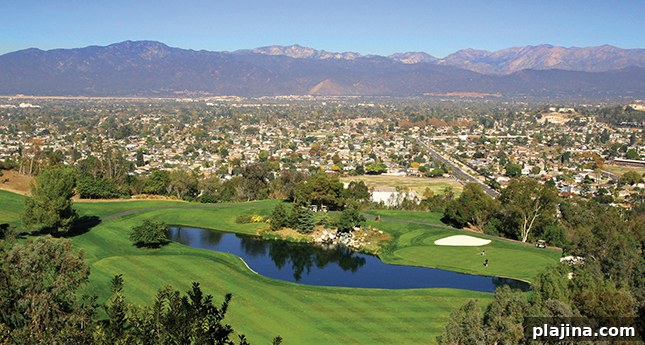
I have played the 36-hole combination at Industry Hills Golf Club at Pacific Palms for many years. Although it is a public facility, the club has a private feel and tee times are generally easy to secure. The property offers two distinct courses: the Dwight D. Eisenhower Course (the “Ike”) and the Babe Didrikson Zaharias Course (the “Babe”). Both present a real test. The Babe is shorter but very tight and demanding, while the Ike is longer and equally challenging. On a recent Sunday morning I played the Ike with some industry colleagues.
One surprising fact I learned from Ken, who works in the waste-management field, is that the entire layout sits atop one of Southern California’s older landfills. Given how often I’ve brought clients here over the past 25 years, I was shocked I hadn’t known. Perhaps that explains some of the questionable shots I’ve hit off the tee over the years.
Regardless of that odd history, you’d never suspect it while walking the fairways. Industry Hills was named National Golf Course of the Year by the National Golf Course Owners Association and has just completed a comprehensive five-year renovation that keeps it in top condition. William F. Bell designed the Dwight D. Eisenhower Course, which opened in 1979. From the back tees the Ike plays 7,211 yards, par 72, with a course rating of 75.1. It has hosted numerous U.S. Open qualifying events and LPGA tournaments.
Hole 1
(534 yards, par 5)
When we played the Ike this dogleg was still under renovation, but it remains worth mentioning. From the tee many weekend players try to cut the corner—Ken and Frank included—and often find themselves in brush, trees or even out of bounds. The smarter play is a straight, controlled drive and to avoid the pond at the turn. Eric and I took that conservative line and were left with a simple second shot that left us a chance to save par.
Hole 7
(465 yards, par 4)
Rated the No. 1 handicap hole, this stretch earns its reputation. The tee shot needs a slight draw to set up the proper angle into the green; otherwise a string of bunkers around the landing zone will trap errant drives. The surest strategy is to aim for the fattest part of the fairway and the green to minimize trouble.
Hole 12
(461 yards, par 4)
Length and a very narrow fairway make this hole formidable. Trees line both sides and bunkers guard the landing areas left and right. A precise tee shot to the center of the fairway is essential. On my round my tee shot sliced over a bunker and, I suspect, was scooped up by another group, which put me out of contention for the hole to the amusement of my partners. The green is uphill and plays long, and three bunkers protect the putting surface.
Hole 18
(652 yards, par 5)
The finishing hole is terrific and can swing a match. During our round we were playing “wolf,” and Frank gambled aggressively. Many players aim right toward a fairway bunker about 250 yards out, but the pond on the left often claims second shots. I managed good tee and second shots, but my approach hooked left of the green and left me a downhill chip that I misplayed. Ken salvaged a par to win the hole; Frank’s final number was less flattering. As usual, the contest was settled at the 19th hole.
Industry Hills Golf Club at Pacific Palms, One Industry Hills Parkway, Industry Hills, CA 91744 tel 626-810-4653
The No. 1 Handicapped Hole May Not Be the Hardest
By Frank Loverme
Many weekend golfers tense up on the tee of the course’s No. 1 handicapped hole assuming it is the toughest. In truth, for a higher-handicap player that top-rated hole can sometimes be the best place to salvage a par and win a hole against a stronger opponent.
The USGA’s hole handicap system is designed to identify where strokes should be given to equalize play between lower- and higher-handicap players. Teams from the USGA evaluate courses and assign hole-by-hole handicap ratings, but the results often seem mysterious to club players.
A common misconception is that the handicap number directly measures difficulty. Instead, handicap ratings are based on the variation in scores between two groups: scratch golfers and bogey golfers (separately for men and women). The rating reflects where the biggest difference in scoring occurs, not simply which hole is hardest for everyone.
The USGA defines a scratch male golfer as someone who averages about 250 yards off the tee and can reach a 470-yard hole in two shots; a scratch female averages about 210 yards and can reach a 400-yard hole in two. A male bogey golfer averages roughly 200 yards and reaches a 370-yard hole in two, while a female bogey player averages about 150 yards and reaches a 280-yard hole in two. The bogey golfer typically falls into a handicap index range that produces higher average scores.
Because the handicap reflects score variation, a long par 4 that bogey golfers rarely reach in two but that scratch golfers can attack often becomes the No. 1. For example, if bogey golfers average 5.1 on a hole and scratch golfers average 3.5—a 1.6-stroke swing—that hole may be rated the toughest on that nine.
The USGA alternates handicap numbers between front and back nines, explaining why odd numbers usually appear on the front nine. Another classic No. 1 setup is a par 4 with a pond placed so bogey players must lay up while scratch players can carry it and reach the green in two. If the bogey group finds water more often, the score variation swells and that hole receives the top handicap.
At Industry Hills the Ike’s 451-yard 12th hole is rated No. 2 handicap. The bogey golfer’s typical 200-yard drive lands in the narrowest part of the fairway, leaving a second shot uphill with the pin often tucked right—tough going for higher-handicap players. Meanwhile Ike’s No. 2 hole, a short 366-yard par 4 rated No. 11, looks easy on paper but can be one of the Ike’s most penal holes. A large pond guards the approach and a bunker sits only yards from out of bounds, creating hazards for both scratch and bogey players.
On that hole even a well-struck layup can end in disaster if a 3-wood careens into the water, and the steep front slope of the green can feed crisp approach shots back into trouble. That dynamic can produce some of the course’s worst scores, yet the hole sometimes plays comparatively easier for high handicappers because both groups are forced into conservative play—reducing the variability that creates top handicap rankings.
In short, the No. 1 handicap hole is often the place with the greatest scoring gap between scratch and bogey players, not necessarily the single most difficult hole for every golfer. Understanding that distinction makes post-round chatter at the 19th hole more interesting—and may help you win a side bet or two.
This article is part of a series on course psychology and how to gain an edge in casual wagers. Next issue: why the card’s slope value has little to do with actual slopes.