
Where does Seoul end and Incheon begin? On the busy expressway between the two neighboring cities, the boundary is marked by a small bilingual sign: Incheon. Only the most observant travelers notice they have crossed the line. For most visitors, the two cities flow into one continuous urban area.
My plane ticket adds to the confusion. The destination is listed as Seoul, yet the airport code is ICN — Incheon International Airport. “Welcome to Seoul,” the chief flight attendant announces on arrival. From my window I peer at the hazy skyline of Incheon, a reminder that the boundaries here are blurred.
South Korea’s dramatic urban growth helps explain this blending. Over the last 50 years Seoul spilled over the surrounding mountains, consuming farmland and nearby towns. Today the Seoul Capital Area covers about 12 percent of the country’s land and includes cities such as Suwon and Incheon, together housing roughly 25 million people.
Yet it’s also fair to say Incheon shaped modern Seoul. Facing the Yellow Sea, this port city opened Korea to the outside world in the late 19th century, helping end the country’s “Hermit Kingdom” era. Incheon’s shores were the site of General MacArthur’s daring 1950 landing that turned the tide of the Korean War and led to Seoul’s liberation. On reclaimed land here, planners are now building a future-focused metropolis.
Incheon’s transformation accelerated in the 1990s when construction began on a state-of-the-art airport built on land reclaimed to link two offshore islands. Incheon International Airport opened to passengers in 2001 and quickly became one of the world’s busiest and most highly regarded airports.
Early infrastructure projects associated with the airport seemed to prioritize direct links to Seoul. The main expressway skirts north of Incheon, and the Airport Railroad Express was designed to carry travelers nonstop to downtown Seoul in about 43 minutes.
Sunset over the Incheon Bridge © KTO NY
The dynamic changed with the 13-mile Incheon Bridge, opened in 2009. This privately operated toll bridge connects Incheon directly to the island airport and cut travel time from over an hour to roughly 20 minutes.
The bridge lands in the Songdo International Business District, a development remarkable even by South Korean standards. A decade earlier this coastline south of central Incheon had been tidal mudflats. Developers envisioned an ambitious $40 billion masterplan and set a bold timetable: complete the project within 15 years.
Creating Songdo required building 1,500 acres of new land—roughly the size of downtown Boston. Millions of cubic yards of soil were brought in and extensive seabed dredging took place. The environmental impact was significant, with the loss of habitat for migratory birds among the costs.
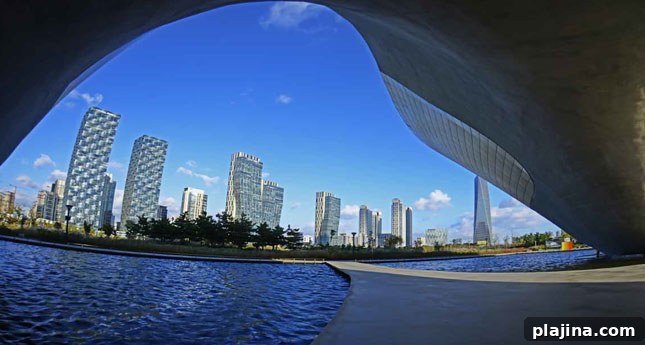
Once the reclaimed land was in place, builders erected more than 400 structures. Each tower rests on deep foundations driven through the fill to bedrock below. That stability allowed a skyline of new high-rises to rise, including the 68-floor Northeast Asia Trade Tower, currently South Korea’s tallest building.
Arriving in Songdo today, visitors expecting a construction zone may be surprised. The district feels like a functioning business center: clean lines, planned green spaces and mixed-use buildings. Empty sidewalks and quiet roads hint at remaining vacancies—population growth has lagged the rapid pace of construction.
Songdo © KTO NY
That population will likely follow. Strolling through Central Park, a leafy network of paths circling a saltwater lake at Songdo’s heart, highlights the lifestyle advantages here: walkable streets, hidden parking beneath green plazas, and buildings designed for both business and residence.
Unlike Seoul’s often chaotic sprawl, Songdo was planned as a 21st-century city focused on efficiency and sustainability. Smart infrastructure is woven into the district, including an underground pneumatic waste collection system that moves trash to a central facility.
From its inception, Songdo aimed to be a “Global Business Utopia.” Targeting industries like IT, biotech and nanotech, it has attracted multinational companies such as Samsung, Cisco and IBM.
Additional developments near the airport are underway. A new eco-friendly city on Yeongjong Island is planned, and proposals for Cheongna International City north of historic Incheon envision a mixed residential, educational and leisure center for about 90,000 residents. The centerpiece, Tower Infinity (Cheongna City Tower), is proposed as an “invisible skyscraper” with LED façades that display live images of the surrounding sky and landscape to visually blend the tower into its background.
Incheon’s futuristic ambitions echo its history. The city first opened Korea to foreign trade in the 1880s, became a Free Economic Zone in 2003, and in 2007 launched an “English City” initiative to increase everyday English usage and compete with Asian hubs like Singapore and Hong Kong.
Incheon International Airport © KTO NY
Incheon Port continues to grow as a major global trading hub, and flights from around the world pass through Incheon International Airport daily. The city is steadily stepping out of Seoul’s shadow. Perhaps the right question now is not where Seoul ends and Incheon begins, but where Incheon ends and the world begins.
Things to Do in Incheon
Incheon’s military history is compelling. Some original American landing sites have been altered by land reclamation, and Green Beach’s small memorial now sits along the Wolmido seafront promenade. A more substantial tribute is the Memorial Hall for Incheon Landing Operation, set into a hillside, where visitors can see an impressive granite monument, a well-curated museum and a collection of military vehicles and weapons. Jayu (Freedom) Park also commemorates the Battle of Inchon with a statue of Gen. MacArthur and a monument marking a century of U.S.-Korean relations.
Below Jayu Park sits Chinatown, the city’s most intact historic district. Unlike the pristine modern developments, Chinatown is a maze of narrow lanes and steep stone steps, with aromatic restaurants lining the streets.
Wolmido district © KTO NY
Wolmido, once an island now connected to the mainland, is adjacent to Chinatown. A monorail project, the Wolmi Eunha Rail, remains unused after safety concerns during testing, leaving an elevated track that is unlikely to enter service.
Incheon Fish Market, south of Wolmido, is a bustling hub near Yeonan Pier, the gateway to many Yellow Sea islands. Some islands are suitable for day trips, while others require more planning.
Muui Island is a popular destination with forested hills and scenic filming locations for Korean cinema and TV. At low tide you can walk from Muui to tiny Silmi Island, but be mindful of tidal changes. Rugged Baeknyeong Island, known for dramatic coastal rocks and rare Chinese egrets, is the closest island to North Korea and a four-hour ferry ride from Incheon; visits there convey a palpable sense of geopolitical tension.
Yeongjong Island, home to Incheon International Airport, also offers attractions. Eurwangni Beach’s white sand remains popular with domestic tourists. Hiking to the top of Baekun Mountain provides striking views of arriving and departing aircraft, and the 1,300-year-old Yonggungsa Temple on its slopes is a reminder that beneath the modern development, Incheon has deep historical roots.
CHECKING IN WITH BORA LEE
Manager, Public Relations Team, Incheon International Airport
WHAT IMPACT HAS INCHEON INTERNATIONAL AIRPORT HAD ON THE CITY OF INCHEON?
Incheon Airport serves as South Korea’s primary international gateway, handling more than 39 million passengers annually. The airport boosts tourism revenue, strengthens the logistics industry, generates employment (about 35,000 airport-related workers, many of whom live in the city) and creates opportunities for local businesses through construction and support services. The Incheon Free Economic Zone aims to maximize the airport’s economic potential and position the region as a Northeast Asian hub.
WHAT DEVELOPMENTS CAN WE EXPECT IN INCHEON IN THE NEXT FEW YEARS?
The airport began a third-stage expansion to increase capacity. A second terminal is central to this phase, which will raise annual passenger capacity from 44 million to 62 million and cargo capacity from 4.5 million to 5.8 million metric tons. The project is a multibillion-dollar investment. Complementary developments in the airport’s hinterland, branded as Air City, will introduce shopping, entertainment, casino and business facilities to transform the area into a regional tourist and commercial destination.
WHICH ATTRACTIONS IN THE INCHEON AREA WOULD YOU RECOMMEND FOR VISITORS?
As Korea’s first open port in 1883, Incheon retains relics from its early encounter with modernity—consulates, trading houses and historic administrative buildings—which offer visitors a unique cultural perspective. Incheon Airport also runs transit tours that let travelers explore major sites for little or no cost (entrance fees and meals are extra). Options include a two-hour Temple Tour featuring Incheon Grand Bridge, a memorial hall for the Incheon landing and a temple, and a longer 3.5-hour Asia in Incheon City Tour with visits to Wolmi Park and the port area.
Incheon: Just the Facts
Time Zone: GMT +9
Phone Code: Country code: 82 City code: 32
Entry/Exit Requirements: U.S. citizens need a valid passport; no visa is required for leisure or business stays up to 90 days. For longer stays, a visa must be obtained before arrival.
Currency: Won
Official Language: Korean
Key Industries: Aviation services, IT, biotechnology, nanotechnology, construction
Incheon Info to Go
International flights arrive at Incheon International Airport (ICN), located on Yeongjong Island just off the city. Access to the mainland is available by bus, ferry or taxi. Using the Incheon Bridge by taxi incurs a toll in addition to the fare.
Where to Stay in Incheon
Harbor Park Hotel Harbor Park is within walking distance of Chinatown and Wolmido and overlooks Incheon Harbor; nearby transit links provide access to downtown Seoul. 3-5 Fifth St., Hang-dong, Jung-gu $$$
Hyatt Regency Incheon Located minutes from the airport, the Hyatt offers easy access to mainland attractions, nearby golf courses and sea fishing arrangements. 208 Yeongjong Haeannamro, Unseo-dong, Jung-gu $$$$
Sheraton Incheon Hotel Situated in Songdo IBD beside the 100-acre Central Park and next to the Songdo Convention Center, this modern hotel suits business travelers. 153 Convensia Road, Yeonsu-gu $$$$
Restaurants in Incheon
Fog City International Café If you crave Western-style steak or pizza near Jayu Park, this casual spot is a reliable choice. Jungang-dong 1, Ga 19-1, Jung-gu $$
Mandabok Incheon’s Chinatown popularized jajangmyeon, the black bean noodle dish. Mandabok is one of the city’s best places to try it. 9-11 Bukseong-dong, Jung-gu $$$
Songdo Duck Located between Songdo IBD and Chinatown, this restaurant is known for oak-roasted duck. 819-1 Dongchun-dong, Yeonsu-gu $$$
Read more about the 2014 Asian Games.