
During the 1990s, both domestic and international travel rose sharply around the world. When COVID-19 disrupted the travel industry in early 2020, many airports faced empty terminals and deserted parking lots. Some halted construction, while others used the quiet period to accelerate expansion projects. For numerous airports, the pandemic window allowed completion of new runways and terminals, along with installations of large-scale artwork that welcomed returning travelers as operations rebounded in 2021.
In New York City, LaGuardia Airport’s Terminal B pressed on with a $4 billion renovation throughout the pandemic. LaGuardia Gateway Partners, the terminal’s developer and operator, calls the project the largest public-private partnership in U.S. aviation history. The redesigned Terminal B features high, light-filled ceilings, upgraded security screening, and a notable public-art collection that enhances the passenger experience.
LaGuardia’s new artworks include Sarah Sze’s powder-coated aluminum and steel Shorter Than the Day, Sabine Hornig’s La Guardia Vistas—latex ink and vinyl mounted on glass—and Jeppe Hein’s bright red aluminum benches titled All Your Wishes. These pieces contribute to a modern, welcoming atmosphere intended to reflect New York’s energy and creativity.
© SLC INTERNATIONAL AIRPORT
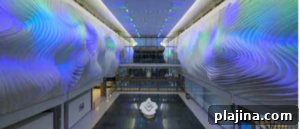
Salt Lake City International moved forward with a complete rebuild rather than piecemeal upgrades. The multibillion-dollar redevelopment replaced older terminals with a brand-new facility that opened in late 2020 and featured large-scale art throughout the concourses. The comprehensive approach aimed to create what airport officials described as the only truly new 21st-century airport in the United States.
Signature installations at Salt Lake City include Gordon Huether’s The Falls and The Canyon, which celebrate Utah’s natural landscape. The Canyon spans 400 by 22 feet and uses tensile membrane fins of aluminum tubing and composite fabric, while The Falls is a 65-foot suspended work that stretches from the terminal ceiling toward the floor. Mid-concourse Tunnel Murals by local artist Traci O’Very Covey and Texas-based artist DAAS depict Utah’s four seasons: O’Very Covey painted summer and fall, and DAAS painted winter and spring—each mural measuring 144 feet and designed to immerse travelers in the region’s changing landscape.
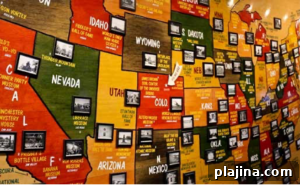
PHOTO: © DENVER INTERNATIONAL AIRPORT
Denver International Airport is advancing a $1.5 billion program that began in 2018 to add 39 new gates and other improvements. As one of the largest airports in the world, DEN features a considerable public-art collection around its iconic terminal. In 2021 the airport dedicated Luminous Wind, a 27-foot sculpture by Laura Haddad and Thomas Drugan honoring former Denver Mayor Federico Peña. Other notable works include Alex Sweetman’s Art Chronicles—seven large photo murals—Betty Woodman’s Balustrade, a set of 28 hand-thrown ceramic vases, and Ned Kahn’s wind-activated Field of Air consisting of brushed aluminum blades.
Philadelphia International Airport continues modernizing its facilities while expanding an award-winning Art Exhibitions Program. Philadelphia artist King Saladeen installed Create Your Gold, a four-part, large-scale painting displayed between terminals C and D. The colorful work mixes patterns, text, and city imagery—including a stylized skyline and the artist’s signature JP the Money Bear.
© TEXAS AIRPORT SYSTEM
Houston’s George Bush Intercontinental Airport is undergoing expansion that includes a new terminal building, while William P. Hobby Airport is also enhancing its facilities. Both airports used art installations to support Houston’s bid to host the 2026 FIFA World Cup. At Hobby, a 10,000-square-foot mural titled Gateway to the World—created by Mario Figueroa Jr. (GONZO247) and collaborators—wraps a building and celebrates Houston’s soccer culture with iconic city imagery. Both airports also displayed painted ceramic soccer balls and other themed works to engage travelers and visitors.
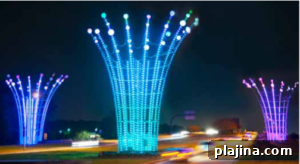
Houston Airports’ public-art curator highlighted the role of art in creating engaging travel environments. IAH’s collection also includes rodeo-themed works, such as Patricia A. Hilton’s Elvis Cowsley in Grazeland and Paige Atkinson’s Rodeo Boot, along with Dennis Oppenheim’s Radiant Fountains—three illuminated towers that interpret a drop of water and are sited near the car rental center.
San Francisco International’s public art program is managed by the San Francisco Arts Commission with exhibitions maintained in partnership with SFO Museum. The museum operates galleries across the terminals and programs that reach millions of visitors annually. Harvey Milk Terminal 1, which opened in 2019, features more than 30 commissioned and acquired works, including Liz Glynn’s Terra-Techne (stainless steel and terracotta) and Dana Hemenway’s hanging light sculpture The Color of Horizons.
Smaller regional airports often showcase local artists and works that reflect regional history and environment. Bozeman Yellowstone International in Montana displays nature photography and sculptures such as Craig W. Hergert’s 3 Swans, Cindy Goeddel’s Free Bison, and Dennis Harrington’s grizzly sculpture Guardian Spirit.
Albuquerque International Sunport is notable for its Southwestern architecture and for housing an original 1914 Curtiss Pusher biplane in the Great Hall. The airport preserves historical elements alongside art from its permanent collection, including works by Pop Chalee (Merina Lujan), a 1930s painter and muralist associated with Taos and Santa Fe.
Internationally, Seoul’s Incheon International Airport combines contemporary and traditional Korean art. Seon-ghi Bahk’s An Aggregation and the colorful Cat and the Butterfly reinterpret historical bookshelf paintings, while the terminal’s Korean Cultural Street features giwajip houses with tiled roofs that represent traditional homes.
Cyprus’s new terminals at Paphos and Larnaca, completed in 2008 and 2009 respectively, display works inspired by the island’s Mediterranean heritage. Installations at Paphos include Helene Black’s Past Presence and Giorgos Gareth Christou–Stelios Tzivas’ A Trip to the City of Aphrodite; Larnaca features Angelos Makrides’ Ceremonial Gathering and Maria Loizidou’s Volant Migrants.
Helsinki-Vantaa Airport presents Stefan Lindfors’ Concorde, a dragonfly-like sculpture in stainless steel and fiberglass, and Aukio, a central square designed with a 360-degree LED display, immersive soundscape, and interactive wall projections that cycle through Finnish nature scenes and the four seasons every ten minutes.
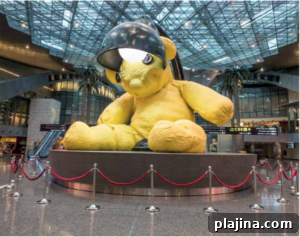
PHOTO: © QATAR TOURISM
At Hamad International Airport in Doha, Urs Fischer’s Lamp Bear—a 23-foot bronze teddy bear inside a lamp—occupies a prominent place in the main foyer. Dia al-Azzawi’s The Flying Man draws on the story of Abu Firnas and features tall cylindrical sculptures inspired by ancient Mesopotamian pillars.
Singapore Changi, consistently ranked among the world’s top airports, integrates art throughout its terminals and at Jewel Changi. Highlights include two 3-D Kinetic Rain sculptures in Terminal 1 that form multiple shifting shapes, Petalclouds, a lengthy kinetic installation that evokes drifting clouds with lights and sound, and Crystal Clouds, which uses thousands of crystals and dynamic lighting in Jewel Changi. Other notable works include Zou Liang’s Swimming, a stainless-steel shark sculpture composed of marine silhouettes, and Yip Yew Chong’s Slices of Singapore, a hand-painted mural that captures distinct slices of local culture.
Across the globe, airports are using art to enhance passenger experience, anchor local identity, and transform transit spaces into welcoming cultural destinations. As terminals are rebuilt and upgraded, public art remains a powerful way to connect travelers with place, history, and imagination.