
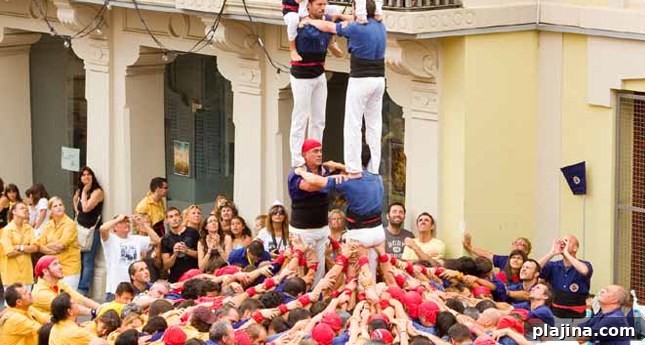
It was another place and another era. Although most readers may know little about Catalonia in the 18th century, certain assumptions come easily from one distinctive tradition carried forward from that time.
We can imagine, for instance, that there were no child protection agencies, few municipal safety regulations, and scarce litigation-minded lawyers — none of which reflects modern 21st-century Europe. Yet in Catalonia this traditional pastime remains a direct link to that less coddled age. Two and a half centuries ago, authorities tolerated citizens climbing onto each other’s shoulders to create human towers nine or ten stories high, and a small child would shimmy up to the top and stand with arms outstretched.
Because the practice was once permitted, people argue it should be allowed now. UNESCO has recognized these human towers — castells — as a Masterpiece of the Oral and Intangible Heritage of Humanity. Modern oversight often looks the other way; safety rules are relaxed for the moment, and lawyers tend to watch rather than intervene.
The tradition of building human towers likely began in the southern Catalan province of Tarragona, though its precise origin remains unclear. In a land of farmers and fishermen who observe leisurely siestas, someone in the 1700s proposed a vertical pastime that captured the imagination. To everyone’s surprise, villagers agreed to stack themselves one upon another.
From that point on, siestas in the region were forever interrupted by the castell craze. Early practitioners discovered quickly that forming stable human towers was no simple feat. It demanded long hours of practice and led to the development of specialized techniques and vocabulary.
Valls claims to be the birthplace of castells, but neighboring towns soon adopted the custom and added competition. Each village formed its own team of castellers, identifiable by distinctive colors. Participants also adopted the black sash worn around the waist, which serves as a vital hand- and foothold for those climbing the outside of the structure.
Since then, castellers have competed not only with rival villages but also with gravity. Each additional level of a tower requires new structural solutions to maintain balance and stability.
Four principles guide the castellers: strength, balance, courage and common sense. Those who lack any of these qualities rarely take part.
Solid foundations are essential. The heaviest, strongest castellers form the base, bearing the greatest load. As levels rise, participants become lighter and often younger, with women increasingly represented in the upper tiers. When the formation is complete, the enxaneta — typically a small child — climbs to the summit, holds a pose briefly and then descends, marking the beginning of the careful dismantling of the castell.
Castell building remains central to many Catalan local festivals, but the premier event is the Concurs de Castells, held every other October in Tarragona’s retired bullring. Around 30 teams compete for top honors at this high-stakes gathering.
The choreography required to raise and lower a tower is captivating. Each castell is both a living testament to a proud regional heritage and a vivid demonstration of what communities can achieve when they set aside bureaucracy and trust each other to reach great heights.