
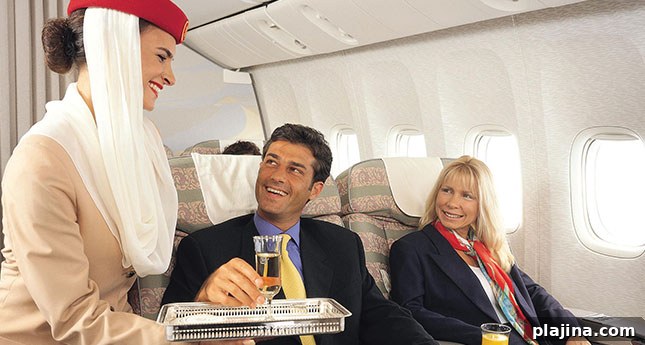
Gulf rivals Etihad Airways and Emirates are continuing their expansions — one measured, one nearly full-throttle — despite the economic turbulence affecting the aviation industry. A key reason is that while global passenger growth has slowed from its peak, traffic in the Middle East continues to rise.
The International Air Transport Association reported that in March passenger traffic in the Middle East grew by almost 5 percent, an increase from February and the only region to record such growth.
Etihad Airways CEO James Hogan observed, “There’s a market here for world travel, and we’re seeing it today.” Several other regional carriers — Qatar Airways, Kuwait Airways, Saudi Arabian Airlines and Lebanon’s Middle East Airlines (MEA) — are likewise planning expansions rather than cutbacks.
Etihad, the youngest of the major Gulf carriers, is adding five routes this year from its Abu Dhabi (AUH) hub. Service to Chicago (ORD) begins in September, joining destinations already introduced this year: Melbourne (MEL), Athens (ATH), Istanbul (IST) and Larnaca (LCA). These additions bring the airline’s network to 55 cities. Last year Etihad carried 6 million passengers, a 34 percent increase over 2007, and achieved higher load factors.
The name Etihad means “unity” in Arabic. The airline will take delivery of 11 narrow- and wide-body aircraft this year, expanding its fleet to 52 and boosting capacity by around 20 percent for the summer season.
Later this year Etihad will roll out a redesigned first class for long-haul flights, featuring larger seats, more private suites and an expanded first-class lavatory that can serve as a changing room. The carrier has also opened new first- and business-class lounges in Abu Dhabi’s Terminal 3, offering all-day dining and spa services.
Dubai-based Emirates, about 90 miles away, remains the world’s fastest-growing airline. The carrier will add 18 new aircraft to a fleet that already includes 132 widebodies. Emirates’ rapid build-up of long-haul aircraft has reshaped global routing patterns, making Dubai a major connecting hub.
Despite a slowdown in construction and tourism in Dubai, Emirates does not plan to defer or cancel existing orders from Boeing and Airbus, which total roughly 150 aircraft. Emirates is the largest customer for the A380 superjumbo. On June 1 the airline redeployed the two A380s that had served Dubai (DXB)–New York (JFK) to Dubai–Bangkok (BKK) and Dubai–Toronto (YYZ). The carrier currently operates four A380s and expects seven more by March 2010, some of which will begin flying Dubai–Seoul (ICN) and Dubai–Singapore (SIN) later this year. Emirates also flies the A380 to London (LHR), Sydney (SYD) and Auckland (AKL).
Emirates plans to expand service in Africa, including Durban (DUR) and Luanda (LAD), and to increase flights to Los Angeles (LAX) and San Francisco (SFO) to daily, pushing its destination count above 100.
Qatar Airways is launching six new routes over the next 10 months across India, Europe and Australia — its first routes to the continent — while increasing frequencies elsewhere in its global network. The carrier is adding new Airbus and Boeing aircraft at roughly one per month, aiming to grow its fleet to about 110 by 2013. Qatar is also investing $1 billion to expand facilities at Doha International Airport (DOH), including extending the exclusive Premium Terminal to handle growth until the New Doha International Airport opens.
Kuwait Airways appears to be taking a conservative approach in 2009 amid lower oil revenues. Its fleet and route network will remain largely stable, maintaining busy routes such as Kuwait (KWI)–London (LHR), Kuwait–New York (JFK) and Kuwait–Chicago (ORD).
Saudi Arabian Airlines has launched an extensive refurbishment program across its wide-body fleet to improve comfort and service. The airline is upgrading all three classes on its 21 Boeing 777s with new leather seats and enhanced sleeper arrangements in first and business class. It will also install new in-flight entertainment systems with larger screens — 15.4 inches in first class and 12.1 inches in business — and add onboard cell phone capability in first class.
On the new-aircraft front, Saudi Arabian Airlines has ordered 12 Airbus A330 twin-engine widebodies and placed a related $900 million order with Rolls-Royce for engines. The investments underline confidence in continued regional traffic growth. The airline will also expand its international network, increasing destinations in India to eight and adding Boeing 757 services from Riyadh (RUH) to Bangalore (BLR), Kolkata (CCU) and Lucknow (LKO).
Lebanon’s Middle East Airlines (MEA) is also optimistic. Managing Director Mohammed al-Hout says Beirut’s international airport is ready to handle an expected 5 million passengers, and MEA expects sustained growth after several decades of disruption.
Established in 1945, MEA navigated the long Lebanese civil war that effectively closed Beirut’s airport from 1975 to 1990 and then weathered subsequent regional instability. Now the airline is rebuilding: adding to its fleet, upgrading service and resuming destinations. For the summer season MEA will introduce three new Airbus A330s configured in two classes, offering 44 business-class seats in a 2-2-2 layout and 299 economy seats. MEA is also adding an A320 to its short-haul fleet, configured with 24 business-class and 102 economy seats.
MEA plans to increase daily flights to Dubai (DXB), Cairo (CAI), Amman (AMM), Riyadh (RUH) and Jeddah (JED), and it aims to resume Beirut (BEY)–Baghdad (BGW) service for the first time in decades.
Overall, the major carriers across the Gulf are moving forward with fleet and network investments, signaling confidence that demand in the Middle East and beyond will continue to support growth even as global markets face uncertainty.