
I’d never been so proud to rip my pants. It was obvious it was my first time ice climbing: I showed up in bright white Columbia ski pants, the same pair that had carried me down black-diamond runs in Utah and through off-piste powder in Switzerland.
One typically doesn’t, as I learned the hard way, wear white ski pants while ice climbing. My guide from Yamnuska Mountain Adventures grinned as he helped me strap on crampons and handed me ice axes for a climb through a Canadian canyon near Banff. Each satisfying swing and solid kick into the ice made me fall deeper in love with the sport. I returned to the canyon base with a grin frozen on my face — and mud-streaked pants, shredded below the knee from a few clumsy crampon slips.
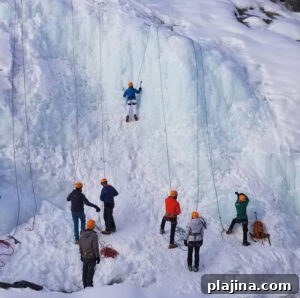
© Kristy Alpert
That rush to experience winter in a bolder, more extreme way is growing nationwide. An estimated three million Americans ice climb each winter, and many more are trying a range of adrenaline-driven winter activities. Skiers hungry for untracked snow often turn to operators like Elemental Adventure to access some of the world’s premier heli-skiing zones — from the Himalayas to the remote Tordrillo Mountains of Alaska.
Ski resorts are diversifying to meet this demand, offering more adventurous options for visitors eager to push themselves. In Park City, daily snowkiting lessons teach participants how to harness wind power to fly, glide and jump over snowfields. In the French Alps community of Samoëns, winter swimming has gained traction: icy lap pools and mountain lakes draw swimmers chasing the thrill of subzero immersion. The European pastime of skijoring — skiing while being pulled by a galloping horse — has found a home at Little Jennie Ranch in Wyoming, and North America’s cat skiing, which brings skiers to remote runs by snowcat, has surged in popularity in places like Niseko, Japan.
These extreme winter pursuits offer freedoms and sensations that conventional sports rarely do: the chance to test personal limits, deepen resilience, explore remote landscapes, and learn practical lessons about gear, preparation and safety. And, if nothing else, they teach you why the right clothing matters — especially when you’re swinging an ice axe on a frozen wall.