
Forbidden. The word itself is magnetic. We stand beside a concrete wall topped with a fence. On this side, goats have nibbled the vegetation down to sun-bleached stalks; on the other, the landscape is lush, shaded by trees. Stern signs make the boundary clear: no entry. We have come to the end of the path. Beyond the barrier lies the monastic state of Mount Athos.
There is a chance someday I might visit the Holy Mountain. Up to 14 non-Orthodox visitors are allowed on Mount Athos each day after completing paperwork that must be started months in advance. But my companion will never cross this border. She is a woman.
Mount Athos occupies the easternmost prong of the three-pronged Halkidiki Peninsula in northern Greece. We had been staying on the westernmost prong, Kassandra, home to the region’s package resorts. The day before, we drove around the steep coastline of the middle prong, Sithonia, and arrived after dark at Ouranoupoli, the port village that lies within walking distance of the Mount Athos frontier.
This morning we hiked the stony track from the village to the wall. The reasons for this strict ban are ancient. According to Greek Orthodox tradition, the Virgin Mary set foot on Mount Athos in the first century, and in her honor all other women — and even female animals — were barred from the roughly 400-square-mile monastic territory when it became a self-governing enclave in the 11th century.
Near the border we explored the overgrown ruins of Zygos Monastery, which until the early 13th century functioned as Mount Athos’s effective capital. By a quirk of history it lies outside the modern demarcation, allowing outsiders — women included — a rare glimpse of the secluded monastic environment that continues on the far side of the wall.
From land, Mount Athos is sealed. At sea, however, its jurisdiction extends only 500 meters offshore, giving visitors an opportunity to peer into the forbidden domain.
By late morning we were back in Ouranoupoli and joined more than a hundred sightseers on a double-decker boat. We set off along the coast while a multilingual commentary — in Greek, German and English — played over loudspeakers on both decks.
From the water the divide is as clear as it is on land. To the left, scrub grazed to the ground; to the right, dense woodlands. For the next half hour we followed the coastline while the guide outlined the area’s history.
We were told there are 20 monasteries on Holy Mount Athos. Most are Greek Orthodox, though there are separate Serbian, Georgian, Bulgarian and Russian monasteries as well. Only Orthodox men over 18 may live here.
We watched towering cliffs rise from the sea. “Imagine,” my companion said, “a place that has never heard children’s laughter.”
The first monastery visible was Dochiariou, its formidable medieval walls a short distance from the shore. Two black-clad monks worked in terraced gardens. Fellow tourists waved; the monks continued their work without looking up.
We steamed past an unbroken succession of monasteries, each more striking than the last. Simonos Petras clung to a sheer outcrop high above the waves. Grigoriou occupied a promontory that would rival any luxury resort.
The final monastery on this stretch is dedicated to St. Paul. The commentary explained that the main complex was built in the 10th century atop the ruins of a 4th-century monastery. We glimpsed monks tending gardens again; surely they could hear the boat’s commentary and see us waving, but they never looked up.
On the surface these buildings and the way of life they represent have changed little over the centuries. It felt as if we were looking not only across 500 meters of sea but back through time. Yet appearances can mislead. Most monasteries now house only a handful of monks. With no stable local population, Mount Athos depends on new recruits to sustain its communities. If current trends continue, the border wall might one day serve no purpose — there may be no monastic way of life left to insulate.
The boat turned back toward Ouranoupoli and we drove back to Kassandra. For miles after leaving the coast we were still under the spell of our glimpse of Mount Athos. Passing through villages we noticed women and children; my companion waved and they waved back.
On the busy highway it felt as though we were moving through layers of history. By Greek standards the medieval monasteries are relatively recent, and along our route brown signs directed us to archaeological sites of much greater antiquity.
Potidea, at the narrow entrance to Kassandra, illustrates those layers vividly. The modern town was established in 1922 by Greek refugees from Turkey, yet the original Corinthian settlement stretches back to about 700 B.C. Archaeologists have even found a skeleton in the area thought to be roughly 700,000 years old.
In theory, then, contemporary Kassandra represents the culmination of millennia of human development. The thought is sobering. Bright billboards line the roads, advertising hotels, restaurants, supermarkets, nightlife, go-kart tracks, water sports and other attractions. Few ancient philosophers could have imagined this future for their land.
We stayed in a villa overlooking the popular resort of Hanioti. The next morning, rather than descend to souvenir shops and crowded beaches, we headed inland toward the hills.
The summer heat was intense. Just two weeks earlier much of Kassandra’s interior had burned. We passed blackened grass and charred trees, a landscape that predates human settlement: Mediterranean habitats have long burned and regenerated. Already fresh shoots were emerging.
We followed the winding road up to the ridge that runs the length of Kassandra, then descended to the Aegean on the other side. Heat shimmered, cicadas droned, and after two hours we cooled off in the clear waters at the little village of Nea Skioni.
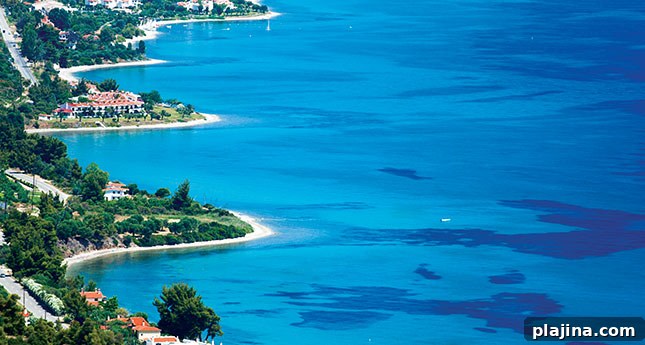
In the days that followed we took more walks into the hills and one morning launched sea kayaks from a secluded cove. As we paddled across crystal-clear water, pebbled shallows dropped away into deep blue. We passed beneath a rocky bluff and then found ourselves parallel to a crowded beach.
From the sea once more we observed life on land. Like the monks, the sunbathers paid little attention to us. Many holidaymakers return to the same beaches year after year. Like the monastic residents, they are drawn to the comfort of familiar routines.
My companion and I are habitual travelers, more akin to the ancient Greeks who sailed from these shores to explore the wider world. We are always curious about what lies around the next headland. For us, “forbidden” is not a deterrent but an invitation.
Info to Go
Flights arrive at Thessaloniki International Airport (SKG), about a 90-minute drive from Kassandra, the busiest of the Halkidiki Peninsula’s three prongs. Kassandra’s eastern coast offers hotels for all budgets, while the western shore features more upscale options such as Sani Resort. Yacht trips, sea kayaking and Mount Athos sightseeings can be arranged through tour operators based in Kassandra. Male visitors interested in visiting Mount Athos must apply for a permit well in advance through the official channels for the monastic state.