
The day we visited, each of us brought our greatest worry written on a scrap of paper, carefully folded into the smallest possible shape and ready to slip into a crack in the Western Wall. Excited and slightly breathless, we descended a limestone staircase into the rectangular prayer plaza.
On that afternoon just before Shabbat, which would begin at sundown, a steady flow of people moved through the men’s and women’s sections. Following Orthodox tradition, a wooden mechitza separates the genders, limiting the view of the opposite side.
On the men’s side, worshippers faced the wall in prayer. Some read from prayer books; others held Torah scrolls. A spinning circle of dancing men—many with payot (sidelocks) and wearing yarmulkes, fedoras or fur-lined shtreimels—filled the plaza with song and celebration as they marked a 13-year-old boy’s bar mitzvah. The boy was called to the Torah while his mother and other female relatives stood on chairs and peered over the mechitza to watch the moment he was welcomed as a man.
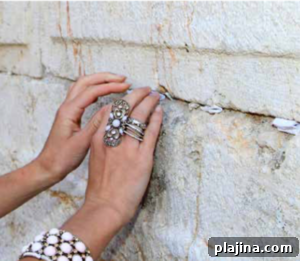
On the women’s side, I stood with friends I had met on a pilgrimage tour of Israel. We moved slowly toward the ancient stones, each block arranged in rectangles and squares according to the period in which it was added to the wall. When it was their turn to stand before the wall, some women seemed to collapse with relief, as if being heard at last by the One who could bring peace. Some wept. Others searched the limestone for just enough space to tuck a piece of paper into a crack already filled with the prayers and hopes of millions.
Known in Hebrew as Ha-Kotel Ha-Maʿaravi, the Western Wall—often simply called the Kotel—is instantly recognizable by that name alone. It began humbly as one of the support walls King Herod added while expanding the Second Temple around 15 B.C.
© SHOTSMAKER | DREAMSTIME.COM
To understand the Kotel fully, it helps to know the long history behind it. King Solomon built the First Temple on the Temple Mount around 960 B.C., and Jewish life there flourished for nearly four centuries until the Babylonians destroyed the temple in 586 B.C. and exiled many inhabitants.
When Cyrus the Great of Persia defeated the Babylonians 47 years later, Jewish exiles returned and rebuilt the less ornate Second Temple in 516 B.C. Around 480 years after that, Herod the Great enlarged the Temple Mount platform to accommodate new structures and constructed four retaining walls to hold the expanded courtyard. Following the Roman destruction of Jerusalem and the temple in A.D. 70, much of the complex was lost; the Kotel remained.
“The Kotel is the holiest, most important and most misunderstood place in the world,” said Patrick Amar, a guide with experience leading visitors through the site. “To truly understand the Kotel, you have to do the tunnel tour.”
At one time the western wall rose nearly 200 feet; today about 62 feet of it is visible above the courtyard, with another 43 feet of ancient, excavated space beneath ground. An entrance at the north end of the prayer plaza leads into a tunnel that runs along the 1,600-foot length of the wall.
We entered the illuminated tunnel at night and walked past layered stones that record centuries of construction, under the bustle of the Muslim Quarter above. My fingers traced the cool, worn stone, smoothed by generations of visitors. Water still trickled down into ancient cisterns, and piles of stones marked ongoing archaeological work.
In the tunnel we saw men—many in Orthodox dress—praying in an underground synagogue beneath Wilson’s Arch. The atmosphere there was quiet and reverent. The women’s section is set on a raised platform, with chairs and prayer books available for visitors.
This subterranean area is close to where the Holy of Holies once stood, the innermost sanctuary of the First Temple, regarded as the meeting point between Heaven and Earth. The Foundation Stone, believed by many Jewish scholars to be the rock from which the world was created and the place where Abraham nearly sacrificed his son Isaac, occupied that spot. Tradition holds that the Ark of the Covenant rested on that stone and contained the stone tablets of the Ten Commandments, Aaron’s rod and a jar of manna. The Ark’s gold cover bore two cherubim between which God’s presence was said to dwell.
The Ark and its contents vanished before the Babylonians sacked the First Temple. The Foundation Stone, however, remained central through the Second Temple era. For Muslims, the same stone marks the place from which the Prophet Muhammad is believed to have ascended to Heaven, making the site—called Haram al-Sharif by Muslims—a focal point of overlapping religious significance and centuries of conflict.
The gilded Dome of the Rock, standing behind the Western Wall, was built over the Foundation Stone by an Umayyad caliph in A.D. 691. While only Muslims may enter the Dome and view the stone, the entire Temple Mount area is open to visitors at varying times; non-Muslims are generally not permitted to pray there.
Because the Western Wall and its tunnels sit closest to the traditional location of the Holy of Holies where Jews may pray, they remain a powerful center of devotion. Some hope for a future in which faiths find fuller reconciliation. As one guide noted, Christians possess the Church of the Holy Sepulchre, Muslims have the Al Aqsa Mosque, and Jews have a fractured wall that symbolizes a hope for restoration—a vision connected for many to the prophecy of a Third Temple and a time of universal peace. Perhaps that is the prayer tucked into the many notes slid into the wall’s cracks.
INFO TO GO
Ben Gurion International Airport in Tel Aviv is less than an hour’s drive from Jerusalem. Visiting the Western Wall does not require reservations, though the tunnel tours often sell out and should be booked well in advance. Two different multilingual tunnel tours are offered: one follows the original tunnel, and another explores recently discovered arches and sites. When visiting holy places, dress modestly—men should cover their heads, and women should wear long sleeves and skirts or pants that cover the knees.