
When the Judas goat arrived, most of the invasive goats on the island were already dead.
Like an undercover informant taking down a criminal network, the Judas goat slipped into the herd. Pheromones and mating behavior made him irresistible to the other animals, and with his horns painted in bright colors so he could be tracked easily, he led them into open clearings where trained marksmen waited on land and in helicopters. The goats were dispatched with biodegradable bullets and their remains left to decompose naturally.
After several such operations, the Galápagos Islands of Santiago and Isabela, off Ecuador’s coast, went from hosting some 100,000 destructive feral goats to being goat-free by 2006, and they have remained so. If a Judas goat ever went astray and hid, its tracking device could be set to self-destruct remotely, preventing long-term problems.
The Galápagos National Park authorities take preservation seriously. The emphasis here is on protecting the islands’ ecosystems rather than catering to visitors. Tourists step on only 0.001 percent of the land set aside as national park, and the national park comprises 97 percent of the archipelago’s total land area. On some islands, only scientists with fumigated clothing — underwear included — are permitted ashore.
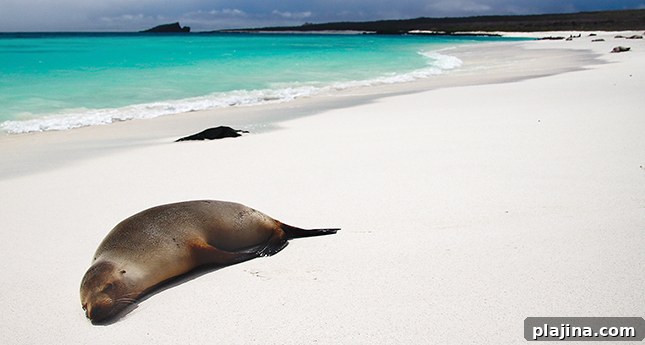
The animals’ lack of fear of humans is striking until you witness it. Sea lions yawn when a person gets close with a camera; sea turtles barely alter course when snorkelers swim past; giant land tortoises, some weighing more than 500 pounds, continue grazing without retreating into their shells. With no history of natural predators, fear simply isn’t hardwired into many of these species.
One morning we wade into the water on a secluded beach while rays glide through the surf and a heron, nearly my height, ambles past, seemingly unimpressed by the humans. A month-old sea lion pup emerges, sniffs a few tourists’ toes, bleats in greeting, then splashes back into the shallows contentedly.
A Galápagos cruise is focused on wildlife and remote landings rather than onboard entertainment or large dining halls. Large cruise ships are banned; most vessels carry between 14 and 42 passengers, though some larger yachts offer bigger cabins and amenities. Smaller boats can access shallow coves more easily, while ships with stronger engines allow longer, faster island-hopping.
Every day offers different encounters: morning visits with sea lions and bright Sally Lightfoot crabs, afternoons spent observing land iguanas and Galápagos penguins. On some beaches the ground is a moving mass of sunning marine iguanas, miniature dinosaur-like creatures that shake seawater from their snouts as they feed on seaweed. It’s common to see a whale’s spout as the ship moves between islands, or dolphins riding the bow for a playful display.
The abundance of life is remarkable: giant tortoises and frigatebirds share space with pelicans and blue-footed boobies. The Humboldt Current and equatorial climate create rich feeding grounds that sustain this diversity. Most animals show little concern for people — the crabs are among the few that dash away when approached. On Española Island, what looks like a beach littered with boulders turns out to be hundreds of sea lions sunning and rolling in the waves.
Isolated from the mainland and each other, the islands provide a living laboratory of evolution and geological change. At Isabela Island’s Urbina Bay, shells and coral fragments lie on the ground a short walk inland from the beach. Our guide explains that the area was underwater until 1954; volcanic uplift pushed the shoreline outward by about a kilometer, and early visitors discovered decomposing sea life in the newly exposed terrain.
At Punta Moreno, sturdy shoes with thick soles are essential as we traverse lava rock from Cerro Azul volcano. The lava formations vary — some ropelike, others resembling cracked asphalt baking under the sun. Sparse vegetation and pink flamingos in nearby lagoons provide contrast to the dark volcanic landscape.
Near the shore, we don wetsuits and snorkel gear to swim among penguins, turtles, a giant manta ray and schools of colorful fish. After the morning’s exercise, a hearty lunch awaits: ceviche, bacon-wrapped filet, multiple vegetables and fruit salad. In the afternoon we explore mangroves by dinghy, where golden rays and penguins share the water with pelicans, cormorants and boobies moving between air and sea.
Our operator, Angermeyer Cruises, follows strict procedures to minimize human impact. A desalination system provides purified water for refillable bottles; cabins are stocked with biodegradable soap and shampoo, and amenities use reusable containers. Strict biosecurity rules mean nothing may be taken onto or off the islands — even pebbles and sand are prohibited, as some travelers have learned at the airport.
After a week of island exploration and nights aboard a gently rocking ship, a few days in Quito offer a striking contrast. Where the Galápagos resist the march of man, Quito showcases what human history has left behind from the Inca era through colonial times to today.
Quito, the first city registered by UNESCO as a World Heritage Site, features 16th-century architecture high in the Andes at nearly 10,000 feet above sea level, framed by often snowcapped peaks. The historic center is a compact maze of narrow streets, church plazas and stately buildings that predate many colonial settlements in North America.
For an expansive view of the city, ride the telefériqo cable car up Mount Pichincha, gaining about 2,000 feet of elevation and panoramic views of the valley and surrounding mountains.
The altitude can be noticeable, but the old city is well suited to walking. Inside the gilded churches, intricately carved altars and gold-covered details reveal the wealth and craftsmanship of the colonial era. After years of neglect, the historic core has been revitalized and now buzzes with life: plazas filled with people, restaurants busy, and pedestrian-friendly streets on Sundays featuring parades and community events.
Boarding the plane home after time in both wild and urban environments, I am moved by the striking contrasts and the enduring beauty of this equatorial land.
Info To Go
International flights arrive in Quito (UIO), with domestic connections to the Galápagos. Trips are offered by international tour operators and local companies such as Angermeyer Cruises and Metropolitan Touring. All 86 vessels registered to operate in the Galápagos visit the same designated sites; choose based on ship type, budget and trip length. Note that national park entrance fees, currently around $110, are typically not included in the trip price.