
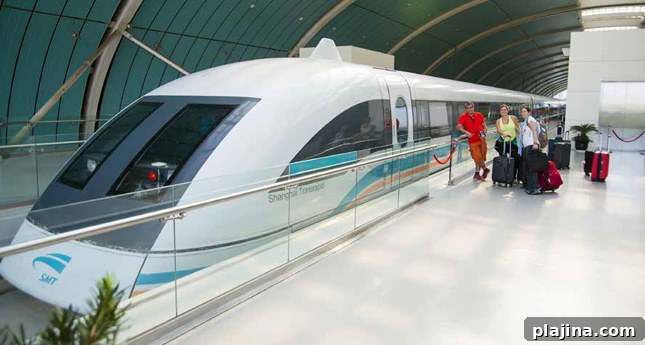
Glamorous, exotic and affluent, Shanghai, China’s largest city, has evolved dramatically from its origins as a small fishing and textile town at the mouth of the Yangtze River. Traces of the Old City remain—ancient teahouses, classical gardens and Buddhist temples—but modern Shanghai is a global financial and commercial powerhouse home to some 23.9 million people. Sleek skyscrapers dominate the skyline, including the Oriental Pearl TV Tower with its sky-high observation decks, and the Shanghai World Financial Centre, home to the Park Hyatt and one of the world’s highest hotels. For a striking introduction to the city’s futuristic side, take the Maglev train from Pudong Airport to the city center: it covers 19 miles in about eight minutes at speeds up to 270 miles per hour.
Business travelers often base themselves in the Lujiazui Finance and Trade Zone in Pudong, a district dense with hotels, domestic and international banks, insurance firms and major stock exchanges. Landmark buildings such as the Jinmao Tower and Shanghai Securities Mansion sit amid this financial cluster. After work, most activity shifts across the Huangpu River to Puxi, where the Bund offers river views, elegant European-style architecture, nightlife and riverside promenades. Popular cocktail venues and rooftop bars draw both locals and visitors, while Latin dance clubs and live music spots provide late-night entertainment. The Bund also hosts excellent dining, from upscale restaurants in prominent hotels to casual local eateries.
Shanghai is a culinary destination as well as a commercial one. Look for freshwater specialties, steamed river crabs and the famous beggar’s chicken—chicken stuffed with vegetables, wrapped in lotus leaves, encased in clay and baked; it’s traditionally cracked open at the table and often requires advance notice. The city is also renowned for its dumplings, especially Nanxiang xiaolongbao, delicate steamed pork dumplings filled with savory broth. One of the most frequented dumpling houses, Jia Jia Tang Bao, is famous for thin wrappers and juicy fillings, and long lines are common at peak times.
Nanjing Road in Shanghai © SONGQUAN DENG | DREAMSTIME.COM
Shopping is a major draw in Shanghai. Nanjing Road stretches for 3.5 miles and attracts millions of visitors each day, offering everything from bargain goods to luxury designer stores across more than 600 shops. For bespoke tailoring and custom-made garments, many travelers combine Shanghai with a short trip to Hong Kong, renowned for its skilled tailors and vibrant shopping scene. Tailors such as long-established shops on Kowloon have built international reputations for quality-made suits, shirts and shoes. The Star Ferry provides a scenic 10-minute crossing between Kowloon and Hong Kong Island, while the city itself blends refined tea rooms and decadent hotel services with gritty, flavorful street food scenes in neighborhoods like Mong Kok.
The Peak Tower in Hong Kong © RONNIECHUA | DREAMSTIME.COM
On Hong Kong Island, Victoria Peak offers panoramic views over the skyline and harbor and is reachable by funicular. For skyline cocktails or Champagne with a view, high-elevation bars such as those in luxury hotels provide spectacular sunset vantage points. Food-focused travelers should not miss classic institutions offering refined dining experiences and extensive wine or Champagne lists, as well as popular dim sum venues where hundreds of varieties are served throughout the day.
Chinese dim sum steamed buns © WANG SONG | DREAMSTIME.COM
Hong Kong’s SoHo and Sheung Wan neighborhoods are well known for their international cafés, galleries, boutiques and nightlife. These districts blend a cosmopolitan atmosphere with local flavor—bakeries, specialty shops and independent designers sit alongside bars and galleries. For a short detour, Macau lies about 37 miles from Hong Kong and is reachable by ferry or a brief helicopter ride. Macau’s Portuguese colonial heritage is visible in pastel-colored architecture, historic churches and the ruins of St. Paul’s, all part of a UNESCO World Heritage ensemble. Yet the city is best known today for its large casino resorts, elegant gaming halls and entertainment complexes, many housed within grand hotels. While gaming remains central to Macau’s tourist economy, the city also offers a diverse program of restaurants, nightlife and cultural events for visitors uninterested in gambling.
China Info to Go
Shanghai is served by two major airports: Pudong International Airport handles the majority of international flights and offers the Maglev train connection to central Shanghai, while Hongqiao International Airport is closer to downtown and handles many domestic and regional routes. Hong Kong International Airport, located on Chek Lap Kok, is the region’s main aviation hub and provides connections to numerous international destinations. Macau International Airport serves regional airlines, and regular ferry and helicopter services link Macau with Hong Kong for convenient day trips or short stays.