When members of the World Water Council chose a location for the world’s largest forum dedicated to water resource issues, one city stood out: Istanbul.
“It was the ideal location, based upon its symbolic, geographical and geopolitical importance,” says Huma Gruaz, president and CEO of Alpaytac Marketing Communications, which handled public relations for the 2009 World Water Forum. “And obviously, as far as its different trade facilities are concerned, it’s a fantastic city.”
As the only major city that spans two continents — Europe and Asia — Istanbul was a natural fit for a conference that emphasized global cooperation on water management. The city is surrounded by water, and the forum’s venues — the Sütlüce Congress and Cultural Center and the Feshane International Fair Congress and Culture Center on the Golden Horn — put delegates within sight of the Bosporus. With a history stretching back some 6,500 years and a location at the crossroads of civilizations, Istanbul promised an unforgettable backdrop.
“It’s not like there’s just one nice palace or museum,” says Haldun Dinccetin, a spokesman for the Turkish Culture and Tourism Office. “Istanbul was the capital of two major empires, the Byzantine and the Ottoman — and the Ottoman was one of the biggest empires in the world for more than 600 years. So it has the elements and monuments of the Eastern, Middle Eastern and Islamic worlds, with so many different ethnic groups and cultures blended really well. You can still feel this culture when you visit the old neighborhoods.”
Istanbul’s reputation as a global meeting place has grown rapidly. In 2000 the International Congress and Convention Association ranked the city No. 40 among top meeting destinations; by 2009 it had climbed to No. 17, hosting 80 major international events. Ease of access drives that popularity: most European capitals are under three hours away by air, and New York is just under ten hours. Hotel rates have traditionally been lower than in Paris, London or Rome, and despite global economic pressures Turkey’s economy showed strong growth around 2010.
Visitors who expect a city of tiled mosques, bustling bazaars, and traditional baths will find all that in Istanbul, along with many modern offerings. The Hagia Sophia, built under Emperor Justinian in 560, and the Blue Mosque, completed under Sultan Ahmed I in 1616, remain iconic sights. At the same time, contemporary venues such as SantralIstanbul — a cultural complex built within the Ottoman Empire’s first power station — and the 16,000-seat Sinan Erdem Dome illustrate the city’s modern cultural life. Traditional performances by the whirling dervishes at the Galata Mevlevihane continue to attract visitors, while contemporary music, theater and sports events draw international audiences.
“I’ve lived in Paris, lived in New York and stayed in London and in Holland. And I’ve never seen nightlife like the nightlife in Istanbul,” says Gruaz, who lives in Chicago. “I’ve never seen a nightclub where there’s a line in front of it at 5 a.m. But that’s how Istanbul is. In summer, everything is in the open air and nightclubs are open every night of the week, buzzing people in at 2 and 3 a.m. I don’t know how they go to work the next day.”
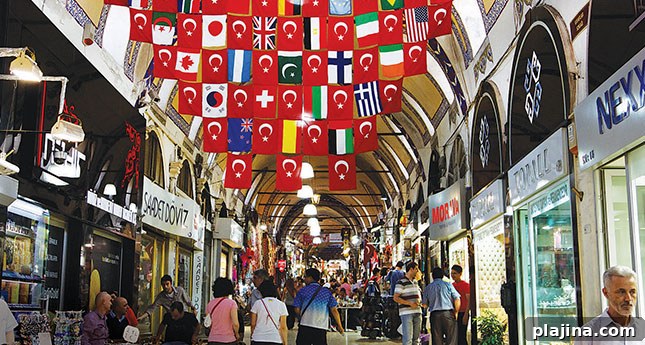
The Grand Bazaar’s roughly 80 streets host some 4,000 shops, offering everything from textiles and carpets to jewelry and spices. Shopkeepers are prepared to haggle, often welcoming visitors with Turkish apple tea served in small hourglass-shaped glasses before negotiations begin. The market experience blends commerce with hospitality: merchants aim to make guests feel comfortable before discussing prices.
“There aren’t people yelling at you, trying to get you to buy stuff. It’s just quiet, until you find something you like. Then you can start to haggle,” says Ann Shoji, a San José resident who found her best deals in the smaller shops just outside the Grand Bazaar. “They’ll offer you Turkish apple tea in little three-inch glasses shaped like an hourglass — and it’s the best tea ever — before they start talking about carpets.”
Dining in Istanbul is often unhurried, designed to honor conversation and flavor. Local specialties such as grilled doner, lamb beyti and strong Turkish coffee are commonly enjoyed with a view: many restaurants overlook the Bosporus and its bridges. Diners often favor waterfront neighborhoods like Ortaköy or historic luxury hotels such as the Çırağan Palace Kempinski for terraces and vistas. For forum organizers like Gruaz, those pleasures contributed to a successful event: while they had anticipated about 10,000 delegates, the World Water Forum drew closer to 28,000 attendees.
“We’ve never had such a huge attendance at the forum,” Gruaz says. “Obviously, accommodating all of those world-class delegates was going to be a challenge. But the facilities were extremely comfortable, with state-of-the-art technology. The food was mouthwatering. And the feedback has been phenomenal.”
“It’s my favorite city in the world,” Gruaz adds. “My heart beats faster whenever I hear the name of Istanbul.”
Convention Centers
Istanbul’s major event venues are clustered in three main districts: the area near Atatürk International Airport, the Golden Horn, and the Conference Valley.
Airport District
The airport district centers on the Istanbul World Trade Center Complex and the CNR International Exhibition Center. Since opening in 1993 the exhibition grounds have expanded to multiple halls and now host dozens of trade fairs annually. The complex includes restaurants, seminar rooms and business facilities; adjacent Showland areas provide large indoor and outdoor spaces for events, seating, and retail amenities. Yesilköy, tel 90 212 465 7474.
Golden Horn
Along the Golden Horn, industrial buildings have been transformed into modern congress halls. The Sütlüce Congress and Cultural Center, a former slaughterhouse, is now a large multipurpose event space, and the Feshane International Fair Congress and Culture Center — once a 19th-century textile factory — was converted into a major hall. Both venues are linked by the Galata Bridge and share waterfront access. tel 90 212 501 7326.
Conference Valley
The Conference Valley is anchored by the versatile Lütfi Kırdar Istanbul International Conference and Exhibition Center. This centrally located complex hosts conferences, cultural festivals and industry events, offering numerous meeting rooms and adjacent exhibition halls. The neighboring Rumeli Fair & Exhibition Hall provides large ballrooms and translation facilities suitable for international gatherings. Harbiye, tel 90 212 373 1100.