
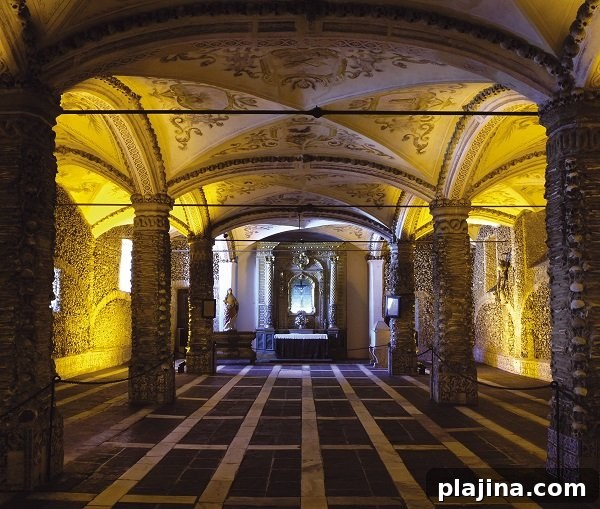
October may be known for eerie attractions, but if you want a site that blends history, artistry and a distinctly chilling atmosphere, put the Chapel of the Bones (Capela dos Ossos) on your itinerary. Tucked in Évora, southeast of Lisbon in Portugal’s Alentejo region, this small yet ornate 16th-century chapel contains more than 5,000 skulls and bones that once belonged to monks.
The chapel sits inside the larger Church of São Francisco, a building commissioned during the reigns of Dom João II and Dom Manuel I. The church features a single nave and a ribbed, vaulted ceiling, and houses twelve chapels in total. Architectural highlights include a late Renaissance doorway with details that change depending on the viewing angle, as well as carved woodwork and traditional azulejo tiles.
© Visit Alentejo
Inside the chapel, bones and skulls are integrated into the walls, ceiling and stone columns, creating an unsettling decorative scheme that also serves as a memento mori. Two complete skeletons are displayed within the space. While Évora’s chapel is the most famous and one of the largest of its kind, it is not unique: there are several bone chapels across the Algarve and Alentejo regions.
Nearby examples include a Baroque-style Capela dos Ossos at the Parish Church of Campo Maior. That chapel was created after a catastrophic explosion in 1776 at the castle’s powder magazine that killed a large portion of the town’s population; the bones displayed there belong to victims of that tragedy.
Another nearby site is the Capela dos Ossos de Monforte, considered the smallest bone chapel in Portugal and attached to the 18th-century Igreja Matriz de Monforte. Skulls dominate its decor, with a prominent skull placed above the chapel’s entrance as a stark visual reminder of mortality.