
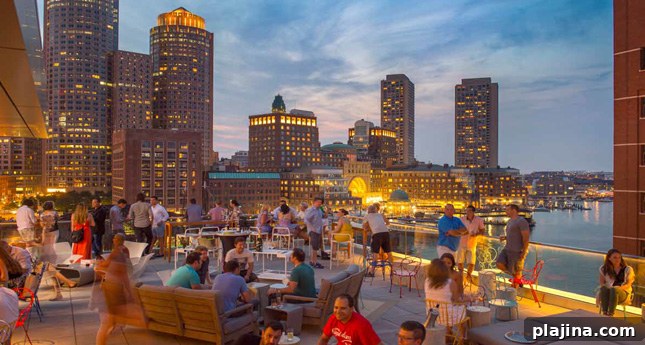
Peering at sailboats slicing through the harbor from the sixth-floor roof-deck bar of the Envoy Hotel, it becomes clear that Boston truly sits on the Atlantic. For years the city underused its waterfront, but that has changed. When the Institute of Contemporary Art opened its striking building on the harbor’s edge in December 2006, the area began to be called the Seaport District. Yet five years later, the neighborhood still felt half-finished: parking lots and industrial wharves remained dominant features of the shoreline.
The Seaport’s transformation accelerated in 2013 when Vertex Pharmaceuticals relocated its global headquarters to twin 18-story towers, bringing 1.1 million square feet of research and office space. Other major firms soon followed, including Manulife, Fidelity Investments and PricewaterhouseCoopers. The result: the late Mayor Menino’s vision of a thriving Seaport District finally started to materialize. Today, new condominiums and office buildings populate much of the waterfront and adjacent blocks.
Opened in June, the 136-room Envoy Hotel, part of the Marriott Autograph Collection, quickly became a popular spot for after-work drinks thanks to its rooftop bar and one of the best skyline views in Boston. Booking the corner room just below the bar grants you that same sweeping vista in private.
Boston skyline at sunset from Fan Pier © Sean Pavone | Dreamstime.com
Directly across from the Envoy, a large construction site marks the beginning of One Seaport Square. When completed, the $600 million development will add 832 apartments atop 260,000 square feet of retail space. The project’s two glass-and-metal towers will rise to 20 and 22 stories between Seaport Boulevard and Northern Avenue and will include amenities such as an Equinox Fitness Club, Kings Bowling and a 10-screen cinema.
Not all growth is limited to waterfront parcels. The Boston Convention & Exhibition Center on Summer Street is planning a 1.3 million-square-foot expansion; the Massachusetts Convention Center Authority is currently interviewing architects and project managers as the redesign takes shape. Nearby, a new hospitality cluster has emerged: a 330-room Aloft Hotel and a 180-room Element Hotel opened on a 5.6-acre site on D Street opposite the convention center. Adjacent to them, The Lawn on D—an urban park—offers food trucks, a rare patch of grass for picnics, an artsy swing installation and live performances.
Renowned local chefs were among the earliest to stake claims in the evolving district, converting affordable warehouses and former art studios into acclaimed restaurants. These pioneers were soon joined by larger waterfront destinations like Liberty Wharf, home to the three-story Legal Harborside. Culinary offerings have multiplied: Mario Batali’s Babbo Pizzeria e Enoteca near the Harborwalk has earned praise for its brick-oven pizzas and approachable pastas, while Ocean Prime opened near the former site of Anthony’s Pier 4, specializing in steaks and seafood such as ribeye and sea bass.
While the neighborhood continues to build out, one practical gap remains: a full-service grocery store. As the residential population grows, however, such amenities are likely to follow, ensuring the waterfront becomes an even more vibrant, livable part of Boston.
SCENIC DRIVES
If Boston Harbor leaves you craving a beach, head north on Route 128 and within an hour you’ll reach Cape Ann, a lesser-known coastal stretch favored by locals. About 40 miles from the city, Cape Ann’s shoreline draws sun-seekers to long sandy beaches. In Manchester-by-the-Sea, Singing Beach occupies a sheltered cove backed by cliffs and elegant homes. Wingaersheek Beach is a family favorite on the North Shore thanks to its shallow, warm waters. At low tide, you can walk nearly a mile toward a classic white lighthouse on the Annisquam point. When you need a break from the sand, visit Rockport’s galleries, shops and restaurants, or stop for a simple lobster meal at Woodman’s in Essex, a longstanding seafood shack with a storied place in regional food lore.
If you prefer not to drive, a daytrip to Salem makes an easy alternative. Less than 20 miles northeast of Boston, Salem has a long maritime history and is famously linked to the witch trials of 1692. Today it is also home to the Peabody Essex Museum, one of New England’s premier cultural institutions. The museum’s collections span Asia and the Pacific, Native American crafts, New England maritime art, and preserved 18th- and 19th-century homes from Salem’s historic districts. The most relaxing way to reach Salem is by ferry from Long Wharf: the ride takes roughly 45 minutes, offering salty air, coastal vistas and a stress-free arrival at the city’s waterfront.