
From the bridge of a cruise ship in the Strait of Malacca, a Swedish captain watches the dark green shoreline of the Malay Peninsula with mixed feelings. We are five miles offshore, finishing an Asian cruise from Penang to Port Kelang.
“For much of my career that coast was an obstacle,” he admits. “On cargo runs from Europe to Hong Kong and Taiwan, Malaysia kept getting in the way.”
The peninsula stands between two great ocean basins, the Indian and the Pacific. Over millennia, natural forces have worn the coastline into hundreds of islands: some born of erosion, some raised by seismic activity, some remnants of coral reefs and others the peaks of ancient volcanoes.
When the ship docks and passengers disembark for mainland Malaysia, the captain’s indifference to the interior comes to mind. “Too big, too hot, too crowded. I prefer the islands,” he says.
Many locals and travelers increasingly agree. In sweltering Kuala Lumpur the rapid move into the 21st century is obvious: gleaming skyscrapers, traffic-choked highways and the metallic tang of pollution in the thick tropical air. Day and night the city pulses with activity, and amid that intensity the appeal of simpler, quieter places grows stronger.
Luckily, Malaysia offers no shortage of escapes. Officially the country claims 878 islands, many developed for visitors and accessible enough that a day that begins amid Kuala Lumpur’s chaos can end with your feet in sand beneath swaying palms.
The main challenge is choosing which island fits your mood. Do you want history and culture, a luxury retreat, a barefoot paradise, the west or east coast of the peninsula, or the shores of Malaysian Borneo? Would you rather hike a rainforest full of wildlife or snorkel among coral gardens? All of these experiences are available.
Penang is one of Malaysia’s best-known islands. Nicknamed the “Pearl of the Orient,” it became a major trading hub for the British East India Company in the late 18th century. Early settlers found an island cloaked in dense rainforest; a colonial legend recalls British officers tossing silver coins into the undergrowth to encourage clearing.
The colonial legacy remains visible in Penang’s architecture and in its population mix. It is the only Malaysian state where people of Chinese descent form the majority. Alongside the Peranakan Chinese and indigenous Malays, Penang is home to sizeable Indian, Indonesian, Vietnamese and Thai communities.
George Town, Penang’s historic melting pot, brings these influences together. With around 2.5 million residents it is Malaysia’s second-largest metropolitan area. Despite rapid expansion since independence in 1957, the Colonial District is remarkably well preserved and has UNESCO World Heritage status.
Rickshaws in Penang © Michelleliaw | Dreamstime.com
A bicycle trishaw offers a charming way to get your bearings in old George Town: you sit on a bench at the front while an elderly driver pedals behind, shaded by an umbrella from the fierce sun. Yet the best exploration is on foot, where the alleys feel like a Joseph Conrad novel. British, Chinese, Indian and Malay influences overlap—modern storefronts sit beside smoke-tinged street stalls, bustling markets, colonial buildings and the cannon-protected walls of Fort Cornwallis.
George Town may not match the captain’s image of island life, but Penang has more to offer than its city. Penang Hill, at 2,750 feet, gives sweeping views of rainforest, settlements and paddy fields. On the north coast, Batu Ferringhi’s stretch of resorts offers beach time alongside jungle hikes in Penang National Park, where the Malayan flying lemur and crab-eating macaque are among notable species.
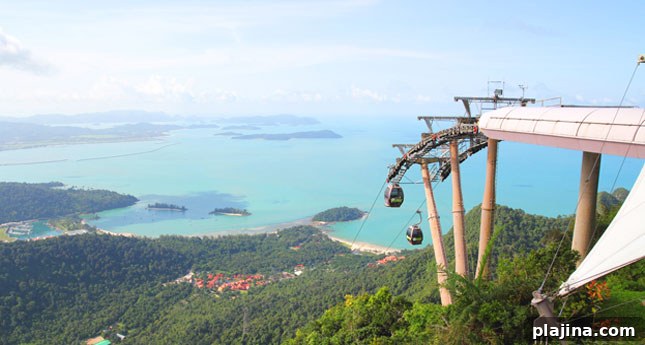
North of Penang, near the Thai border, lies Langkawi: an archipelago of 99 islands known as the “Jewel of Kedah.” Once a backwater, Langkawi was transformed in the late 20th century into a tourist destination, attracting upscale resorts and new attractions like the cable car to Mount Mat Chinchang and the Langkawi Sky Bridge, which offers dramatic views over the forest canopy. With its white-sand beaches and crystal Andaman waters, Langkawi now handles more than a million visitors a year, complete with an international airport.
For travelers seeking a more bohemian or barefoot atmosphere, the Perhentian Islands on the peninsula’s east coast are a popular alternative. Accessible only by boat, Perhentian Kecil and Perhentian Besar sit in the South China Sea and offer superb snorkeling directly from shore. There are no roads—movement is by boat or on foot—and the resorts are small and informal. Nights often end with fire jugglers entertaining guests in front of beach bars.
Further down the east coast the Seribuat Archipelago scatters 64 coral-fringed isles. Pulau Rawa, owned by the Johor sultan’s family, emphasizes exclusivity. Though much of its shoreline is flanked by sheer cliffs, Rawa has a picture-perfect white-sand beach and a resort with chalets on both beachfront and hillside locations set among lush vegetation.
Tulai, an uninhabited island near Tioman © Dmitry Kushch | Dreamstime.com
Tioman Island, northeast of Rawa and 20 miles off the peninsula, is a rugged wildlife haven. Its isolation supports species that differ from their mainland counterparts, including monkeys, lizards and over 130 bird species. Tioman developed some tourism infrastructure—Ayer Batang (ABC) offers relaxed accommodation options and the island’s most developed resort is the Berjaya Tioman Resort—but it retains a wild interior and secluded beaches that many visitors hope remain largely untouched by mass tourism.
Far to the east across the South China Sea lies Borneo, the world’s third-largest island. The island is mostly Indonesian, with Brunei and the Malaysian states of Sabah and Sarawak occupying parts of it, alongside the Federal Territory of Labuan.
Labuan, a small cluster of islands off Sabah, is a free trade zone and offshore financial center with a reputation similar to other tax-friendly territories. Tourism here often focuses on short “booze cruises” from Brunei, but diving draws serious enthusiasts to Labuan Marine Park for excellent wreck dives.
A speedboat ride up the Borneo coast brings you to volcanic Pulau Tiga, which gained fame as the original filming location for the TV series Survivor. Accommodation is basic and rustic at the Survivor Lodge, with hiking trails and diving trips to nearby islets, including Snake Island, home to the banded sea snake.
Two hundred miles northwest of Sabah is Layang-Layang (Swallow Reef), a remote deep-sea atoll in the disputed Spratly chain. Initially a naval base, the atoll now hosts the exclusive Avillion Layang-Layang dive resort. Access requires a permit and an hour-long flight from Kota Kinabalu, but divers prize Layang-Layang for its clear water, pristine coral and dramatic 6,000-foot drop-off.
In the end the Swedish captain’s preference makes sense: for all the attractions of Malaysia’s mainland, the greatest gift may be the knowledge that an extraordinary variety of island experiences lies just a boat ride away.
INFO TO GO TO THE ISLANDS OF MALAYSIA
The main international gateways are Kuala Lumpur International Airport (KUL) and Singapore Changi Airport (SIN). From Kuala Lumpur you can reach most major Malaysian islands, Sabah and Labuan in Borneo, and travel overland to Penang. Singapore offers onward flights to Tioman, Penang and Langkawi.
Lodging in Malaysian Islands
1926 Heritage Hotel Once home to British colonial officers, this atmospheric hotel evokes a bygone era. 227 Jalan Burma, Penang.
Bagus Place Retreat An award-winning resort with quirky, individually designed chalets overlooking a beautiful beach. Kampung Muku, Tioman.
Bon Ton Resort A distinctly Malaysian property built from century-old wooden stilt houses. Pantai Cenang, Langkawi.
Malaysian Island Dining
The Eighty-Eight Restaurant Mediterranean cuisine with Asian influences from Chef Danny Ng. 49-A Jalan Kelawai, George Town, Penang.
fatCUPID A trendy spot serving Asian food with Australian twists, adjacent to a fashionable hotel. Jalan Teluk Baru, Langkawi.
Tamarind Located at Japamala Resort, the Tamarind Terrace serves refined Asian dishes in a seaside setting. Kampung Lanting, Tioman.