
This isn’t like Africa at all. In a verdant suburb of Durban, we drive beneath arching trees that cast dappled green light. Large homes peek out behind high walls and hedges, evoking images of Beverly Hills or New England’s affluent enclaves. Only the vervet monkeys bouncing through the treetops remind you where you are.
When the engine stops, the neighborhood falls quiet. Birds sing, sprinklers hiss over neatly kept lawns, and you can see why someone playfully altered the entrance sign from “Kloof” to “Aloof.”
Back on the highway that bisects Kloof, the scene shifts instantly. Heading southeast, we join a dense stream of crowded minibus taxis, trucks belching smoke and cars in various states of repair.
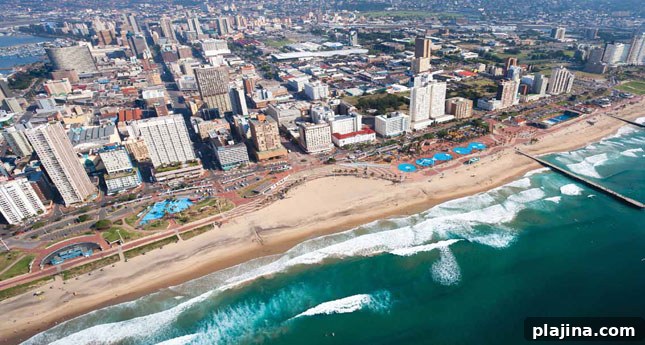
The road drops toward the coast in dramatic sweeps. The heat intensifies and the humidity rises. We pass through Pinetown, Westville and Berea West before the skyline of downtown Durban appears, set against the shimmer of the Indian Ocean.
Durban is South Africa’s third-most populous city, but in political influence it ranks below Pretoria, Cape Town, Bloemfontein and Johannesburg. Despite that, it remains a vital maritime and cultural hub.
Moses Mabhida Stadium © Jborzicchi | Dreamstime.com
Until 2010, international access to Durban was limited by the old airport’s short runway, and many potential visitors were deterred by perceptions of urban decline after 1994. The high-rise Central Business District, bordered by Africa’s busiest port to the south and a long ocean beach to the east, had been largely ceded to the informal economy as businesses and retailers moved north to the growing Umhlanga area. Leafy suburbs like Kloof became guarded enclaves, uncertain about their future in the new South Africa.
That trend began to reverse ahead of the 2010 FIFA World Cup, when Durban—one of the host cities—saw major investment. The city’s CBD and the Golden Mile beachfront were refreshed, an aquarium and waterpark opened at the southern end of the beach, and an iconic stadium rose at the northern end.
The most transformative project was King Shaka International Airport at La Mercy, about 22 miles north of downtown. With a runway capable of handling the largest passenger and cargo aircraft, the airport anchors Dube Tradeport, an integrated mega-project planned to expand over decades. Dube Tradeport includes the airport, an agricultural zone, advanced IT services and the Dube City business park.
When the old airport south of the city closed in April 2010, debate followed about the site’s future. Transnet National Ports Authority purchased the land with plans to excavate a dug-out container port to supplement the existing Port of Durban. The first phase was projected to strengthen Durban’s position among global trading hubs.
Durban has always benefited from its geography. Founded in 1835 and named for Sir Benjamin d’Urban, the settlement sat beside a sheltered bay that became a safe harbor for ships traveling between Europe and Asia.
Durban City Hall houses The Natural Science Museum and the Durban Art Gallery.
Photo: © Renata Hajkova | Dreamstime.com
Over time British settlers fought Zulus and Boers to secure control of the Natal hinterland. As a staging post, Durban prospered. Workers were recruited from British India, including a young Mohandas Gandhi, who sharpened the leadership skills that later shaped India’s struggle for independence.
Today more than a quarter of Durban’s population is of Indian descent, believed to be the largest Indian community outside India. About a quarter are white—mostly English-speaking with some Afrikaners—and roughly 37 percent are black Africans, primarily Zulu.
Under apartheid, strict segregation consigned black communities to townships that often lacked basic services. The rise in crime after majority rule reflected long-term inequality, but the city has been pursuing redevelopment and integration ever since.
Projects such as Bridge City north of the CBD aim to provide economic anchors for township communities, while new roads and upgraded public transport seek to connect the city more effectively. The broader eThekwini Metropolitan Municipality now governs Durban and surrounding suburbs and townships, and though the post-apartheid transition has been difficult, signs of cohesion are emerging.
From the Golden Mile beachfront and the bustling port to township communities, golf courses and shopping malls, from colorful curio markets and neoclassical City Hall to the modern Moses Mabhida Stadium and the leafy calm of Kloof—Durban displays a wide and compelling diversity.
CHECKING IN WITH ANDREW LAYMAN
CEO, Durban Chamber of Commerce and Industry
WHAT OPPORTUNITIES DOES DURBAN OFFER AMERICAN INVESTORS, AND WHAT ARE THE KEY DEVELOPMENTS TO LOOK FOR IN THE FUTURE?
Durban’s port is its primary economic asset—the gateway to Africa. Plans for a new port and a Back of Port strategy aim to rezone areas for transport and logistics, add a dedicated freight route inland, and ease congestion. These initiatives create opportunities across transport, logistics and related services.
The northern corridor, including Umhlanga Ridge and Dube Tradeport, has unlocked significant investment potential. Hopes include connecting King Shaka International Airport to the city via high-speed rail and developing an aerotropolis with efficient links to the port. The availability of land and consolidated ownership make expansion viable.
Tourism is also poised for growth: studies have identified Durban as one of the African cities expected to see strong tourism expansion, creating demand for hotels, resorts and property development.
WHAT CULTURAL DIFFERENCES SHOULD FOREIGN INVESTORS BE AWARE OF WHEN DOING BUSINESS IN DURBAN?
One important consideration is South Africa’s Black Economic Empowerment policies. While they may seem daunting, partnering with reputable black-owned businesses can smooth dealings with government and local communities. Many capable black entrepreneurs operate professionally and effectively. Overall, much of Durban’s business culture is Western in its practices, and the business-to-business environment is generally suitable for American investors.
IS THE CENTRAL BUSINESS DISTRICT STILL A MAJOR FOCAL POINT OF BUSINESS, OR HAS THE CENTER OF GRAVITY MOVED ELSEWHERE?
Commercial gravity has shifted north. The CBD still functions as a retail center, but affluent shoppers favor malls in northern precincts, and many companies relocated their headquarters to areas like Umhlanga. There is interest in inner-city revitalization to balance development, and completing stalled projects at the Point could help restore activity to the southern CBD.
WHICH LOCAL ATTRACTIONS DO YOU RECOMMEND?
Durban offers warm beaches and a welcoming sea even in winter. uShaka Marine World is a major draw with its aquarium and waterpark. The Drakensberg mountains lie just over two hours away, and numerous game parks and scenic rural areas are easily accessible for day trips.
DIVERSIONS
The Golden Mile—Durban’s beachfront promenade—has been a popular domestic destination for decades. After a post-apartheid downturn when tourists and residents moved to Umhlanga Rocks, significant investment has sought to restore the Mile’s appeal. At its southern end, uShaka Marine World combines aquarium exhibits and a waterpark. At the northern end, Suncoast Casino and Entertainment World draws large crowds with gaming, restaurants and cinemas. Nearby stands Moses Mabhida Stadium, a 54,000-seat venue built for the 2010 World Cup that hosts sporting events and concerts, and offers arch climbs for panoramic city views.
North of Durban, Umhlanga is home to the Gateway Theatre of Shopping—one of Africa’s largest malls—and the KwaZulu-Natal Sharks Board headquarters. Inland, the Midlands Meander region presents rolling farmland, craft shops and charming bed-and-breakfasts, while further inland are historic battlefields and the dramatic Drakensberg mountain range.
The Drakensberg
Photo: © Daleen Loest | Dreamstime.com
LODGING
Coastlands on the Ridge
Guestroom balconies offer views of the city; the hotel is a short taxi ride from the Central Business District. 315-319 Peter Mokaba Ridge.
Hilton Durban
A modern downtown hotel beside the International Conference Centre Durban and within walking distance of the Golden Mile beachfront. 12-14 Walnut Road.
The Oyster Box
A recently refurbished colonial-era seafront hotel with a lighthouse in upmarket Umhlanga Rocks. 2 Lighthouse Road, Umhlanga Rocks.
DINING
9th Avenue Bistro
Housed in a small shopping center, this restaurant serves refined fusion cuisine. 2 Avonmore Centre, 9th Avenue.
Capsicum Restaurant
Located beside a major highway, Capsicum is known for local curries, including bunny chow. Britannia Hotel, 1299 Umgeni Road.
Havana Grill
Enjoy ocean views while dining on South African steaks. Suncoast Casino, Marine Parade.