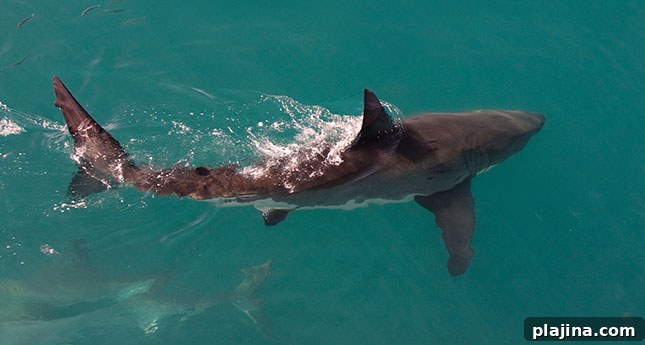
Photo: Roger De Marfa, Dreamstime
The reverberation of a prosthetic leg on a tennis court is a sound that lingers. I woke to that noise each morning during a two-week family vacation in Durban, South Africa, almost 40 years ago. I would pad barefoot to the window and watch the early-morning game below.
On one side of the net was my mother, returning every ball with fierce accuracy — she later became a club champion. On the other was a man we had met on the beach on our first day.
We had seen him unstrap his prosthesis and hop down to the water for a long swim. When he returned, towel around his shoulders and balancing on his single leg, I asked the inevitable question. I was five, with no sense of tact. “Why does that man only have one leg?”
After strapping the limb onto his stump, he walked over and answered simply: “My left leg was bitten off by a shark.” Out there, during a morning swim.
I kept that story to myself when, one recent morning at 6:30, I joined half a dozen tourists aboard a small boat marked with the KwaZulu-Natal Sharks Board logo. We were heading into some of the world’s most shark-populated waters.
The Sharks Board was founded in 1962 to reduce shark attacks on bathers along South Africa’s Indian Ocean coast. Their most visible measure is the installation of shark nets a quarter-mile off 38 popular beaches.
“The nets are the last line of defense,” our guide said as we waited at our mooring in Durban Harbour. “The Board also researches shark behavior. The more we understand, the easier it is for people and sharks to coexist.”
After an introductory talk and safety briefing, we cast off. Inside the harbour the water was calm, but as we chugged along the mile-long entrance channel huge whitecaps rose beyond the breakwaters.
“We’re already in shark territory,” the guide said. “We installed underwater CCTV in the channel. They show great whites and Zambezi sharks coming and going every day. There are probably sharks under us right now.”
When we reached open water the boat rocked badly and spray lashed everyone. The guide steered around the seawall so we could face downtown Durban and the hotel-lined stretch known as the Golden Mile.
From the sea the city looked much the same as it had during our family holiday, though old photos told another story.
My father had once put the Durban album in front of me and pointed out a few candid snapshots. One close-up showed a sign by the city’s famous beach: “This Bathing Area Is Reserved for Members of the White Race Group.” Another photo of my brother and me at the dolphinarium revealed, in the background, African schoolchildren confined to a segregated section.
Apartheid ended in the 1990s and, while much of Durban’s architecture remains familiar, the city’s social fabric has been remade.
Throughout those changes the shark nets have endured. Most mornings crews in bright-yellow boats service the protective barriers, releasing any live fish trapped in the netting and collecting those that have died.
Our trip followed the staggered line of nets, and we passed close to a service boat. The guide yelled, “Found anything?”
A crew member hoisted a three-foot dead shark. “Young shortfin mako,” he said. The carcass would be taken to the Board’s Umhlanga headquarters north of Durban for study.
On average 591 sharks are caught in the nets along the coast each year; only about 13 percent are released alive.
The shark mortality is the grim cost of protecting bathers and surfers. Since the nets were installed, there have been no fatal attacks within Durban’s cordoned zone.
After the Sharks Board voyage I returned to the Royal Hotel in downtown Durban and reflected on a different danger — one found on land.
The lingering injustices of apartheid contribute to widespread crime. The U.S. Department of State identifies the neighborhood around the U.S. Consulate as higher risk for muggings and urges visitors to exercise “heightened awareness.”
Walking away from my hotel felt like stepping into the ocean: a potentially hazardous environment that demands caution. I put up metaphorical nets around the downtown area, staying within a limited cordon of familiar streets and never walking alone after dark.
Fear can be useful. My mother’s former tennis partner had shown none and paid a terrible price. His misfortune became a formative lesson for me. Whenever I enter an unfamiliar place — a foreign city or a wild landscape — I instinctively raise my guard.
On the few occasions I have strayed into danger — down an empty alley or into the path of a wild animal — my pulse pounds in my ears, a reverberation that reminds me, in tone and rhythm, of an artificial leg striking a tennis court.