
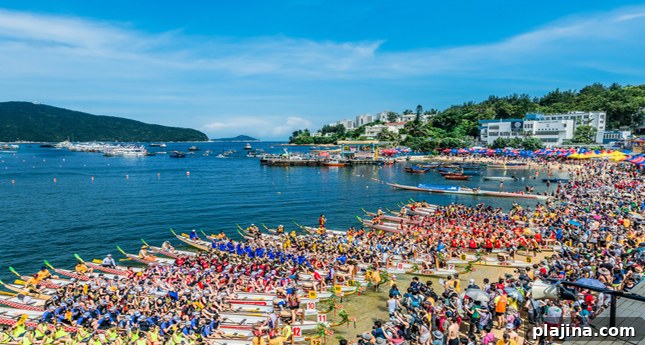
On the fifth day of the fifth lunar month, usually in May or June, Hong Kong’s waterways fill with competitors and spectators for the Dragon Boat Festival. Races are held at multiple venues across the city, including the well-known Stanley International Dragon Boat Championships.
Stanley hosts both local and international teams—often around 200 entries—and draws crowds of roughly 30,000 spectators. Other events, such as the Tai O Dragon Boat Festival with its water parade, and races near the fishing village of Aberdeen, add regional variety and local flavor to the celebrations.
A dragon boat is a human-powered wooden vessel carved and painted to resemble a Chinese dragon. Boats differ in size by region, and crew complements vary accordingly, commonly requiring between 20 and 60 paddlers to propel a single boat.
Each team includes a drummer positioned at the bow who establishes the stroke rate for the paddlers. The drummer’s rhythm is essential to synchronize the crew’s efforts and maintain peak speed and coordination during the race.
Dragon boat racing commemorates the ancient poet and patriot Qu Yuan (c. 340–278 B.C.). Qu Yuan served as a loyal court minister in the state of Chu and pushed for political reforms. After falling out of favor with the king, he was exiled and spent his later years composing poetry that expressed his deep concern for his homeland. In 278 B.C., when news arrived that his state had been invaded, Qu Yuan waded into the Ni Lo River and drowned himself. According to tradition, local fishermen raced out to retrieve him but were unable to save him. To protect his body from fish, they cast rice dumplings into the water as an offering to his spirit.
Modern observance of the festival includes eating rice dumplings on the day of the races, a culinary nod to that ancient story. After the competitions, participants and visitors often spend the rest of the day enjoying street theater, traditional Chinese dance, martial arts demonstrations, and other cultural performances that celebrate the festival’s heritage.