
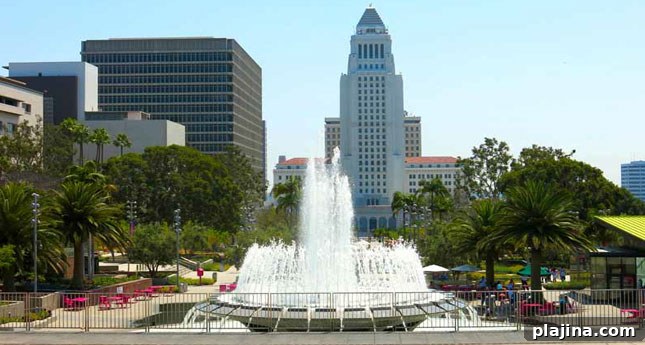
If Jane Jacobs’ criteria for a thriving city—diversity, density and energy—still apply, downtown Los Angeles is rapidly evolving into a West Coast SoHo. The area offers historic housing with character, abundant commercial space ripe for reuse and a growing base of educated, high-income residents. “It’s very creative, cutting-edge — and it’s just exploding,” says Adele Yellin of The Yellin Co., operator of the historic Grand Central Market.
The Oregon-based Ace Hotel opened its stylish downtown outpost in 2014 in the landmark United Artists Building, restoring the 1,600-seat United Artists Theatre and bringing movie premieres and screenings back to the neighborhood. “This is a community of people of passion,” says Carol Schatz, president and CEO of the Downtown Center Business Improvement District, “and the key players are passionate about bringing back Downtown L.A.”
On weekends, Upstairs at Ace draws a line of visitors along Broadway, while across the street Alma, named Restaurant of the Year by Bon Appétit, attracts food lovers with an elevated tasting menu. Retail and creative collectives have also moved in: Stockholm’s Acne Studios opened in the Eastern Columbia Building, and Kinfolk Studio established a presence in the area, signaling increased interest from international and boutique brands.
Framed by freeways, downtown stretches from Bunker Hill to the Convention Center and includes the city’s historic core as well as the arts and fashion districts. The resident population has grown from roughly 10,000 to over 50,000 in the past decade, while the employment base totals around 500,000 and annual visitors approach 10 million. “Downtown L.A. has emerged as one of the nation’s most diverse city centers,” says Ernest Wooden, Jr., president and CEO of the Los Angeles Tourism & Convention Board. With nearly 5,000 new housing units under construction, the residential population is projected to rise further.
The 1999 Adaptive Reuse Ordinance unlocked the potential of many historic buildings, converting commercial and office space into thousands of residential units. “This was the hottest housing market before the crash,” Schatz notes, “and it’s come back with a vengeance as the recession has eased.”
Major developments are reshaping the skyline: the $1 billion sail-shaped Wilshire Grand Tower, a 73-story mixed-use complex, will become the tallest skyscraper west of the Mississippi. Frank Gehry’s Grand Avenue residential and hotel project, adjacent to his Walt Disney Concert Hall, is slated to begin construction in 2015. Arquitectonica recently completed a 19-story condominium tower next to The Broad, a new museum funded by Eli Broad.
Restored landmarks have proven popular for residents and retailers alike. Residential lofts in the Eastern Columbia Building sold quickly after an $80 million renovation, and neighborhood cafés and shops have rejuvenated street life. “We are in this 1930 masterpiece,” says Michael Backlinder, managing partner at il Caffé.
L.A. Live © Gerry Boughan | Dreamstime.com
At L.A. LIVE, the luxury Ritz-Carlton Residences completed sales of their units in early 2014, reflecting growing confidence in downtown living. “It’s been an educational process for the public,” says Michael Roth, vice president of communications at AEG. “We needed Staples Center to help teach people that they could stay — and not just for dinner.”
Long-standing efforts to revive downtown’s cultural and commercial corridors are gaining traction. Led by councilmember José Huizar, “Bringing Back Broadway” launched in 2008 as part of a decade-long plan to restore the historic Broadway corridor and its dozen movie palaces. According to the Business Improvement District, Broadway—once known as “the hole in the donut” because of its stalled redevelopment—is now undergoing rapid transformation from 11th Street to First Street.
New Historic Commercial Reuse Guidelines aim to preserve Broadway’s architectural heritage while enabling adaptation of more than one million square feet of commercial space. In 2015, Whole Foods Market planned a 42,000-square-foot store within a new mixed-use development at Seventh and Grand Avenue, reflecting the mix of retail and residential growth.
Hospitality and entertainment additions near L.A. LIVE include a 24-story tower hosting both Residence Inn and Courtyard by Marriott properties, with a Renaissance Hotel planned nearby. The nation’s first 4DX theater, combining motion seating with immersive special effects, opened as part of the expanding entertainment offerings.
The Convention Center is also under review through an architectural competition to reimagine the 1970s complex. For meeting and convention attendees, downtown’s compact urban fabric means hotels, restaurants, cultural venues and transit are often within walking distance or a short Metro ride.
Public transit projects are returning to the city’s agenda. A proposed downtown streetcar received federal approval for a $75 million Small Starts grant in March 2014. The planned route would link Broadway, L.A. LIVE, the Civic Center and Walt Disney Concert Hall—echoing the extensive trolley network Los Angeles operated in the 1920s. The streetcar is viewed as a catalytic piece of infrastructure to reconnect neighborhoods and encourage street-level activity.
Environmental and recreational investments are also underway along the Los Angeles River. A $10 million U.S. Army Corps of Engineers study outlined ecological improvements and recommended expanded parkland, bike paths and pedestrian bridges along the river corridor, bringing more green space and better connectivity to adjacent neighborhoods.
“What’s happening now in downtown is pulling people out of their cars and into the streets,” says Adele Yellin, capturing the shift toward more walkable, vibrant urban life.
SCENIC DRIVES
When you want to leave the city, the Pacific Ocean is less than 30 minutes away. Coastal communities such as Malibu, Santa Monica and Venice offer beaches, world-class museums, acclaimed dining and dramatic ocean views.
For a different kind of scenic trip, passenger ferries run from Long Beach to Catalina Island, an hour-long journey to a 22-mile island that was a favorite getaway for Hollywood stars in the 1930s.
About 95 miles up the coast, Santa Barbara—often called “The American Riviera”—is known for its mild climate, Spanish colonial revival architecture and a lively cultural calendar. The city hosts events like the Santa Barbara International Film Festival and a robust theater scene. Wine and food festivals, including regional vintners’ events and culinary celebrations, highlight the area’s gastronomic and viticultural strengths.