
German forests are unique. Walking along well-maintained paths beneath the dappled light of ancient trees, listening for animals in the undergrowth and watching birds flit between branches, you are experiencing more than wilderness—you are entering the cultural heart of Germany. Many of the country’s artistic traditions, musical heritage, myths, Gothic architecture and aspects of national identity were shaped in forests like these.
Dominating them all is the Schwarzwald, the Black Forest, a vast mountainous region in southwestern Germany that borders France and Switzerland. For visitors it evokes picturesque spa towns and the famous cherry-and-chocolate cake. For Germans it carries deeper spiritual and cultural meanings. For everyone it offers abundant year-round outdoor activities.
The Black Forest has attracted visitors for at least 2,000 years. Celts and Romans were among the first to enjoy the natural hot springs in the northern reaches. Today you can still see the well-preserved ruins of a Roman bathhouse beneath the century-old Friedrichsbad spa in Baden-Baden.
Although bathing here has ancient roots, the region became fashionable with Europe’s elite during the 19th century, when Baden-Baden emerged as the continent’s premier spa town. (The name Baden-Baden means “baths” and refers both to the town and to the former state of Baden.)
In its Belle Époque heyday, Baden-Baden was favored by monarchs such as Queen Victoria and Kaiser Wilhelm I, composers like Brahms and Berlioz, and writers including Dostoyevsky and Tolstoy. Traces of that illustrious past remain in its historic spas, in the 200-year-old casino that inspired Dostoyevsky’s The Gambler, and in its grand hotels such as the elegant Brenners Park-Hotel.
Baden-Baden is an upscale base for exploring the Black Forest. Despite its refined atmosphere, genuine wilderness is only minutes from the town’s genteel streets. The town stretches long and narrow within a valley, so if you arrive by train expect a brief bus ride into the center.
That geography also means many accessible walking trails fan out into the surrounding hills. The highest point above Baden-Baden is Mount Merkur at 2,191 feet, with scenic routes to the summit. If you prefer an easier ascent, the Merkur Funicular Railway—one of the steepest in the world—carries visitors to the top, from where you can stroll back down at your own pace.
The world’s largest cuckoo clock in Triberg © Alexandre Fagundes De Fagundes | Dreamstime.com
Triberg is a popular gateway to the central Black Forest. In summer it can be crowded with tour groups and traffic on the narrow approach roads, and many visitors come for the town’s iconic cuckoo clock. Although popular culture sometimes associates the cuckoo clock with Switzerland, its origins lie in this region of the Black Forest in the 18th century.
Local shops sell handcrafted clocks, and two businesses at opposite ends of town each claim the title of “World’s Biggest Cuckoo Clock,” inviting comparison. The Schwarzwaldmuseum in Triberg showcases cuckoo clocks alongside exhibits that trace the region’s cultural history.
If crowds become overwhelming, you can quickly escape into the surrounding wilderness—often within a short walk you’ll find solitude among the trees. One nearby trail leads to Triberg Falls, Germany’s highest waterfall, which drops in seven tiers over a total of 524 feet. While the falls attract visitors, more remote long-distance trails soon leave the crowds behind.
The Black Forest has a strong tradition of hiking and is often credited with helping to popularize the activity. Trails are well signposted (note that distances are shown in kilometers), and detailed maps are readily available. Local tourist offices can arrange luggage transfers so you can hike light between overnight stops.
Parkhotel Wehrle in Triberg is a favored stop for long-distance walkers and offers a luxurious spa to soothe tired legs. The hotel was a favorite of Ernest Hemingway when he visited the area.
For a scenic experience without the exertion, ride the Black Forest Railway. Triberg sits roughly midway on the line, which runs north toward Offenburg and south to Singen. The route navigates mountains and valleys, passing through 39 tunnels and changing elevation by more than 2,000 feet. Another picturesque option is the Murg Valley Railway, which winds through the western forest near the French border.
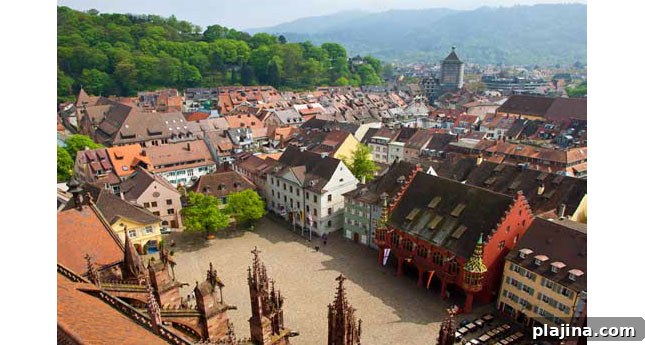
The city of Freiburg in the Black Forest © Pere Sanz | Dreamstime.com
Freiburg im Breisgau is an engaging university city and an excellent base for exploring the western Black Forest. It matches many expectations of a medieval German city, although much of it was rebuilt after World War II.
The interior of Freiburg Minster, the 13th-century cathedral, reveals how Gothic architecture was inspired by the forest: columns rise and branch overhead like a stand of trees, forming an interlaced canopy above the nave. Carved figures and playful gargoyles add character to the stonework, sometimes concealed in plain sight much like shy wildlife in the woods.
A spirit of mischief and humor is often evident around the Black Forest. Local dialects, especially Swabian in the eastern areas, can be difficult even for native German speakers to understand. A regional tourism slogan captured the region’s self-deprecating tone: “We can do anything. Except speak German.”
The dialects may distinguish the Black Forest, but as you wander its villages, meadows and shaded woods you sense how deeply the landscape has influenced German culture and identity, binding regions together through shared traditions.
Near Furtwangen im Schwarzwald a spring rises to form the Breg River, recognized as the upper tributary of the Danube. A small plaque marks this source, which sends water on a 1,785-mile journey from the Black Forest to the Black Sea. Nearby another marker notes the watershed between the Danube and the Rhine.
Just as small streams from the Black Forest join to form great rivers, the region’s customs and crafts flowed outward to shape the broader cultural heritage of Germany. Here, in this landscape of springs and forest, many of those roots remain visible.
Black Forest Info to Go
For access to the northern Black Forest, Stuttgart Airport is the most convenient hub. The southern Black Forest is easily reached from EuroAirport Basel-Mulhouse-Freiburg, which serves Basel (Switzerland), Mulhouse (France) and Freiburg (Germany). The region is also well connected by rail and road from major German cities.
Read more about Black Forest cake.