
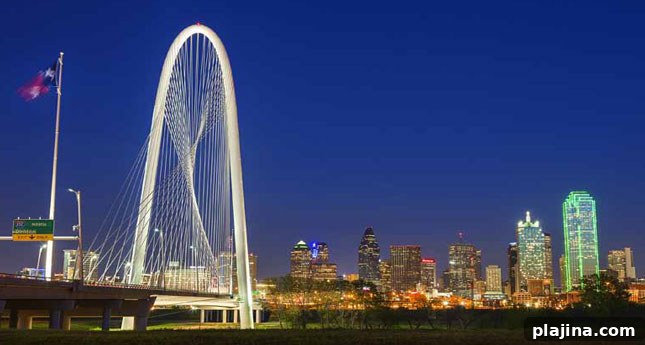
Following the completion of the architecturally focused Dallas Arts District, Dallas remains deep in a major building boom. Over the past year the Perot Museum of Nature and Science opened a new $185 million facility in Victory Park; the George Bush Presidential Library and Museum debuted on the Southern Methodist University campus; and Trinity Groves, a restaurant and retail destination at the foot of the Santiago Calatrava–designed Margaret Hunt Hill Bridge, joined multiple projects underway along the Trinity River Corridor.
The Dallas Arts District began in 1984 with the opening of the Dallas Museum of Art. Five years later the I.M. Pei–designed Morton H. Meyer Symphony Center was added, followed by the light-filled Nasher Sculpture Center by Renzo Piano in 2003. In 2009 the neighborhood welcomed two buildings by Pritzker Prize–winning architects: the Winspear Opera House and the Wyly Theatre. The most recent addition, City Performance Hall, is a 750-seat venue that hosts small- and mid-sized theater companies, concerts and lectures.
Complementing the Arts District, Klyde Warren Park opened last October. This five-acre deck park built over the Woodall Rodgers Freeway features an open amphitheater, a dog park, shaded walkways and a broad lawn—perfect for picnics before or after cultural events.
“It has quickly become a focal point between the hotels and offices in Uptown and the entertainment corridor of the Dallas Arts District,” said Phillip Jones, CEO of the Dallas Convention and Visitors Bureau.
The Perot Museum of Nature and Science © Raycan | Dreamstime.com
Jones also noted that convention bookings rose 30 percent year over year following the 2011 opening of the 1,001-room Omni Dallas Hotel. Connected to the hotel by a skybridge, the Dallas Convention Center recently completed Phase I of a $60 million upgrade that refreshed function spaces, added multimedia conference rooms and introduced a new mezzanine-level ballroom. Phase II will add approximately 100,000 square feet, with construction planned to begin in 2015. A new trolley service now links conventioneers to the growing Bishop Arts District, a neighborhood known for boutique restaurants, chocolate shops, cafés and art galleries.
Two minutes from the convention center stands the striking Margaret Hunt Hill Bridge, whose 400-foot arch by Calatrava has become an iconic city image. Beneath that arch, former corrugated steel warehouses, brick storefronts and loading docks along the river are being transformed into Trinity Groves, a lively mixed-use district. So far it has opened several restaurants, a brewery, a bowling alley, a home décor store and a large culinary event space—only the beginning of the planned development.
The entire Trinity River Corridor is earmarked as Dallas’s next major project: a roughly $3 billion plan to create 20 miles of trails for hiking, biking and horseback riding through one of the largest remaining urban hardwood forests in the nation. The Trinity River Audubon Center already operates on 120 acres of waterfront, and an 18-hole Trinity River Golf Course is scheduled to open in 2017 and will host the PGA-affiliated Byron Nelson Championship Tournament. A 60-acre mixed-use neighborhood called “The Rivers” is set to break ground this summer, with early plans calling for 2,000–3,000 townhouses and condominiums, plus restaurant and retail space and the future Dallas Maritime Museum, which has an agreement to display the movie submarine from The Hunt for Red October.
Dallas’s reputation as a shopping destination continues to grow. NorthPark Center, one of the state’s premier malls, added six stores recently, including the city’s only J. Crew Men’s Shop as well as Tory Burch and Rolex locations. The Omni Dallas Hotel intends to add 25,000 square feet of retail space to serve convention attendees.
Noted chefs and restaurateurs are also expanding in Dallas. Wolfgang Puck opened Cloud Nine Café atop Reunion Tower’s GeO-Deck, which reopened after six years of renovations and now offers sweeping views of the city and the illuminated Margaret Hunt Hill Bridge at night. Chef Stephen Pyles has announced plans to relocate his namesake restaurant to a new 18-story tower in the Arts District. Chef Dean Fearing’s popular Fearing’s at The Ritz-Carlton continues to draw crowds; his maple- and black-peppercorn–soaked buffalo tenderloin remains a standout on the menu.
Rather than resting on its success with the Arts District, Dallas is turning attention to the Trinity River Corridor, aiming to better connect the city to its natural surroundings and evolve into a 21st-century metropolis. The next five to ten years promise significant change as these projects mature and new developments emerge.
SCENIC DRIVES
Although Dallas is not typically noted for scenic drives, one memorable stretch lies just east of downtown: a 2.5-mile run along Swiss Avenue. In the early 20th century, cotton gin manufacturer Robert Munger envisioned an upscale neighborhood of stately homes on Swiss Avenue, where estates had to cost at least $10,000 and be at least two stories. The plan attracted Dallas’s elite—figures such as Carrie Marcus Neiman of Neiman-Marcus—and led to commissions for prominent architects like Bertram Hill. Swiss Avenue became the city’s first paved street and in 1974 was listed on the National Register of Historic Places as a premier example of turn-of-the-century architecture in the Southwest.
Today the neighborhood remains home to notable residents, and a slow drive down Swiss Avenue reveals an attractive mix of architectural styles, from Italian Renaissance to Prairie to Spanish Revival. It’s a reminder that large-scale development and fine design have long been part of Dallas’s story.