
Although many Qatari curators and museum directors take a cautious approach when assembling collections, there are clear efforts to expand the cultural landscape with bold, contemporary exhibitions in government museums, private galleries and public spaces.
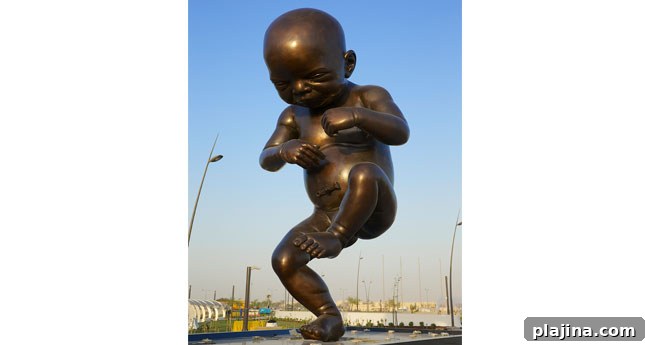
In late 2011, an 80-foot-tall sculpture by American artist Richard Serra was installed in a newly designed park adjacent to The Museum of Islamic Art. In spring 2013, with official permission, French-Tunisian street artist eL Seed painted 52 graffiti-style panels along the walls of an auto tunnel on Salwa Road. More recently, Sheikha al-Mayassa bint Hamad bin Khalifa al-Thani, chairwoman of the Qatar Museums Authority and sister of Qatar’s emir, introduced a set of controversial sculptures by British artist Damien Hirst titled The Miraculous Journey. The series is on display outside the Sidra Medical and Research Center, a striking steel, glass and white-ceramic complex dedicated to women’s and children’s health.
Each of these public commissions—Serra’s monumental work, eL Seed’s tunnel project and Hirst’s sculptures—received support from Sheikha al-Mayassa and form part of Doha’s extensive public arts initiative. The program aims to expose Qatari citizens and visitors to contemporary art forms that lie beyond traditional local aesthetics, even when the works prompt debate among more conservative members of society.
Reactions to these projects have varied. While some Qataris expressed concern over the imagery and styles on display, the authorities have generally allowed the works to remain, viewing them as opportunities to broaden cultural discourse and stimulate engagement with international contemporary art. These installations also reflect a broader strategy to position Doha as a global cultural hub by combining architecture, public space and ambitious art commissions.
Beyond the headline-making pieces, Qatar’s evolving arts scene includes rotating exhibitions in state institutions, experimental shows in private galleries and site-specific works in urban settings. Together, these initiatives contribute to a slowly diversifying visual culture, encouraging dialogue between traditional values and contemporary expression while attracting international artists and curators to work in the region.
As Doha continues to develop its museums, parks and public plazas, such high-profile projects help define the city’s identity and offer residents new ways to encounter and interpret art. While public opinion may remain mixed, the presence of these works demonstrates an ongoing commitment by Qatar’s cultural institutions to invest in contemporary art and to challenge audiences with pieces that provoke thought, conversation and sometimes controversy.