
In the dark at 3:30 a.m., we remind ourselves that this is Borneo. The island’s usual tropical vibrancy vanishes within our flashlight beams; we push through a monochrome landscape of twisted shrubs and dancing shadows. The heavy, familiar scent of rainforest has faded, and the humid heat of the lowlands feels like a distant memory. The air here is thin and piercingly cold.
The trail winds in one relentless direction: up. Every weary step takes us higher. The effort leaves us breathless and tempted to stop, but we must press on. The earth is turning and dawn is advancing from the east. We need to reach our target before first light.
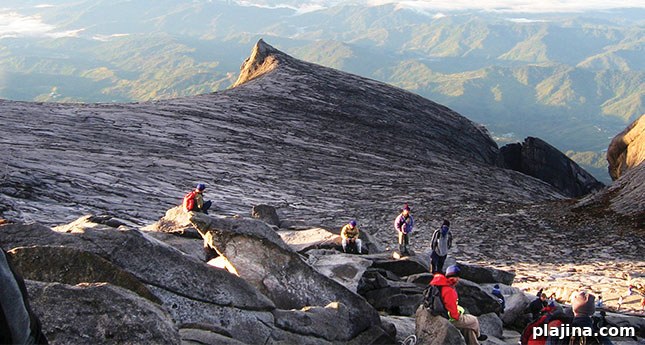
After what feels like an age of climbing, the terrain changes. We break out of scrub onto bare granite. In places the slope is so steep we haul ourselves upward using ropes anchored to the rock. At last the ground flattens and we arrive—and we are not alone.
At least two dozen people have endured the same trek this morning. As the horizon brightens, we jostle for position at 13,435 feet above sea level. We stand on Low’s Peak at the summit of Mount Kinabalu, one of southeast Asia’s highest mountains. As the sun rises, cameras come alive. This is the moment that makes the early start and punishing climb worthwhile.
The gaudy beauty of daybreak is not the only reason we came at this ridiculous hour. As the lower slopes warm, cloud cover builds; within an hour or two the view can vanish entirely. This is our best chance to enjoy the panorama.
And what a view it is. To the west, the mountain tumbles toward the South China Sea, with the city of Kota Kinabalu nestled between highlands and water. To the east, land stretches toward the Sulu Sea, shrouded in morning haze. Northward lies the very tip of Borneo; to the south stretches the vast, green interior of the world’s third-largest island.
The name “Borneo” often evokes impenetrable rainforest, exotic wildlife and, in older imaginations, fierce tribes of headhunters. Even in the 21st century, some of those images retain truth.
Logging has frayed much of the rainforest; numerous species are threatened and many indigenous communities have been forced to modernize. Yet stretches of wild forest remain, and there are still painful reminders of past conflicts—skirmishes between indigenous groups and settlers have included reports of gruesome violence.
Modernity has left a firm mark. More than 200 ethnic groups live here, yet the island is divided among three countries. Northern Borneo holds the Malaysian states of Sabah and Sarawak, along with the small independent sultanate of Brunei on the northwest coast. The central and southern regions, known as Kalimantan, belong to Indonesia.
I visited Sabah, the most developed and visitor-friendly part of Borneo. My trip began and ended at a luxury beach resort; in between I sought the wilder side of the island.
On Mount Kinabalu’s summit I layered up against the morning chill. In the days before the climb I had sweated through visits to several sandy beaches and cooled off by snorkeling over coral reefs.
From my hotel near Kota Kinabalu, it was easy to reach the five protected islands of Tunku Abdul Rahman National Park. Each morning the hotel’s speedboat carried us out to the islands. The presence of other tourists slightly dulled the castaway fantasy, but once beneath the surface or on forested paths, it was easy to leave signs of humanity behind and embrace solitude.
Around Mamutik Island, coral reefs teemed with marine life. I swam among shimmering shoals and, in a thrilling encounter, floated above a banded sea snake—one of the planet’s most venomous reptiles (their venom is far more potent than a cobra’s, though bites are rare).
On Sapi Island I stayed mostly in the shade after a sunburn from the previous day’s snorkeling and had my first extended contact with Borneo’s coastal rainforest, spotting monitor lizards and macaque monkeys.
That was only the prelude. The next day I crossed mainland Sabah to the Danum Valley Conservation Area, a remarkably well-preserved stretch of primary rainforest. The richness of life in the forest comes at a cost: each jungle walk left me with a variety of insect bites, and once a tiger leech latched onto my ankle. My comfortable cabin at the Borneo Rainforest Lodge was a welcome refuge from those discomforts.
Borneo ranks among the world’s most biodiverse places, with a staggering number of endemic plants and animals. For many visitors, the headline attractions are the large mammals.
One of the most impressive is the Bornean elephant. This island subspecies of the Asian elephant is smaller than mainland varieties, but up close it still leaves a strong impression. These elephants are generally docile and sometimes allow close approaches. In my case, I caught only a glimpse—a wrinkled gray rump vanishing into foliage.
The highlight of my visit was seeing a wild orangutan. He sat hunched high on a fragile-looking branch, then, when he had enough of our attention, unfurled long arms and swung to denser cover with surprising agility and grace.
Another striking primate, the proboscis monkey, can be found at Tabin Wildlife Reserve, a two-hour drive east of Danum. Touring with a group of older Australian women, we came across one perched in a tree. The monkey’s bulbous nose and potbelly prompted a burst of joking that left us all laughing, while the animal regarded us with what seemed like disdain and then turned away.
The island’s wildlife faces severe threats. Deforestation for timber and, increasingly, to clear land for biofuel plantations has devastated habitats. According to conservation groups, Borneo loses forest cover at an alarming rate—an area comparable to a large U.S. state each year.
From Mount Kinabalu’s peak, the human footprint is obvious in every direction: roads snake between oil palm, cocoa and rubber plantations, and many of the last tracts of primary forest are under pressure.
Yet Mount Kinabalu’s granite summit stands immutable. Its lower slopes, protected as a national park, remain cloaked in ancient forest. As Borneo’s wild places continue to shrink, these protected areas offer vital refuge.
Walking through the dappled forest shadows at the start of my ascent, I felt the island meet my expectations. Every sound, sight and scent drew me deeper into Borneo’s heart—a place of remarkable beauty, fragile balance and unforgettable encounters.
Info to Go
The Shangri-La Tanjung Aru Resort and Spa near Kota Kinabalu is one of Borneo’s premier beach hotels. The Borneo Rainforest Lodge provides rainforest excursions with comfortable accommodation. For official travel details, consult local tourism resources.