
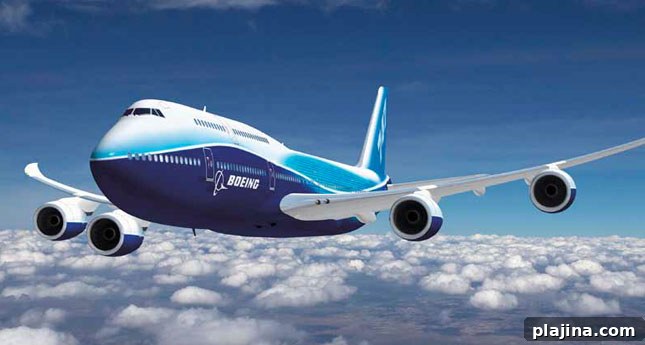
“Oh my gosh. How are we going to get an engine big enough to carry that weight?” That was Joe Sutter — often called the father of the Boeing 747 — when he was given the task of designing an airplane roughly 2.5 times larger than the 707 and able to carry 350 to 400 passengers. It was the 1960s, a period of rapid expansion in commercial aviation. Sutter led a team nicknamed “The Incredibles,” a workforce that included engineers, mechanics, construction crews, administrators and office staff, to turn the ambitious concept into reality.
The first order for the 747 was placed in April 1966. The aircraft was delivered to Pan Am on December 13, 1969, and entered commercial service in January 1970. From initial design to first flight took 29 months, and production of the first airplane required less than 16 months—an exceptional pace for an aircraft of that size. The introduction of the 747 transformed long-haul travel.
The earliest 747 models established the wide-body, two-aisle layout with three distinct seating sections, a configuration that became standard for high-capacity long-haul jets. Its landing gear was an engineering highlight: the 747 uses four main landing gear units, each with four wheels. As Sutter explained, the challenge was fitting all 16 main wheels into the structure without sacrificing fuel capacity. The engineers devised a compact and efficient arrangement that solved this problem. Boeing initially offered the 747 in three configurations: an all-passenger version, an all-cargo model, and a convertible passenger/freighter variant.
Boeing 747-8 Intercontinental interior © Boeing
Over the decades the 747 evolved through multiple variants. The most recent passenger and freighter versions, the 747-8 Intercontinental and the 747-8 Freighter, offer industry-leading operating efficiency and improved environmental performance. The 747-8 Intercontinental, capable of seating between 400 and 500 passengers depending on layout, delivered its first example to Lufthansa in June 2012.
Despite updates and modernizations, some core aspects of the 747 remain remarkable. The airplane is built from roughly six million parts and contains about 171 miles of wiring and five miles of tubing—figures that underscore its complexity. Standing over 63 feet tall and weighing around 95,000 pounds empty (specific configurations vary), the 747 is an imposing presence. Throughout its operational history the 747 family has flown billions of nautical miles and transported billions of passengers, cementing its legacy as a milestone in commercial aviation engineering.