
Few cities live up to their names as perfectly as Brazil’s Belo Horizonte — literally “beautiful horizon.” Surrounded by a ring of green mountains, the city’s skyline of modernist and postmodern buildings creates an elegant silhouette that complements the natural panorama.
Located just over 200 miles north of Rio de Janeiro, Belo Horizonte is the capital of the state of Minas Gerais and Brazil’s third-largest urban center after São Paulo and Rio. The city itself is home to more than 2.4 million people, while the greater metropolitan region holds over 5.5 million residents.
Settlement of the region began during Brazil’s colonial period in the 1700s, when Portuguese settlers and enslaved Africans established towns to serve nearby mines. Later waves of Italian immigrants arrived to work in expanding industries; today roughly one-third of Belo Horizonte’s population traces Italian ancestry. While the gold that launched early mining booms has been exhausted, Minas Gerais still supplies important mineral resources such as iron. Mining and processing industries, together with textiles, food production and energy, form the backbone of the local economy.
Belo Horizonte is one of Latin America’s most dynamic industrial regions and ranks as Brazil’s second-largest economic center after São Paulo. The arrival of Fiat in 1973 and subsequent investments helped spark sustained growth. The city now hosts operations from multinational firms including Arcelor and Toshiba, Google’s Latin American headquarters, and large-scale projects such as a major integrated steelworks on the metropolitan fringe.
Despite its economic weight, Belo Horizonte is relatively young. Until the early 20th century, the state government was based in Ouro Preto, a steep colonial town built above the old gold mines. Though rich in history and declared Brazil’s first UNESCO World Heritage site, Ouro Preto’s terrain was unsuitable for a modern capital. Belo Horizonte was therefore planned and built on more even ground, developed from an agricultural settlement into a purpose-designed capital.
The city’s original plan borrowed ideas from Washington, D.C., combining a grid of streets with diagonal avenues and generous public squares and parks. Built during the peak of the Art Nouveau and Art Deco periods, Belo Horizonte still retains many attractive examples of these styles. Two decades later, the young architect Oscar Niemeyer produced some of his earliest and most important works here, helping to define the city’s architectural character. Over the 20th century, successive waves of construction turned Belo Horizonte into a showcase of modern Brazilian design — a local training ground that later influenced Niemeyer’s work in Brasília.
Although not yet a major leisure tourism destination, the city has invested heavily in infrastructure for business and events. Belo Horizonte hosts more than 3,000 meetings and conferences each year, drawing regional and international visitors. Recent additions to airline connectivity, including direct flights from Miami, have improved access for North American travelers.
Lodging
HOTEL LIBERTY PALACE
A 12-story retreat in the lively Savassi district, Hotel Liberty Palace offers a peaceful stay and English-speaking staff. Ideal for business and leisure travelers. $$$–$$$$
HOTEL LIBERTY PALACE
Rua Paraíba 1465, Savassi
tel 55 31 2121 0900
OURO MINAS PALACE HOTEL
This extensive conference and events hotel lies about 10 minutes from the city center and provides specialized rooms for women and guests with allergies. $$$$
OURO MINAS PALACE HOTEL
Av. Cristiano Machado 4001, Ipiranga
tel 55 31 3429 4001
PROMENADE BH PLATINUM
A 4-star high-rise in the upscale Lourdes neighborhood, Promenade BH Platinum is popular with business travelers for its attentive management and spacious in-room work areas. $$$
PROMENADE BH PLATINUM
Rua Olegário Maciel 1748, Lourdes
tel 55 31 2125 3800
Dining
DONA LUCINHA
Traditional Minas Gerais country dishes are the specialty here, with regional cheeses and a tempting selection of candied fruits. $$$
DONA LUCINHA
Rua Sergipe 11, Savassi
tel 55 31 3261 5930
FOGO DE CHÃO
A classic churrascaria where meats are roasted over wood fires in the gaucho tradition, Fogo de Chão offers an authentic Brazilian barbecue experience. $$$
FOGO DE CHÃO
Rua Sergipe 5, Savassi
tel 55 31 3227 2730
RESTAURANTE XAPURI
Set on a historic farm setting, Restaurante Xapuri serves regional favorites such as linguica sausage and stuffed pumpkins prepared with chicken and local cheese. $$$
RESTAURANTE XAPURI
Rua Mandacaru 260, Pampulha
tel 55 31 3496 6198
Diversions
Belo Horizonte is often called the Bar Capital of Brazil, and a walk through the lively Savassi neighborhood explains why. Cafés and bars spill out onto sidewalks year-round, creating social hubs where families, friends and colleagues mingle over beer, coffee or a refreshing caipirinha. These public meeting places are ideal for travelers who want to experience daily local life quickly and comfortably.
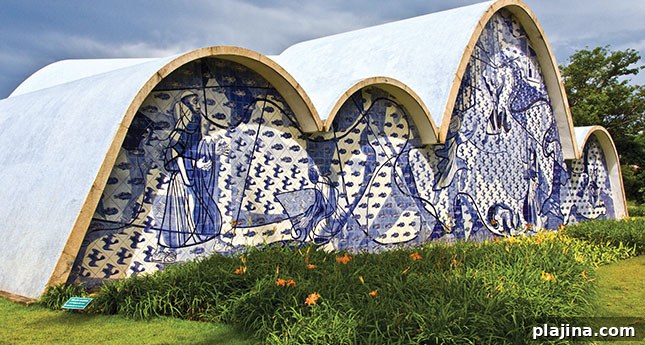
To explore Oscar Niemeyer’s early works, start in the park-lined suburb of Pampulha. The Church of St. Francis of Assisi, with its distinctive curved silhouette, reflects in the lake, while the former casino — now the Pampulha Museum of Art — hosts rotating exhibitions. Nearby, the Burle Marx sculpture gardens frame outdoor works, and the Pampulha Ecological Park is a pleasant spot for biking and weekend concerts.
In the city center, Edifício Niemeyer curves gracefully above Praça da Liberdade, a tranquil square with fountains and shaded paths. Across the square is the futuristic Museum of Mineralogy, home to a large collection of minerals. The Palácio das Artes, another Niemeyer landmark, anchors the edge of Parque Municipal and serves as the city’s principal complex for performing and visual arts. It includes galleries, theaters, exhibition spaces and an artisans’ shop featuring pottery, woodwork and jewelry made with native stones. The adjacent park has century-old trees, flower beds and an Orchidarium; in spring and summer, the Orchestra of Minas Gerais often performs free Sunday concerts here.
Praça da Estação hosts outdoor concerts and festivals, and the former train station now houses the Arts and Crafts Museum, which documents Brazil’s pre-industrial material culture. For a larger escape from the urban center, visit Inhotim in Brumadinho, an expansive contemporary art park set among landscaped gardens and ponds. Inhotim combines innovative architecture with large-scale installations and sculptures set across acres of grounds, offering a striking blend of nature and culture.
INFO TO GO
Tancredo Neves/Confins International Airport (CNF) is approximately 23 miles from Belo Horizonte. Taxi fares into town are about $40, while the frequent executive shuttle offers a lower-cost option near $10. A metro system connects major downtown points, making it simple to move around the city.