
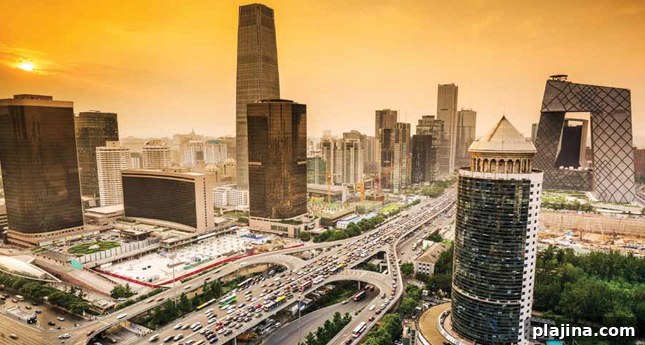
China’s capital has been transformed into a showcase of modern innovation and urban development. Located on the northern edge of the North China Plain, Beijing sits strategically near the port city of Tianjin and the resource-rich Hebei Province, and is framed by the Xishan and Yanshan mountain ranges.
Beijing’s importance as a political center dates back centuries. When Kublai Khan established the Yuan Dynasty, he made the city a capital, and Beijing has served as the national seat of power through most subsequent dynasties. One enduring legacy of China’s imperial past is the Great Wall, which traces the outskirts of the city and remains a powerful symbol of its history.
Today Beijing is home to some 21.1 million people representing China’s 56 ethnic groups, with a Han majority. Rapid population growth and urbanization have put pressure on planners, developers and residents to manage expansion while maintaining livability.
Economic growth in Beijing has been strong. By 2013 the city hosted hundreds of thousands of private enterprises, and its GDP accounted for a notable share of the national economy. Over the early 2000s and into the 2010s China’s national economy expanded rapidly, and Beijing’s diverse sectors helped drive that growth.
Service industries dominate Beijing’s economy, with finance, wholesale and retail trade, and information technology all playing significant roles. Scientific research and technical services have been among the fastest-growing areas, reflecting the city’s emphasis on innovation and knowledge-based industries.
Environmental challenges—especially air and water pollution—have shaped recent policy and development choices. New laws and regulations hold multiple industries accountable for pollution prevention, reduction and remediation. Efforts to protect groundwater have included plans to close thousands of urban wells, and authorities have shuttered some polluting factories in pursuit of cleaner air.
To promote renewable energy and build awareness, Beijing has launched initiatives like installing solar panels on school rooftops through the “Sunshine Schools” project. These installations provide clean power for schools, educate students about renewable energy and serve as visible examples of sustainable practice.
Young businesspeople embrace green transportation. © Shannon Fagan | Dreamstime.com
Yanqing County, in the city’s northwest, has developed into a low-carbon economic zone, investing in wind-solar hybrid plants, reforestation and wetland restoration to increase carbon absorption. Local initiatives such as the annual Climate Race promote green transportation and environmental protection. With expanded bike lanes and scenic routes near the Great Wall, Yanqing aspires to become a national model for cycling tourism.
Badaling Great Wall in Yanqing County © Bjmcse | Dreamstime.com
Many foreign companies based in Beijing offer flexible work hours to reduce congestion and lower pollution. Surveys show some firms have implemented staggered schedules for middle and senior staff to ease peak-hour traffic and emissions.
On the macroeconomic front, Beijing and international institutions recognize that slowing the pace of growth can be beneficial, allowing China to pursue structural reforms while maintaining stability. To improve transparency and accessibility, the government has committed to international data standards that make economic information easier for businesses to use.
A group of economic zones generates a substantial portion of Beijing’s output. One standout is Zhongguancun in Haidian District, known as China’s Silicon Valley. By the end of 2012 it hosted thousands of high-tech firms and employed a large, skilled workforce. The area benefits from proximity to leading universities such as Peking University and Tsinghua University, creating a strong pipeline of research and talent. Entrepreneurs and technology companies have flourished here, contributing to the city’s status as an innovation hub.
Tourism is another major pillar of Beijing’s economy. Millions of visitors come to the capital each year to experience its historical sites, cultural attractions and modern amenities. Large-scale projects and theme parks have been proposed or developed to capitalize on tourist demand, and major international couriers have expanded operations to serve the growing consumer market.
Beijing continues to chart a path of reinvention—combining tradition with high-tech development and sustainability efforts. How these strategies will play out over time remains to be seen, but the city’s drive toward modernization is unmistakable.
Things to Do in Beijing
Beijing is rich in history and culture. You can step into an emperor’s former residence, walk along ancient walls, or explore archaeological sites like Zhoukoudian, where Peking Man remains were discovered.
Forbidden City © Hungchungchih | Dreamstime.com
Visit Tiananmen Square, the vast plaza anchored by Tiananmen Gate and the imposing portrait that once marked the entrance to the Forbidden City. Many visitors come to the memorial hall on the square’s south side to pay respects to the founding leader of the People’s Republic.
Explore the Forbidden City through the Meridian Gate and then walk the inner and outer courts of the world’s largest palace complex, with more than 8,700 rooms. The sprawling compound served as the political and residential center for emperors of the Ming and Qing dynasties until 1912.
The nearby Temple of Heaven, set within a large park, is a lively community hub where locals gather to dance, play cards, exercise and socialize. Historically, emperors visited the temple to pray for bountiful harvests; today it’s prized for its architecture and public atmosphere.
The Temple of Heaven © Zoom-zoom | Dreamstime.com
No trip to Beijing is complete without seeing the Great Wall. Sections like Badaling are popular for visitors and are supported by renovated facilities, shops and restaurants. Trails vary in difficulty—some routes have steep, uneven steps, so wear sturdy shoes and choose a section that matches your fitness level.
CHECKING IN WITH MICHAEL HENSSLER
President, China, Kempinski Hotels
What’s going on in Beijing, and what are the current hot topics?
Beijing is a city in constant motion, hosting major international events and pursuing sustainable growth. Discussions focus on managing rapid change, implementing sustainable policies and preparing for large-scale global meetings.
What does Beijing offer business travelers?
The city provides extensive infrastructure for conferences and events: modern airports, hotels and convention facilities, plus many leisure options for downtime. Nearby attractions such as Yanqi Lake and the Summer Palace offer pleasant escapes between meetings. There are also many value options for travelers on a budget.
What’s new on the hotel scene?
New domestic luxury brands are emerging, aiming to reflect authentic Chinese design and hospitality. The launch of flagship properties will help define the next chapter in Beijing’s hospitality market.
What do you recommend seeing and doing while in Beijing?
Allow ample time to explore—traffic and sheer variety of attractions mean one visit won’t cover them all. Try Beijing duck, visit museums and historical sites, and enjoy the nightlife and street food in areas like Sanlitun.
How has Beijing changed in the time you have known it?
Beijing has evolved rapidly, continually adapting and modernizing. Despite constant change, it remains a compelling city full of activity and potential.
Beijing: Just the Facts
Time Zone: GMT +8
Phone Code: Country code 86, City code 10
Currency: Renminbi (yuan)
Entry/Exit Requirements: U.S. citizens require a passport valid for at least six months and a visa to enter China; short-term tourist and business visas are commonly used.
Official Language: Mandarin
Key industries: automobiles, chemicals, electronics, finance, household appliances, machinery, real estate, retail and tourism.
Beijing Info to Go
Beijing Capital International Airport lies roughly 18 miles north of downtown. Taxis to the city center typically take 40 minutes to an hour, depending on traffic, and fares vary by meter. The Capital Airport Subway Line connects the airport to central stations in about 20 minutes and is a convenient option for travelers.
Where to Stay in Beijing
East, Beijing Located about 15 minutes from the airport, this 25-story business hotel offers shopping, a cinema and dining. Guestrooms provide modern conveniences and the hotel offers complimentary Wi-Fi. 22 Jiuxianqiao Road, Chaoyang District
Four Seasons Beijing A luxury property near the Third Embassy Precinct, featuring a skylit atrium and rooms that blend contemporary and traditional design. 48 Liang Ma Qiao Road, Chaoyang District
Sunrise Kempinski Hotel, Beijing A striking 21-floor hotel on an island overlooking Yanqi Lake, notable for its design and service. 18 Jia Yanshui Road, Yanqi Lake, Huairou District
Restaurants in Beijing
Brasserie Flo Beijing A French-style brasserie offering à la carte and multi-course menus, with English-speaking staff. 18 Xiaoyun Road, Chaoyang District
Najia Xiaoguan Known for pork belly dishes served in a beautifully preserved courtyard once associated with a Qing Dynasty imperial physician. 10 Yonganli, Jianguomenwai Dajie, Chaoyang District
Wangfujing Roast Duck Shop Famous for its roast duck preparation, served in a setting adorned with traditional decor and an open roasting kitchen. 45 Wangfujing St., Dongcheng District