
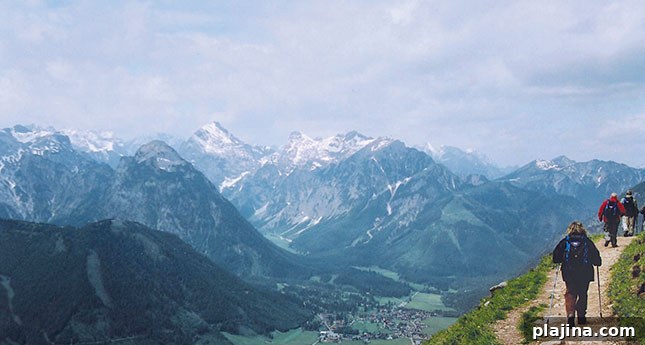
Steep, stony, narrow — and at times unnerving. The trail to Rinnenspitze, a 9,900-foot summit in the Austrian Alps, proved far more demanding than we expected. What began as a hike quickly turned into serious scrambling over unstable rock. The final section was fitted with safety cables to hold onto while negotiating narrow ledges. The stones shifted underfoot, a classic case of rock scrambling that felt more like risky roulette than a casual walk.
All fear and fatigue vanished the moment we reached the summit. The view opened into a panorama of jagged peaks, some streaked with glacier ice. Standing there, surrounded by the high alpine world, we tasted that rare combination of triumph and calm that only a mountain top can deliver.
During the years we lived in Germany, my husband and I often crossed the border into Austria for summer adventures. Austria’s landscapes invite more than hiking: bicycling, glacier skiing, sailing, kayaking, canoeing, rafting and fishing are all popular. Golfers tee off on courses framed by dramatic scenery, and riders follow superb trails through high meadows and forested valleys.
Our ascent of Rinnenspitze was part of a weekend trek that included an overnight at the Franz Senn Hut and a second-day climb of Asperer Turm (9,688 feet). The Franz Senn Hut felt almost luxurious by Alpine-hut standards, offering hot and cold running water, indoor toilets and showers. Many mountain huts are far spartan — dormitory bunks or Matratzenlager (mattress rooms) with shared blankets and limited privacy — so a semi-private room was a welcome treat.
Evenings in huts have their own special atmosphere. After a hearty alpine meal, hikers gather around long tables to swap stories, sing and share music. It’s common to find a guitar and someone who can play familiar tunes while the group links arms and laughs long into the night.
The Asperer Turm route rose along a surging stream through a broad valley where cows grazed lazily. The path climbed past dirty glacier edges into loose rock and gravel, and the final stretches narrowed to exposed paths with steep drop-offs. The nervous energy transformed into awe at the summit’s sweeping views. On that six-hour round trip we encountered only four other hikers — a reminder of how solitary and expansive the mountains can feel.
Austria boasts some 25,000 miles of hiking trails and 241 mountain huts, accommodating walkers of every ability. Less active visitors can ride chairlifts or mountain trains to summits, enjoy short walks and take in the views. Day hikers or long-distance trekkers can carry backpacks and spend nights in huts or campsites. For experienced climbers, glaciers and pinnacles offer technically demanding terrain that requires ropes, crampons and ice axes. For those who prefer company or added safety, local guides and organized groups are widely available.
“Hiking and mountaineering are good — good for the body, the heart, the mind,” says mountain climber Peter Habeler, who runs a mountaineering school in Austria. We hiked part of the Eagle Trail, a 173-mile route in the Tyrolean Alps near Innsbruck, with Habeler as our guide. We began by taking a cable car, then followed a gentle trail with sweeping views of the Achensee, Tyrol’s largest mountain lake. Passing cozy huts beneath towering peaks, Habeler reminded us that hiking is deliberately unhurried — a counterpoint to modern fast living and a clear way to discover new horizons.
Bicycling in Austria opens equally enticing routes. The country features about 6,250 miles of signed cycling paths, mostly on paved lanes or quieter roads. Our first tour was the 175-mile Salzkammergut route east of Salzburg, a three-and-a-half-day ride. We took a cable car to reach our first hotel, ferried our bikes across a lake, and explored the region’s cultural highlights: the imperial residence at Bad Ischl, the lakeside charm of St. Wolfgang and the postcard-perfect village of Hallstatt.
On sections of the Tauern route south of Salzburg we carried gear in panniers for three days of pedaling through the Hohe Tauern National Park, a landscape of glaciers and alpine peaks. The route continues north through Salzburg to Passau on the German border. While it includes steep climbs, Austria’s bike-friendly trains make it easy to bypass the toughest sections.
The Mozart route traces places connected to the composer’s life across Austria and Germany. We pedaled much of the 250-mile loop, starting in Salzburg, and enjoyed rolling valleys, mountain views and lakes. The route combines scenic riding with rich cultural stops. Had time permitted, we would have taken the themed bicycle tour in Salzburg that highlights locations from The Sound of Music.
The Danube cycle route is perhaps the most famous: beginning upstream in Germany and following the river through Austria to Budapest. The Austrian stretch runs roughly 210 miles from Passau to Vienna and is widely regarded as easy, scenic riding — ideal for long-distance cyclists and families alike.
For off-road riders, mountain biking networks provide marked singletrack and trails. Montafon in western Austria, for example, maps some 500 miles of routes with color-coded signage to indicate difficulty levels. Rental shops in towns along the routes make bikes of all kinds accessible, and organized tours or luggage-transfer packages simplify multi-day trips.
Austria’s waters — roughly 9,000 lakes, along with countless rivers and streams — are a playground for aquatic sports. Crystal-clear lakes invite sailing, swimming, kite-surfing and even scuba diving. Rivers offer paddling options from relaxed float trips to adrenaline-fueled whitewater. Most rapids fall in Class II or III, suitable for enthusiastic novices with a guide, though more challenging Class IV and V sections exist for experienced paddlers.
On guided rafting trips you’ll be outfitted with a wetsuit, boots, spray jacket, personal flotation device and helmet. As rapids approach, the raft surges and plunges, tossing riders in every direction; you’ll get soaked, but the combination of speed, teamwork and scenery makes for a memorable experience.
Summer glacier skiing remains a unique offering in Austria. Eight ski areas maintain glacier slopes — Kaprun, Hintertux and Stubai among them — where you can step from a cable car onto sunny slopes at 9,000 feet. Conditions tend toward easy-to-intermediate runs; the atmosphere is relaxed and beach-like, with short ski days that often finish by early afternoon as the sun softens the snow. After skiing, many visitors sunbathe, sip a cold drink and sometimes take a refreshing dip in a nearby lake.
Horseback riding is well supported across Austria, from short scenic rides to multi-day treks through forests and villages. Riding centers in places like Zell am See arrange excursions on hardy mountain breeds such as the Haflinger, offering a tranquil way to absorb alpine vistas.
Golfers will find Austria’s 152 courses noteworthy for quality and setting — parkland fairways near Vienna and alpine layouts framed by towering peaks. Many enthusiasts praise the country as offering some of the most beautiful golf courses in Europe.
Info To Go
International air connections to Vienna, Zürich and Munich make Austria accessible; domestic flights to Innsbruck and Salzburg are also available. Trains provide excellent coverage for travel within the country, while rental cars offer added flexibility for reaching remote trailheads and lakes. For official travel information and practical planning details, consult Austria’s national tourism resources.