
For five millennia Athens has adapted to the shifting needs of civilization. While monumental ruins such as the Acropolis remain a constant, the city itself has continually grown and reinvented itself. Guided by a history of innovation and cultural exchange, modern Athens is embracing new approaches to urban life that prioritize wellbeing, sustainability and resilience.
One of the most ambitious examples of this transformation is the urban regeneration project known as The Ellinikon. Already reshaping the city’s coastline, this large-scale development aims to become a global model for sustainable, mixed-use urban living.
The Ellinikon is the largest development project in Greece’s history and one of the most significant in Europe. Led by Lamda Group, it will be a city within a city: a smart, mixed-use district that integrates nature, daily life and cutting-edge technology to support residents, visitors and the environment.
When Lamda Group acquired the site from the Greek government in 2014, the 1,500-acre area along the Athenian Riviera was a patchwork of derelict buildings and historic structures. The land had hosted Athens’ first airport (opened in 1938), served as an airbase during World War II, accommodated U.S. military facilities after the war, provided shelter for refugees and even hosted events during the 2004 Olympic Games.
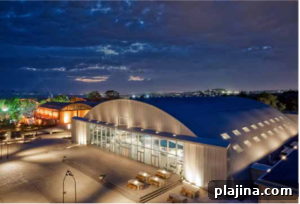
© SASAKI
When construction began in 2021, the site included more than 400 buildings. Most will be removed, while a select few will be preserved and repurposed—three historic airplane hangars are notable examples. One hangar currently operates as the Experience Centre, an interactive venue that introduces visitors to the project’s technologies and planning strategies. Eventually all three hangars will become cultural venues celebrating the site’s history and Greek heritage.
Materials from demolished structures are being processed on-site for reuse across the development. Reclaimed concrete has been transformed into new walkways and sculpture gardens within the Experience Park, a precursor to the larger 600-acre Ellinikon Park that will form the heart of the project.
Careful material reuse and extensive site remediation are central to The Ellinikon’s environmental strategy. The former airport lands are undergoing soil and groundwater assessment and treatment to meet strict safety and ecological standards. The master plan includes facilities for composting and water treatment, ensuring the site meets modern environmental requirements.
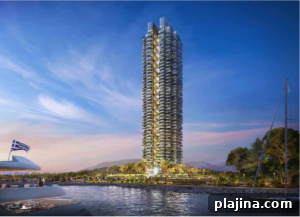
PHOTO: © DBOX
Green space will dominate: 70 percent of the development is dedicated to parks and planted areas. Buildings will employ bioclimatic architecture, including Riviera Tower, a 600-foot residential skyscraper with 50 floors and sustainably designed suspended gardens. Extensive greenery will help lower urban temperatures, reduce air pollution and strengthen residents’ connection to nature.
The full build-out is expected to take roughly 25 years and will be delivered in phases. The master plan includes private residences, conference facilities, luxury hotels, retail districts, schools and healthcare services, sports facilities, cultural venues, indoor and outdoor entertainment, a public beach, a marina and a casino. The initial phase, begun in 2021 and due to become operational in stages by 2026, includes a People With Disabilities Building—a pioneering facility for Greece—scheduled to open this summer.
Innovative infrastructures are woven throughout the plan to improve efficiency and sustainability. The development will feature Greece’s first smart park, integrated connectivity, augmented-reality navigation and advanced energy systems. A trailblazing smart irrigation network will treat and reuse sewage water for landscape irrigation. Ancient streams that were once blocked will be restored and paired with modern drainage to manage heavy rainfall and protect the site.
The Ellinikon will prioritize walkability and low-carbon mobility: 30 miles of pedestrian and bicycle paths and a tram will connect the waterfront to inland sections, creating a 15-minute city where most daily needs are accessible within a short walk or ride. Tram lines will also link the development to the wider Athens transit network for seamless integration.
Planting plans emphasize native species adapted to hot Athenian summers. More than 2,000 trees present before construction began have been moved to a nursery for safekeeping and will be returned as landscaping progresses. The roughly €8 billion development is financed primarily by private investment and strategic partners, supplemented by instruments such as a €230 million green bond issued in 2022. Economically, The Ellinikon is expected to generate 10,000 temporary construction jobs and up to 75,000 permanent positions when complete.
As The Ellinikon unfolds over the coming decades, it will leave a lasting imprint on Athens’ urban fabric. Nearby neighborhoods are already upgrading infrastructure to connect to the development, and the broader economy is beginning to feel the benefits. The project offers an example of how cities can plan comprehensively for the future—improving quality of life while addressing environmental and economic challenges.

PHOTO: © LAMDA DEVELOPMENT
CHECKING IN WITH MELINA PAIZI
Chief Development and Investment Portfolio Officer, Lamda Development
As The Ellinikon changes the face of the city, how will it impact Greece’s economy?
Our vision is for The Ellinikon to generate broad benefits and mark a new era for Greece. This €8 billion project is projected to contribute as much as 2.4 percent to national GDP over time and provide significant tax revenues to the state. The development aims to support an inclusive economy through job creation and training, boosting Greece’s investment profile and serving as a major driver of growth at both national and local levels.
What types of commerce will Athens attract with The Ellinikon?
The Ellinikon’s retail and leisure districts are designed to deliver a contemporary retail experience across high-end and mid-range segments, attracting both local residents and international visitors. Planners estimate more than a million tourists and many millions of visitors in the development’s initial years. Several prominent food, beverage and lifestyle brands have already committed to locations within the project.
At over 185,000 square meters, the Commercial Hub—designed by Aedas—will be the largest mall in Greece and aims for LEED Gold certification, a first for Greek retail. Conceived as a future-facing shopping and entertainment destination, it seeks to raise standards for consumer experience, brand performance and investor returns while supporting community engagement and sustainability-led design.
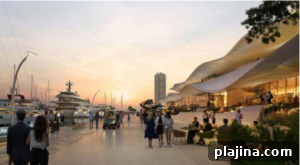
© BLOOMIMAGES
Riviera Galleria, designed by architect Kengo Kuma, will be a coastal destination for premium and accessible brands near the new residential district. It will host boutiques, haute couture and high-street fashion, alongside waterfront dining with sea views. The venue is planned to host cultural programming, music events and exhibitions, offering both inspiration and entertainment. Riviera Galleria has achieved LEED Gold precertification as part of its sustainability commitments.
Did any global projects inspire The Ellinikon?
The Ellinikon draws inspiration from a global imperative to rethink urban life in response to climate change. While it stands as a landmark for Greece and Europe, the project is primarily shaped by local context and the urgent need to create sustainable, resilient urban environments. Its scale and ambition aim to make Greeks proud and offer a model that can inspire other cities.
DIVERSIONS
Athens is rich in history and offers world-renowned sights. Visiting the Acropolis provides panoramic views of the city and an opportunity to explore one of the most important archaeological sites in the world. Nearby, the Acropolis Museum displays many artifacts discovered on the slopes of the hill, with glass-floored exhibits and an open-air area that reveals excavated ancient neighborhoods uncovered during the museum’s construction.

© WITOLD RYKA | DREAMSTIME.COM
A scenic drive along the Athenian Riviera leads to the Temple of Sounion, a dramatic coastal sanctuary dedicated to the god Poseidon. Perched on a cape overlooking the Aegean Sea, the site is an ideal place to pause from city life and enjoy spectacular sunsets.
LODGING
A for Athens
Located in the heart of Monastiraki, this stylish hotel offers views of the Acropolis and a rooftop bar that overlooks the city.
2-4 Miaouli St., Monastiraki, Athens
$$$$
Four Seasons Astir Palace Hotel
Set on a wooded peninsula along the Athenian Riviera, Astir Palace is a tranquil retreat from the city’s energy.
40 Apollonos St., Vouliagmeni, Athens
$$$$$
Hotel Grande Bretagne
A landmark property serving visitors since the 19th century, this hotel occupies a prime location adjacent to Syntagma Square, the Hellenic Parliament and the Tomb of the Unknown Soldier.
1 Vasileos Georgiou A’ St., Syntagma Square, Athens
$$$$$
DINING
Delta
Delta focuses on sustainability and creative gastronomy, offering multi-course tasting experiences crafted by leading chefs.
364 Syggrou Ave., Kallithea, Athens
$$$$$
Dopios
Led by Chef Christoforos Peskias, Dopios serves inventive Greek meze with strong vegetarian and vegan options.
1 Skouleniou, Platia Agion Theodoron, Athens
$$–$$$
Orizontes
Perched on Lycabettus Hill, Orizontes serves traditional Greek dishes on a terrace with sweeping city views that include the Acropolis and the Aegean beyond.
1 Aristippou, Lycabettus, Athens
$$$–$$$$$
JUST THE FACTS
Time zone: GMT +2
Phone code: Country code 30, city code 210
Currency: Euro
Key industries: Tourism, agriculture, shipping and mining
COMING AND GOING
U.S. citizens entering Greece should carry a return ticket and a passport valid for at least six months. No tourist visa is required for stays under 90 days.
OFFICIAL LANGUAGE
Greek
INFO TO GO
Eleftherios Venizelos (Athens International Airport) serves more than 150 destinations and is well connected to the city by frequent bus routes and the Metro Blue Line (Line 3). Multiple bus routes link the airport with central Athens and the nearby port of Piraeus, while the metro provides direct, efficient access to downtown and connections to other lines for neighborhood access.