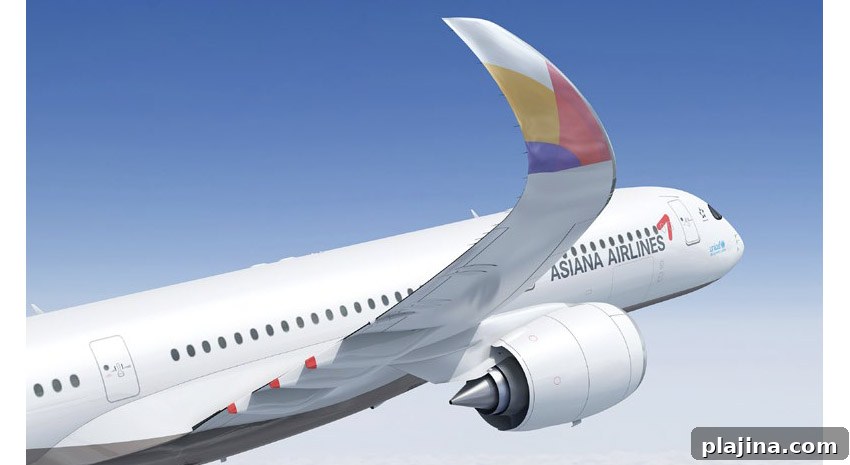
THE MERE THOUGHT OF STARTING a new airline is daunting enough; keeping it operating and growing for three decades is an even greater challenge. Despite the obstacles, Asiana Airlines has done exactly that.
Founded in 1988 as Seoul Air International, Asiana Airlines was created to introduce competition into a Korean market long dominated by Korean Air. From the start, the airline pursued a strategy of service quality over price competition, operating relatively new aircraft and focusing on passenger experience. Initially serving domestic routes from hubs in Seoul and Jeju, Asiana expanded quickly, launching flights to four Japanese destinations within 18 months.
By early 1991 Asiana had added international destinations including Taipei, Hong Kong, Bangkok and Singapore. That November it inaugurated a combined passenger and freight service to Los Angeles using a Boeing 747, and by the end of 1992 the carrier had also launched routes to San Francisco and New York.
The airline faced serious challenges along the way. In July 1993 a Boeing 737 crashed on the Korean coast, resulting in fatalities. Later in the decade, the Asian financial crisis heavily impacted both Asiana and Korean Air; in 1997 Asiana reported a significant loss and, like its competitor, sold aircraft to reduce debt. Despite these setbacks, Asiana persevered, continually improving service and operations to maintain its place in the market.
Recognition followed Asiana’s sustained effort to raise standards. In 2009 Air Transport World named Asiana Airline of the Year. In May 2010 Skytrax ranked Asiana among the world’s best airlines, and the carrier currently holds a Skytrax 5-Star rating. Skytrax evaluates airlines on a unified scale from one to five stars based on product and service quality in both onboard and airport environments.
2017 was a particularly active year. In April Asiana entered a codeshare partnership with Hong Kong Airlines to increase options between Hong Kong and Seoul. That same year Asiana received its first Airbus A350-900 aircraft, becoming the 12th operator of the type. The A350-900 operates in a three-class layout with 311 seats and introduced Asiana’s Economy Smartium product—36 economy seats offering an additional three to four inches of seat pitch, larger overhead bins, a travelers’ kit and the option to upgrade for a fee per sector.
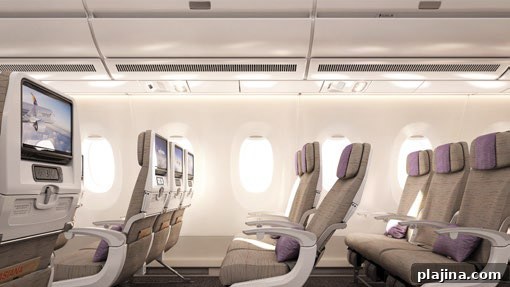
Airbus A350 interior © ASIANA AIRLINES
Also in 2017 Asiana selected Panasonic Avionics’ eX3 inflight entertainment and connectivity system for its A350 fleet. The platform provides audio and video on demand, a broad content library and global connectivity so passengers can access the internet and communicate while airborne where services are available.
Asiana has promoted environmental stewardship for more than two decades. It banned in-flight smoking in 1995 and earned ISO first-in-class certification in 1996. In 2001 South Korea’s Ministry of Environment recognized Asiana as the first environmentally friendly company in the service industry. The airline’s initiatives include emissions measurement and reduction, minimizing pollution at ground facilities and partnerships—such as with the Rainforest Alliance—for sustainably sourced onboard coffee.
To improve operational efficiency and passenger comfort, in June 2017 Asiana selected Honeywell auxiliary power units to provide ground power and air conditioning during boarding. These systems help reduce maintenance costs and deliver fuel savings across the fleet lifecycle.

Airbus A380 dressing room © ASIANA AIRLINES
In January 2018 Asiana formed a 30-year joint venture with gategroup, a global leader in airline catering, retail and onboard solutions. The partnership aims to enhance onboard food and retail services, lounges and logistics by co-designing offerings tailored to Asiana’s passengers and staying aligned with industry trends.
Shortly after, Asiana signed a codeshare with Croatia Airlines to strengthen connections between Croatia and South Korea. In 2018 the carrier added Venice to its network and planned further European expansion with Barcelona. To increase efficiency on shorter routes, Asiana began introducing fuel-efficient Airbus A321neo aircraft into its fleet.
Looking ahead, Asiana’s leadership has emphasized preparing for the next 30 years with a modern, long-range fleet and a strategy focused more on long-haul routes. The airline plans to reduce exposure on highly competitive short-haul Asian routes dominated by low-cost carriers and prioritize services beyond the continent. Starting with two additional A350s in 2018, Asiana aimed to acquire up to 32 widebody aircraft and expand long-distance routes to 19 by 2022, with long-haul operations expected to represent the majority of its flights in the long term.