
The Boeing final assembly factories near Seattle, Washington—two of the world’s largest structures by volume—are as impressive as the airplanes that emerge from them.
I visited one of those assembly plants in September, just weeks before the long-awaited Boeing 787 Dreamliner made its first commercial flight. Walking the vast factory floor, it was easy to see why such a sophisticated aircraft— a wide-body, twin-engine jet composed of tens of thousands of parts supplied by more than a dozen companies across multiple countries—could fall behind schedule. Building a modern airliner is a complex undertaking.
The Dreamliner is no ordinary plane. Largely constructed from lightweight composite materials, it represents a major leap in aircraft design and engineering. Despite repeated delays and more than 60 canceled orders during development, the 787 remains one of the most in-demand passenger jets in aviation history.
Even before its maiden commercial flight—All Nippon Airways Flight 7871 from Tokyo to Hong Kong—the Dreamliner had accumulated a record 821 orders, a backlog valued at roughly $150 billion. Major customers included ANA, United Airlines, Qantas and Air Canada. Boeing has been racing to meet that demand ever since.
“It’s going to be well worth the wait,” Qantas chief executive Alan Joyce said at the Dreamliner’s Australian debut, calling the airplane a “game changer.” The aircraft’s composite construction slowed production, but it is central to the 787’s main advantages: roughly 20 percent better fuel efficiency compared with a similarly sized aluminum jet, longer range, and the ability for airlines to retire older, less economical aircraft.
In an industry sensitive to fuel costs and intense competition, those gains translate directly to lower operating costs and stronger route economics. The improved efficiency also helps airlines pursue environmental goals agreed to at the 2009 United Nations Forum on Climate Change, including incremental carbon reductions and long-term commitments to limit the industry’s net emissions.
Composites contribute more than fuel savings. They are lighter and stronger than aluminum, easier to shape, and tend to require less maintenance—approximately 30 percent lower maintenance costs in some comparisons. For passengers, composite construction enables a more resilient airframe and the opportunity to maintain cabin pressure at levels closer to those on the ground, which can reduce fatigue and discomfort on long flights.
The 787 also incorporates advanced environmental systems: an air purification system that refreshes cabin air more frequently, a climate control system designed to reduce dryness, modestly higher cabin oxygen levels to aid breathing, and LED lighting that shifts hue to reflect the time of day—all intended to improve passenger comfort on long routes. Those features, combined with a list price in the neighborhood of $193 million, have contributed to the airplane’s premium reputation.
Visually and technically, the Dreamliner offers unmistakable innovations: its gracefully curved wings with extended raked tips, distinctive serrated engine nacelles for noise reduction, and a sculpted tail. Aviation enthusiasts often respond to such details with visible excitement.
When aviation blogger David Parker Brown flew on a 787 from Tokyo’s Narita Airport, he described the experience with near-childlike enthusiasm. From the oversized windows made possible by the composite fuselage to the bowed wings and the throaty but refined sound of the Rolls-Royce Trent 1000 engines, the flight highlighted many of the aircraft’s next-generation attributes. Those engines are a major contributor to the 787’s fuel-efficiency gains and significantly lower the plane’s noise footprint—by as much as 60 percent versus comparable jets—thanks to advanced inlet and nozzle designs and a high bypass ratio.
Another hallmark of the 787 is its “more-electric architecture,” which shifts many systems from pneumatic or hydraulic power to electrical power. That approach enables several new capabilities and efficiencies. Examples include an electro-thermal wing ice protection system that is more energy-efficient than conventional pneumatic systems; an active gust alleviation system that uses wireless sensors to detect turbulence and adjust control surfaces; and integrated airplane health-monitoring systems that detect maintenance needs and communicate them to ground-based systems.
These systems combine to deliver a quieter, smoother and more reliable flying experience for passengers and operators.
Many of the Dreamliner’s technical advances go unnoticed by most travelers—benefits that are felt rather than seen. Subtle aerodynamic refinements, such as a carefully controlled paint thickness on engine inlets to preserve laminar flow and reduce drag, quietly contribute to fuel savings and efficiency even if passengers never detect them. The transition from aluminum to composite construction is less visually dramatic for the average flyer than earlier shifts in aircraft technology, but its effects are significant.
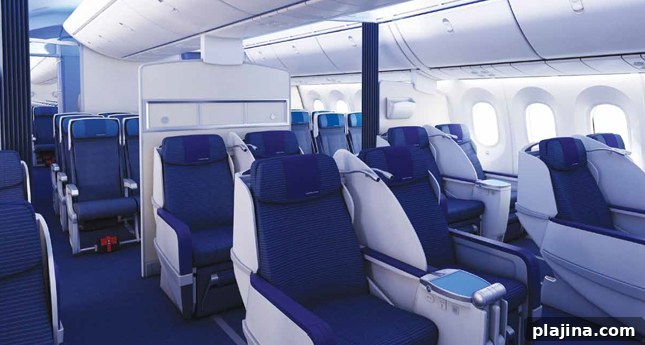
Other features are immediately apparent to passengers. The 787’s in-flight entertainment system runs on Android-based servers and offers a range of screen sizes. Economy-class seats feature touchscreens and include laptop power outlets and USB ports. Overhead bins are larger, seats provide more headroom, and the seat recline mechanism slides seats forward instead of reclining into the space of the passenger behind. The windows are notably larger—approximately 11 by 19 inches, about 65 percent larger than typical industry windows—and use an electrochromic dimming system in place of traditional pull-down shades.
Some amenities draw playful attention: Flightglobal’s Jon Ostrower noted features like hands-free toilet seats and automatic flushers—small but illustrative examples of how designers are rethinking passenger convenience.
Boeing’s history provides context for the 787’s importance. The company defined the Jet Age with the 707 in the late 1950s and dominated commercial aviation for decades before Airbus gained a leading market position in the early 2000s. After a period of setbacks and strategic challenges, Boeing sought a comeback with the 7E7 project that became the Dreamliner. Strong order books and renewed market interest signaled a recovery for the company and kept competitors on notice.
Despite prolonged development and delivery delays that tested patience across the industry, the Dreamliner has entered service and begun to reshape airline operations with improved efficiency, passenger comfort and environmental performance. If industry experts are correct and the 787 represents a new direction in commercial aviation, that future is already underway.