
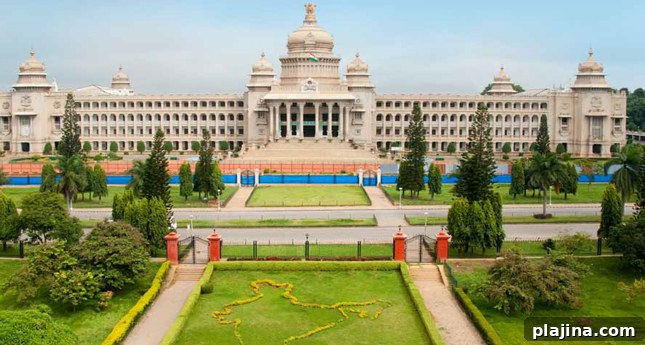
Some countries have leapt into the future by sweeping away much of their cultural and architectural past. India, however, is vast, ancient and deeply rooted in tradition, so its modernization often happens by layering the new on top of the old. Nowhere is this contrast more striking than in Bangalore.
Perched on the rocky Deccan Plateau in Karnataka, Bangalore’s dramatic transformation accelerated in the 1990s when the city positioned itself as a hub for high technology. As electronics and IT companies arrived, a supporting network of service firms emerged. Growth compounded quickly, and Bangalore became known as “India’s Silicon Valley.”
The city’s rise had global effects: IT professionals in developed countries found jobs being shifted to highly skilled, lower-cost workforces in Bangalore’s modern business parks. Tech talent from across India now converges on the city: roughly 44 percent of new arrivals bring technical skills, outpacing the San Francisco Bay Area. Bangalore’s talent pool expands by an estimated 26,500 people each year, attracting established companies and startups alike. At current rates, the city was projected to have more than two million tech workers by 2020.
Today Bangalore is one of India’s most cosmopolitan and economically advanced cities, with a GDP in the tens of billions and steady projected growth. Its rapid evolution has reshaped demographics: once a stronghold of Kannadiga culture and the Kannada language, the city is now multicultural and multilingual. Immigrants from other Indian states account for roughly half the population, and a sizeable expatriate community also calls Bangalore home.
Success has brought challenges. The population nearly doubled after 2001 and now exceeds 10 million, straining infrastructure. Traffic congestion is notorious—IBM’s Commuter Pain Index ranked Bangalore among the worst cities in the world for commuters—and drivers are estimated to lose billions of man-hours annually in jams. Construction of the Namma Metro (meaning “Our Metro”) began to address this: the first phase opened in 2011 and additional lines have steadily added air‑conditioned, rapid alternatives on key routes, though construction has temporarily worsened traffic in some areas.
Power supply has struggled to keep pace with growth, so rolling outages and widespread use of standby generators are common. Authorities have signaled a shift toward renewables in coming years, but for now energy remains a concern. Air pollution and water scarcity also pose serious challenges; parts of the city record pollution levels well above national limits, and studies have warned of groundwater contamination and future shortages if resource management does not improve.
Bangalore’s modern boom is rooted in a landscape with millennia of human occupation. Archaeology shows habitation in the region dating back around 6,000 years, and successive dynasties left visible traces. Finds such as ancient Roman coins reveal long-standing links between the region and international trade, so the city’s present-day global role echoes older patterns.
Traveling through Bangalore—often while stuck in traffic—reveals a city of vivid contrasts. Shiny glass-and-steel towers rise beside crowded markets and narrow streets that feel centuries old. Luxury sedans share lanes with auto-rickshaws, hand-pulled carts and the occasional roaming cow. The result is a rich, sometimes chaotic tapestry that exemplifies contemporary India.
Names reflect that colonial and cultural layering. In a push to shed colonial-era labels, many Indian cities were renamed: Bombay became Mumbai, Calcutta became Kolkata, Madras became Chennai. In 2007, Bangalore was officially renamed Bengaluru, a Kannada-derived name meaning “town of boiled beans.” Some businesses and institutions adopted the new name, while others retained the familiar “Bangalore” because of its global recognition.
Bangalore can be infuriating and exhilarating, ancient and modern, bureaucratic and opportunity-filled, confusing yet welcoming. It captures many of India’s contradictions and energies in one evolving urban landscape.
Things to do in Bangalore
For first-time visitors, Bangalore can be a sensory overload. Crowds, noise and unfamiliar norms demand alertness. Early on, you are more vulnerable to scams and accidents: sidewalks are often uneven and road crossings require vigilance because traffic flows unpredictably. Use official taxis at first and, once comfortable, three-wheeled auto-rickshaws provide an inexpensive option—always agree the fare in advance and decline detours to shops recommended by drivers.
At the city’s heart is Cubbon Park, a leafy British-era public garden established in 1870. With walking paths, shaded lawns and a boating lake, it serves as a social and recreational hub where locals gather. South of the center lies Lalbagh Botanical Gardens, commissioned in 1760 by Hyder Ali, which hosts one of India’s largest collections of rare plants and a famous glasshouse.
Historic sites include remnants of Bangalore Fort, largely demolished by the British after an 18th-century siege; parts of the main gate and ramparts remain. Near the fort is Tipu Sultan’s Palace, an evocative wooden structure from the late 18th century. Bangalore Palace, a turreted, ivy-clad estate north of the downtown area, showcases Victorian Tudor-style architecture and often hosts major concerts and events.
The Bangalore Government Museum offers collections on regional history, art and natural history, while the nearby Venkatappa Art Gallery displays the work of early 20th-century artists. Aviation enthusiasts should visit the HAL Heritage Centre and Aerospace Museum near the old airport to view vintage aircraft and aviation exhibits.
Outside the city, Nrityagram—about 20 miles northwest—is a residential dance school focused on classical Indian dance; visitors can arrange tours and performances by contacting the school in advance. A three-hour drive southwest lies Mysore, known for its lavish Amba Vilas (Mysore Palace) and a railway museum with the maharaja’s historic carriages. Further afield, Bandipur National Park, accessed via Mysore, is a renowned wildlife reserve home to elephants, leopards, sloth bears, dholes and tigers.
Checking in with Olivia Godeluck
Director, Sofies – India, an international consulting firm specializing in sustainability
What brought you to Bangalore?
I arrived in February 2006 for an internship to learn about microfinance on the ground. Nearly a decade later, I remained engaged in the city’s development.
How has the city changed in the time you’ve known it?
Bangalore changed dramatically. When I arrived it had five to six million people and movement around the city was relatively easy. Lakes and parks felt more dominant. Over ten years, population growth outpaced infrastructure: parking is difficult, travel is challenging, and high-rise towers have proliferated where low-rise buildings once stood.
What cultural differences should foreign investors be aware of?
Flexibility, curiosity and respect for local culture are essential. Many opportunities lie in India’s domestic market, so adapting to local needs rather than imposing external models is key. Working here is also an opportunity to learn about yourself and how to engage with a dynamic society.
What developments do you foresee for Bangalore’s future?
Sustainability is the central challenge. Infrastructure lag has made commuting harder and has widened social divides as gated enclaves emerge. Continued construction and longer commutes—already a concern—may further affect quality of life unless planners prioritize equitable, sustainable solutions.
Bangalore Info to Go
International and domestic flights land at Kempegowda International Airport, about 25 miles north of the city center. Taxi fares to central hotels run roughly $12 and travel time is 40–60 minutes depending on traffic. The older HAL Bangalore Airport near downtown is still used for general and business aviation.
Bangalore: Just the Facts
Time Zone: GMT +5 hours, 30 minutes
Phone Code: Country Code: 91 City code: 80
Entry/Exit Requirements: Visitors require a valid passport and visa; obtain visas from Indian diplomatic missions or authorized visa agencies before travel. Visa rules change frequently.
Currency: Indian rupee
Official Language: Kannada remains the regional language, though Hindi and English are widely used; English serves as the primary language of business.
Key Industries: Information technology, biotechnology, aerospace, electronics, automotive manufacturing, floriculture
Where to Stay in Bangalore
Escape Hotel & Spa Located on 100 Feet Road in Indiranagar, this contemporary hotel blends modern design with Indian touches. 770, 100 Feet Road, Indiranagar $$$
The Leela Palace Bangalore Set in nine acres of gardens, the Leela offers opulent rooms and modern amenities. 23 HAL Airport Road $$$$
The Taj West End A historic hotel dating to 1887 that combines colonial charm with modern comforts. 25 Race Course Road $$$$
Restaurants in Bangalore
Dakshin Located in ITC Windsor, Dakshin specializes in rich and spicy South Indian cuisine. ITC Windsor, Bengaluru; 25 Windsor Square; Golf Course Road $$$
Karavalli Set in the Gateway Hotel gardens, Karavalli features coastal cuisine with a strong seafood focus; some dishes are served on banana leaves. The Gateway Hotel, 66 Residency Road $$$
Sunny’s A long-standing local favorite with an international menu emphasizing pizza and pasta. 50 Lavelle Road $$