
At just 101 years old, Finland is a comparatively young nation. For much of the last millennium it belonged to the Kingdom of Sweden, and during the 19th century it was part of the Russian Empire until declaring independence in 1917. Both Swedish and Russian influences have left lasting marks on Finnish culture, especially visible in its capital.
Helsinki is a compact capital of just over 600,000 residents and remains Finland’s most diverse and rapidly evolving region. Often grouped with the Nordic capitals, Helsinki is best known for its bold, varied architecture rather than religious life. Yet the city’s churches are among its most striking structures, offering a clear architectural timeline that reflects Helsinki’s layered history.
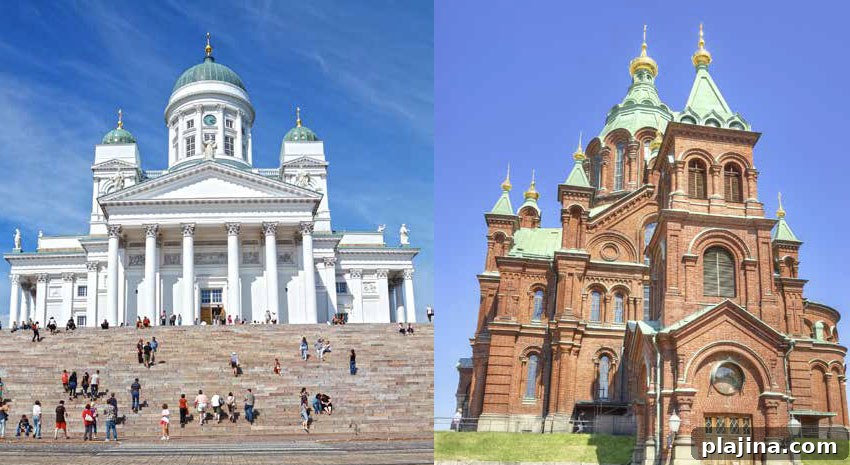
Helsinki Cathedral, constructed between 1830 and 1852, dominates Senate Square. Set high above broad, steep steps, the white Neoclassical cathedral was designed by Carl Ludvig Engel to command attention. Senate Square itself—with the government palace, the University of Helsinki and the city’s oldest building—was laid out to recall a miniature St. Petersburg, but the cathedral’s five green domes remain the square’s defining feature.
Not far away on the Katajanokka Peninsula, Uspenski Cathedral sits atop a hill, its red-brick façades and Byzantine Revival style contrasting with the Neoclassical center. Topped by a glittering gold onion dome and verdigris roofs, Uspenski reflects the Russian influence that was present when Emperor Alexander II held sway over Finland; a commemorative plaque at the site marks that historical connection.
Western Helsinki showcases a very different approach to sacred architecture in Temppeliaukio Church, commonly called the Rock Church. Completed in 1969 by brothers Timo and Tuomo Suomalainen, this unique building was carved directly into solid bedrock. The circular interior is capped by a broad copper dome ringed with skylights, and the exposed stone walls create remarkable acoustics, making the Rock Church a favored venue for concerts as well as a popular tourist attraction.
For a quieter, contemporary contrast, Kamppi Chapel in Narinkka Square—often referred to as the Chapel of Silence—provides an intentional pause in the city center. Completed in 2012, this award-winning, minimalist timber structure offers an ecumenical space for reflection and rest amid Helsinki’s busy streets. Its intimate atmosphere and thoughtful design make it an essential stop on any architectural walk through the city.
Together, these churches illustrate Helsinki’s architectural diversity and historical layers: Neoclassical grandeur, Byzantine-influenced ornamentation, modernist integration with nature, and minimalist spaces for contemplation. Whether you’re following a formal route or simply wandering the neighborhoods, visiting these landmarks gives a clear sense of how different eras and influences have shaped Finland’s capital.