
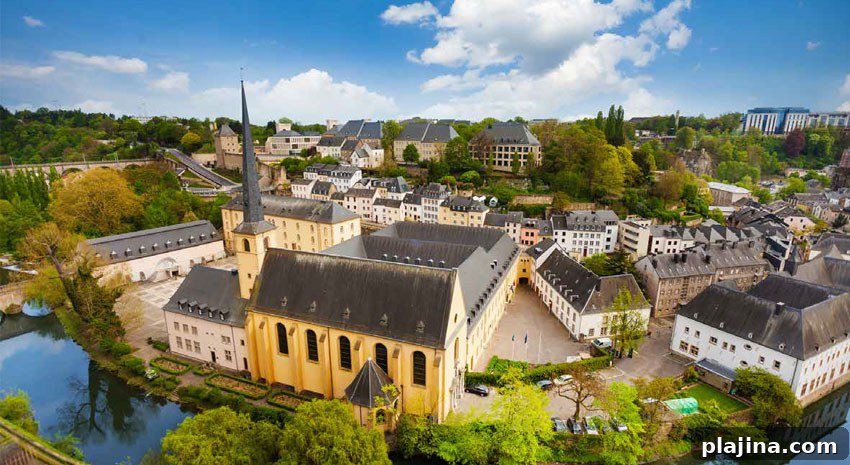
ONE OF THREE HEADQUARTERS for the European Union — along with Brussels, Belgium, and Strasbourg, France — Luxembourg City benefits from a strategic location, rich natural resources and a multicultural population, which together make it one of Europe’s leading business centers. Major companies such as Amazon, Skype, iTunes and PayPal maintain European operations here, alongside numerous other international firms with offices in the city.
Despite its modern importance, the city began humbly as a fortified castle. Built atop steep ravines, that stronghold developed into a strategic fortress that successive powers — French, German, Dutch and others — fought to control. Each period of occupation left a mark on the city’s culture and inhabitants, as people and customs blended over the centuries.
Control over the city shifted so frequently that Luxembourg developed much of its distinct identity only after the 1867 Treaty of London, which required the demolition of the city’s fortifications. The later discovery of iron ore in the late 19th century helped transform Luxembourg into one of the world’s wealthiest nations, and Luxembourg City became the economic heart of the country. International banking grew alongside emerging industries such as telecommunications and agriculture.
Today, more than 160 nationalities live and work in Luxembourg City. High housing costs mean many employees commute from other parts of Luxembourg or from neighboring France, Germany and Belgium. Consequently, the city’s population swells from roughly 120,000 residents to over 200,000 on weekdays, as commuters arrive for work.
Heavy commuting contributes to traffic congestion, so the city has invested significantly in public transportation. An extensive bus network already links most districts, including the Old City (once protected by the ruined fortifications), the Grund down in the ravines, and the Kirchberg business district. A 600-foot funicular opened in 2017, providing a convenient connection between the Grund and Kirchberg.
Ongoing plans call for stronger links between public transit, the central bus station and Luxembourg International Airport, located less than four miles away in Findel. In a major move to encourage public transport use, the country planned to make existing public transportation free of charge by 2020, reflecting Luxembourg’s focus on accessibility and mobility. Note that Uber does not operate in Luxembourg, and taxi fares tend to be very high.
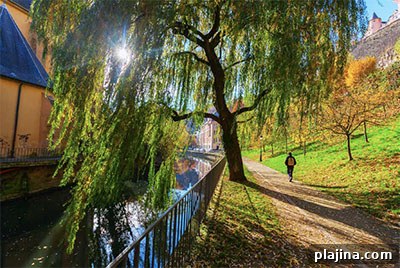
Footpath along the Alzette River in the Grund district © MADRABOTHAIR – DREAMSTIME.COM
Language skills are a notable advantage in Luxembourg City: most citizens speak at least three languages, which makes navigating the city and conducting business straightforward for international visitors. Schoolchildren start with Luxembourgish, a Germanic dialect with French influences, and later learn German and French. English is commonly taught as well, and many residents also speak family languages such as Portuguese at home.
Business etiquette in Luxembourg tends to be formal and punctual. Meetings are expected to start on time and run efficiently unless they take place during a meal. A variety of professional meeting spaces are available across the city, including historic venues like Neumünster Abbey and hotel conference facilities at properties such as Le Place d’Armes and Sofitel Luxembourg Le Grand Ducal. Informal locations such as coffee shops are generally not used for formal business meetings.
For business meals, the square Place d’Armes in the Old City is a popular choice and is often called “the parlor of Luxembourg.” Restaurants such as Brasserie du Cercle, Le Grand Café and the dining options at Hotel Le Place d’Armes provide suitable settings for working lunches or dinners. For traditional local cuisine, Am Tiirmschen near the Bock Casemates serves classic dishes like smoked pork with beans, bacon and dumplings.
Typical business lunches usually begin around 1 p.m. and may last up to two hours; dinners often start at 8 p.m. or later and can extend even longer. These longer meals are intended to build relationships, but it’s important to respect personal boundaries: Luxembourgers are private and may find personal questions intrusive.
Dining in Luxembourg often draws heavily from French culinary traditions and tends to include generous portions. If your schedule includes a heavy meal, consider planning time for exercise. Green spaces make up nearly one-quarter of the city, providing abundant opportunities for walking, jogging and outdoor activity. In Kirchberg, trails behind Fort Thüngen and the Museum of Modern Art lead into pleasant, forested areas that feel far removed from the urban center.
One recommended route for staying active is the 3.5-mile Circuit Wenzel, which begins at the Bock Casemates. You can walk or jog the clearly marked circuit straight through — including the stairs down into the Grund and back up — or use it as a leisurely sightseeing route that includes visits to the casemate fortifications and the Old City.
If your schedule allows for more sightseeing, consider a one-, two- or three-day Luxembourg Card, which grants free access to over 60 attractions and includes second-class public transportation across the country. Alternatively, many noteworthy local sites are free to visit, such as Cathédrale Notre-Dame, the Grand Ducal Palace and the Luxembourg American Military Cemetery, the final resting place of U.S. Gen. George S. Patton.