
Although concerns about safety have long made some travelers hesitant to visit the Middle East, the recent opening of the Grand Egyptian Museum in Giza, Egypt, is changing perceptions and drawing renewed interest from both leisure and business visitors.
The Grand Egyptian Museum (GEM) is expected to attract millions of additional visitors, with projections estimating up to seven million new arrivals and total annual visits potentially reaching around 30 million by 2030. The museum’s scale and profile are already reshaping tourism expectations for the region.
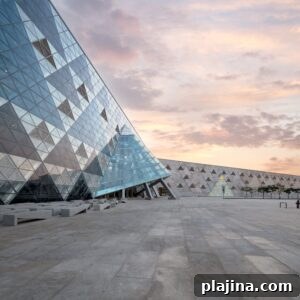
© Grand Egyptian Museum
Designed by Heneghan Peng Architects, the GEM celebrated the completion of its long-planned design and opened to the public in early November 2025. The $1 billion, 120-acre complex sits about one mile from the Pyramids of Giza and stands as a testament to the longevity, scale and enduring influence of ancient Egyptian civilization.
Planned to house up to 100,000 artifacts, the Grand Egyptian Museum is the largest museum in the world dedicated to a single civilization. The museum’s completion was highlighted by the opening of the Tutankhamen Gallery, where more than 5,000 artifacts are now displayed publicly for the first time.
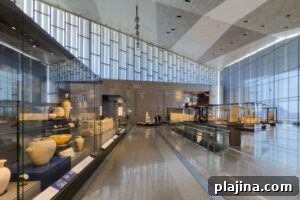
© Ivan Baan
The museum’s design responds directly to the alignment of the pyramids, creating a clear dialogue between the ancient monuments and the new building. Heneghan Peng won the commission in 2003 after the Egyptian Ministry of Culture organized one of the world’s largest architectural competitions for the site.
“Designing a museum of this caliber and size, in such close proximity to a landmark as monumental as the pyramids, is a once-in-a-lifetime opportunity,” said Róisín Heneghan, founding partner of Heneghan Peng Architects. “Our design strengthens the connection to history and place, providing a home for never-before-seen artifacts that rests upon the land from which they were created.”
Situated on a desert plateau shaped by the Nile over millennia, the museum’s geological setting played a key role in its layout. A focal point outside the entrance establishes a visual axis that aligns the building toward the three pyramids. Interior walls fan out along this axis while the roof slopes upward to echo the pyramids’ presence, deliberately rising toward but never surpassing their height. This architectural strategy integrates the pyramids into the visitor experience, making them feel like a continuous part of the museum’s narrative.
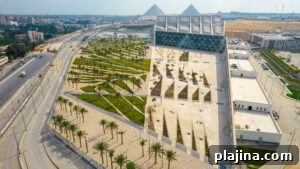
© Grand Egyptian Museum
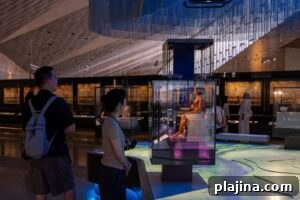
The Permanent Exhibition gallery is oriented toward the tallest pyramid. A grand six-story staircase functions as a chronological spine, guiding visitors through galleries that trace Egyptian history from the Predynastic Period through the Coptic era. The new Tutankhamen Gallery sits at the top of this sequence, inviting visitors to move through the museum’s timelines before culminating in the iconic pyramids view.
Master planning and museological guidance were provided by Cultural Innovations and Metaphor. Their input helped shape a visitor route that encourages immersion in each period’s material culture, while prominent artifacts—including ten statues of King Senusret I—are strategically placed on the staircase at different levels to enhance the narrative and spatial experience.
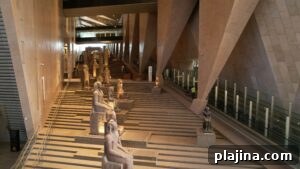
© Grand Egyptian Museum
While museums often limit natural light to protect sensitive objects, many of the GEM’s exhibits are carved in stone, giving architects an opportunity to bring daylight into major circulation and gallery spaces where appropriate. This measured use of natural light enhances the visitor experience without compromising conservation standards.
The museum grounds include extensive public gardens designed with West 8, offering green public space for the local community. The Thematic Gardens, Welcome Plaza and Grand Hall reference the lush Nile valley where Egyptian civilization first flourished. A broad forecourt punctuated with date palms evokes the ancient floodplain that once enabled the transport of building stones by ship. This open area stretches the museum’s full 2,624-foot length and includes 12 acres of outdoor exhibition space.
© Georges and Samuel Mohsen / The GS Studio
Behind the public galleries, the museum houses an extensive conservation and research complex. A tunnel links the conservation center, laboratories and storage facilities to the main building. Seventeen specialized labs support the preservation and preparation of artifacts for display, addressing the varied needs of papyrus, textiles, pottery, sculpture and human remains. This infrastructure ensures the collection receives the care required for long-term conservation and study.
With its scale, careful design, and integrated conservation facilities, the Grand Egyptian Museum positions itself as a global cultural destination—one that connects ancient heritage with contemporary museum practice while inviting millions of visitors to experience Egypt’s deep historical legacy.