
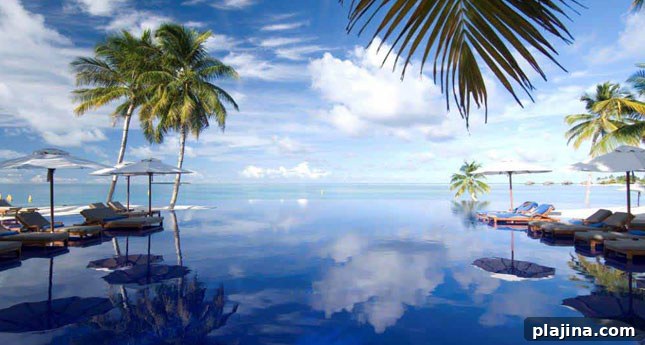
Travelers seeking a glimpse of paradise can find a convincing preview at the Billy Graham Center Museum in Wheaton, Ill., where a gallery lined with soft white clouds and ethereal choral music evokes heaven. For many visitors, however, the truest version of paradise is a real-life trip to the Maldives.
Composed of 1,190 coral islands, each rimmed with powdery white sand and turquoise waters, the Maldives offers almost nothing but pleasure. Arranged into 26 atolls that stretch roughly 500 miles north to south across the Indian Ocean, southwest of India and Sri Lanka, no island is larger than about a square mile and the country’s average elevation is just six feet above sea level. Only around 200 islands are inhabited, and nearly half of those are resorts, typically one resort per island. Each resort creates its own interpretation of utopia, so island-hopping becomes a way to sample different versions of paradise.
Most visits begin with arrival at the country’s airport island near the capital, Malé. The airport hub is well organized for onward connections: boats, seaplanes and domestic flights are coordinated right alongside the terminal so passengers can transfer efficiently to outlying islands. On a recent trip I arrived at the airport three separate times, each time moving on to a different resort via seaplane, speedboat or domestic flight.
At arrival you’ll often be welcomed by resort staff and escorted to private transfer lounges while you wait for a seaplane or boat. Transfers vary: on one trip staff ushered me to a Conrad Maldives lounge to await a seaplane; on another the Vivanta by Taj – Coral Reef team guided me to a speedboat for a 50-minute ride; on a different occasion the Shangri-La staff assisted with a commercial flight to the southern atoll. Transfers are part of the experience and can be scenic introductions to the islands’ vivid waters.
Once you reach a resort, the basic attractions are the scenery—lush tropical foliage, white-sand beaches and clear turquoise lagoons—but accommodations, activities, dining and atmosphere differ widely from place to place.
The first choice is where to stay: beach villas or overwater bungalows. Beach villas provide immediate access to sand and gardens; at the Conrad, for example, a private path took me a few steps from my suite to the shoreline. Overwater villas hover on stilts above the lagoon for guests who want to live above the sea. At the Vivanta Taj I could step from my deck into the water to snorkel off the villa; the Conrad’s Spa Retreat features luxury overwater villas with private massage and treatment rooms. Many villas are tranquil enough that guests can stay in, order room service and relax without leaving their private sanctuary.
Beyond the villa, activities abound. Paddle boarding, sailing, surfing, water skiing and kitesurfing are commonly offered. Snorkeling is almost inevitable—many guests step into the water from the beach or the villa deck to watch fish and coral. Dive centers provide lessons, equipment and boats for SCUBA trips; some resorts feature scores of nearby dive sites, and beginner programs can prepare novices to explore shallow wrecks and reefs in a single day.
Spas are a major draw. The Conrad built an overwater Spa Retreat where the ocean flows beneath the wooden floors. The Shangri-La’s Chi Spa offers private multi-room suites for preparation, treatment and recovery, with signature massages using warm coconut oil and heated cowry shells. The Jiva Spa at the Taj follows ancient Indian wellness traditions: treatments begin with ceremonial foot washes and emphasize aromatherapy and ritualized relaxation. Many resorts provide specialized services for men, such as modern traditional shaves and grooming treatments.
Although the Maldives is a Muslim country where alcohol is restricted on local islands, resorts are permitted to offer full bar menus and wine lists on-site. Because most food must be imported through Malé, resort restaurants draw on international cuisines—Indian, Malaysian, Chinese, Indonesian, Italian, Japanese and Middle Eastern choices sit alongside European and international dishes. Breakfast buffets commonly include fruits, cheeses, cereals, baked goods and sometimes sushi. Resorts also arrange sailboat picnics, sandbar lunches and private candlelit dinners on the beach. Many offer tailored “dine-in-villa” experiences for romantic meals.
Dining can be expensive: a three-course lobster dinner with wine and a pizza-and-beer lunch at some resorts can add up quickly. To control costs, consider booking full board (all meals included) or half board (breakfast and dinner included), depending on how much you plan to dine at resorts or off-site. With generous breakfast spreads, guests often find they need little for lunch.
Each resort offers unique attractions. The Conrad’s Ithaa underwater restaurant lets diners eat beneath an aquarium dome; the property also runs short submarine excursions and guided reef tours. At the Vivanta by Taj a daily gathering of stingrays approaches the shore to be hand-fed by guests. The Shangri-La schedules a broad range of activities—sunset dolphin cruises, visits to a Chef’s Garden, cycling routes linking islands, fitness classes and guided eco-programs—often published in a weekly schedule for guests.
Island-hopping by liveaboard safari is increasingly popular. Liveaboards range from economical shared-cabin yachts to luxury cruise vessels with spas, air-conditioned cabins and personal attendants. Safaris package accommodation, meals and a full schedule of activities—fishing, snorkeling, sandbank picnics and visits to local islands. Specialized safaris focus on surfing or multi-dive itineraries that can visit several dive sites a day.
For travelers who want more land-based activity, larger islands provide additional options: golf, nature trails, bicycle paths, shopping villages and eco centers. Resorts typically include fitness facilities and indoor recreation—treadmills, weights, ping-pong, pool tables and video games. Many offer in-room movie packages and other entertainment for rainy or quiet days.
Resorts generally operate in U.S. dollars and accept credit cards. Most supply daily bottled drinking water and reliable WiFi. Before you travel, confirm the cost of spa treatments, sports equipment rentals and transfer fees to and from Malé; some resorts include transfers in their rates, while others arrange transport for an additional charge.
Because the Maldives is extremely low-lying and environmentally fragile, conservation is a priority. Islands produce their own electricity and desalinate seawater; waste management is a constant challenge. Visitors are asked to avoid damaging coral and to follow reef-friendly practices; many resorts run coral-restoration projects that welcome guest participation. Small gestures—respectful dress on local islands, mindful use of resources and cooperation with resort guidelines—help preserve the islands’ beauty for future visitors.
Maldives Info to Go
Visitors do not need a pre-arranged visa if they arrive with a valid passport, proof of onward travel and sufficient funds. Malé International Airport (MLE) is located on its own island near the capital; organized inter-island transfers by air and sea depart from there. Direct international flights serve the country from several regional hubs, and some international routes connect to Gan (GAN) in the southern atoll.
Where to Stay in the Maldives
Conrad Maldives Rangali Island A relaxed, barefoot-elegant resort spread across two islands with an overwater Spa Retreat, multiple restaurants and bars. Rangali Island, Ari Atoll
Shangri-La’s Villingili Resort and Spa, Maldives A mile-long island offering tennis, nature hikes, a nine-hole golf course and a variety of recreational options. Villingili Island, Addu Atoll
Vivanta by Taj – Coral Reef A compact island surrounded by a rich house reef, ideal for water-sport enthusiasts and dining beside an infinity pool overlooking the lagoon. Hembadhu Island, North Malé Atoll
Restaurants in the Maldives
Dr. Ali’s Distinctive dining rooms at the Shangri-La featuring Indian Ocean, South China Sea and Arabian Gulf flavors. Shangri-La’s Villingili Resort, Addu Atoll
Latitude The main dining room at Vivanta by Taj presents fusion dishes alongside traditional Maldivian breakfasts such as mas huni. Vivanta by Taj – Coral Reef, North Malé Atoll
Mandhoo The overwater restaurant at the Conrad Maldives Spa Retreat showcases menus inspired by the five elements and creative seafood dishes. Conrad Maldives Rangali Island, Ari Atoll
Whether you choose a secluded beach villa, a dramatic overwater bungalow or a multi-day liveaboard, the Maldives delivers an immersive tropical experience. Arrive prepared, respect the fragile environment and you’ll find this island nation among the most memorable destinations on Earth.