Downtown Brooklyn’s present infrastructure challenges began during an ambitious modernization effort in the 1930s. Large sections of the business core, along with parts of Brooklyn Heights and Dumbo (Down Under the Manhattan Bridge Overpass), were cleared to make way for expressways, ramps and parks. Over the decades, businesses, condominium towers and office high-rises rose up around that complex web of roads and scattered green spaces, leaving Downtown Brooklyn with a mix of dense development and fragmented public areas.
Despite these challenges, Brooklyn grew to become the most populous of New York City’s five boroughs, and Downtown Brooklyn is now the third-largest central business district in the city, after Midtown and Lower Manhattan. The neighborhood contains more than 17 million square feet of office space, shopping centers and luxury high-rises. Its boundaries encompass about 60 cultural organizations and 10 higher-education institutions that serve approximately 60,000 college students.
Set between towering new buildings and aging warehouses, Downtown Brooklyn supports a lively cultural scene and draws hundreds of thousands of visitors to institutions such as the Brooklyn Academy of Music. BAM, one of the nation’s oldest performing arts centers, programs more than 220 performances annually. The borough’s cultural resurgence also spurred the restoration and reopening of historic venues such as the Loew’s Kings Theatre in Flatbush. Restoring the opulent theater became a major community project, supported by former borough president Marty Markowitz, who helped raise $95 million for renovations. Although Superstorm Sandy caused damage just before completion, the Kings Theatre reopened with a sold-out Diana Ross concert.
Nearby, a second historic theater in Flatbush is slated for major renovation. Long Island University approved a 49-year lease of the former Brooklyn Paramount Theater to developers planning to revive it as a live-entertainment venue. The building, once used by the university as a gym and assembly hall, still houses a functioning Wurlitzer organ—one of just two of its kind—heard across campus during tuning. The reimagined venue will offer around 2,800 seats and can accommodate up to 3,500 attendees with standing room.
In July 2014, Mayor Bill de Blasio announced a set of initiatives designed to transform Downtown Brooklyn into a more cohesive, 21st-century downtown. Plans aim to better connect the commercial corridor, business district and parks to create a more dynamic environment for residents and workers. The borough, already thriving as a business center, has been seeking more office space after reporting a 19.3 percent increase in private-sector jobs between 2003 and 2012.
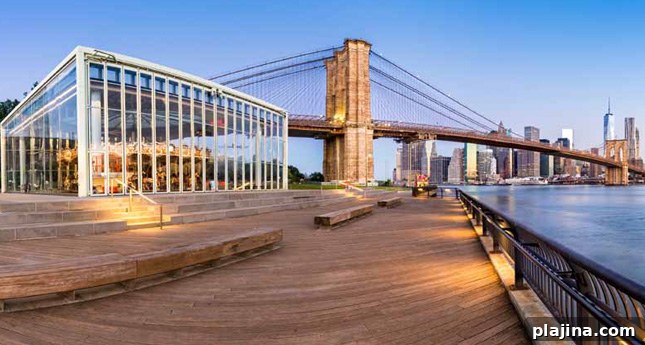
Those plans also focus on linking the rapidly changing Dumbo neighborhood and Brooklyn Bridge Park with the downtown core. Brooklyn Bridge Park has become a waterfront destination with eateries, free fitness classes, the historic Jane’s Carousel and new development at Pier 1. Until 2010, the National Cold Storage Warehouses blocked the sweeping views of Manhattan; those warehouses were eventually demolished to make way for Pier 1 development approved in 2005. The Pier 1 project was planned to include a 200-room Starwood hotel, about 100 residential units, 16,000 square feet of restaurant space and 2,000 square feet of retail, with completion originally expected by winter 2016.
Much of Dumbo’s waterfront was once dominated by industrial warehouses that stored coffee and other goods. Many of these buildings sat vacant despite remarkable views of the Manhattan Bridge. Redevelopment plans preserved historical features—like original coffee chutes and industrial detailing—as nods to the district’s past. The warehouse complex known as Empire Stores was planned to reopen as a mixed-use destination with a food market, restaurant, beer garden and retail spaces.
Other parts of the borough’s downtown are also undergoing revitalization. The Brooklyn Navy Yard, an early naval shipbuilding site authorized by President John Adams, had fallen into decline by the 1960s but is now experiencing its largest expansion since World War II.
In November 2012, the Downtown Brooklyn Partnership, DUMBO Improvement District and Brooklyn Navy Yard released a master plan to redevelop the 300-acre Navy Yard and grow the Brooklyn Tech Triangle. The area already supports more than 500 technology firms and roughly 10,000 employees, with projections to expand to 15,000 jobs. A major new building, Dock 72—a $380 million, 675,000-square-foot commercial project—was planned for completion by late 2017 to house numerous small businesses and shared workspace.
The Navy Yard’s Admiral’s Row, once lined with Second Empire–style homes for naval officers, fell into disrepair over time. Those 11 homes became overgrown and dilapidated, and plans were made to replace them with a $120 million, 285,000-square-foot mixed-use project featuring a Wegmans grocery, multiple retail outlets, parking and commercial office space. Until redevelopment proceeds, the decaying houses remain an evocative reminder of the yard’s history.
SCENIC DRIVES
If you prefer scenic drives, head up the West Side Highway and cross the George Washington Bridge for waterfront views en route to Bear Mountain State Park. Before you exit toward the bridge, look beneath the structure in Fort Washington Park for the 40-foot Little Red Lighthouse. Although inoperable since the 1940s, the lighthouse was saved from sale by public outcry and inspired the children’s book The Little Red Lighthouse and the Great Gray Bridge.
After crossing the bridge, enjoy views of the Palisades and the rising mountains along the Hudson. Bear Mountain State Park, roughly 50 miles from Brooklyn, features a hand-carved merry-go-round with 42 painted and carved seats, including figures like a bobcat and a black bear.
Continue north on Route 287 to Tarrytown to visit the Lyndhurst mansion, about 24 miles from the city. Listed with the National Trust for Historic Preservation, Lyndhurst is a Gothic Revival estate that once housed figures such as Mayor William Paulding, merchant George Merritt and railroad magnate Jay Gould. The mansion is open for tours that explore its architecture, 19th-century decorative arts and landscaped grounds.