
Seoul is a vast, energetic city that can overwhelm first-time visitors. The language, customs, cuisine, architecture, sounds and scents arrive all at once, creating an intense, memorable experience.
Disorientation is an expected part of international travel—and one of its pleasures. When you travel to Seoul with family, that disorientation often takes on a generational dimension. Children and parents may respond to the city in very different ways.
Take Samsung d’light, the three-story showroom for Samsung Electronics in Gangnam. Teenagers—Korean and international—tend to connect instantly with the sleek new devices on display, while many parents find themselves struggling to keep up with the technology and its implications.
Exhibition of wax soldiers at the War Memorial of Korea © Jackbluee | Dreamstime.com
Similarly, people raised on programs like M*A*S*H may carry a built-in familiarity with Korea’s 20th-century history that younger generations may lack. At the War Memorial of Korea—an impressive museum built on the site of the former Army headquarters—older visitors often find a shared understanding of the exhibits, while children may need more context to appreciate the displays.
The legacy of the Korean War still divides the peninsula along the 38th parallel. With figures like Kim Jong-Un widely reported in global media, families today are likely to grasp the stark contrast between North and South Korea, even if the deeper history may be less familiar to younger visitors.
A visit to the Demilitarized Zone (DMZ) is a powerful, sobering experience. It’s one of the few places where you can feel the immediacy of geopolitical history. Several operators run daily tours to the border; these visits carry strict rules. Children under 11 are generally not allowed, photography is limited, and visitors must dress conservatively. This is not a place for selfies or casual fashion statements.
The restrictions are understandable and worthwhile. Standing near the DMZ and seeing North Korean soldiers across the line is an experience that stays with everyone. It offers a rare, direct view of one of the world’s most closed regimes and becomes a shared family memory.
While North Korea remains frozen by ideology, South Korea thrives as a dynamic, innovative society. Seoul often leads global trends in design, technology and culture.
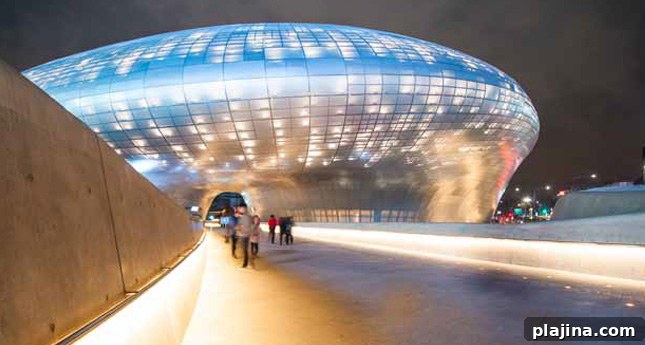
One emblem of the city’s modern spirit is the Dongdaemun Design Plaza (DDP), opened in 2014. Designed by Zaha Hadid and built at great expense, the DDP is a futuristic, multi-use complex that hosts exhibitions and events. Its sculpted grounds revealed parts of the old Seoul Fortress during construction, blending historical layers with bold contemporary architecture.
Seoul is a city of contrasts where old and new sit side by side. You can move between centuries simply by walking through a gate. Gyeongbok Palace, just north of downtown, provides one of the most striking examples. Enter the palace grounds and you leave skyscrapers behind to find a 98-acre walled garden dotted with buildings that date back centuries.
Gyeongbok Palace © Chee-onn Leong | Dreamstime.com
The nearby Bukchon neighborhood, immediately beyond the palace walls, shows how ordinary people once lived. Its narrow alleys and traditional houses—hanoks—have survived for centuries and offer a photogenic, atmospheric glimpse of old Seoul. While parts of Bukchon have been restored and now host cafés, galleries and craft shops, the area still evokes a strong sense of history.
Bukchon Hanok Village © Michelleliaw | Dreamstime.com
For a more immersive, bustling experience, visit Gwangjang Market. Its crowded lanes and dense stalls immerse you in the sounds, smells and flavors of everyday Seoul. The market feels timeless: a place where you can taste street food, watch traditional food preparation and sense the city’s living history. In the evening, the alleys fill with people and steam from food stalls, creating an unforgettable atmosphere. Because it’s easy to become separated in the crowd, agree on a clear meeting point—such as the market’s northwestern entrance—before you dive in.
Itaewon, south of downtown on the far side of Namsan Mountain, offers a more international, Westernized scene. Long popular with U.S. military personnel stationed nearby, Itaewon is still a place to find global cuisine, shops and nightlife that feel familiar to many visitors.
Seoul’s youth culture has also created new private social spaces known as bangs—rooms for karaoke, gaming and socializing. For teenagers, these rented rooms are a popular hangout. Visiting a bang can be a generational experience: fun and trendy for young people, less appealing for parents.
Seoul Info to Go
Most international flights arrive at Incheon International Airport (ICN), about 30 miles west of Seoul. The airport is connected to the city by express train (about 40 minutes), bus and taxi. Gimpo International Airport (GMP), nine miles west of downtown, handles domestic flights and some regional services to Japan, China and Taiwan.
Where to Stay in Seoul
Fraser Suites Insadong — A family-friendly option with serviced, spacious apartments in Insadong, the antique and cultural district. 18 Insadong 4-Gil, Jongno-gu $$$$
Lotte Hotel Seoul — A long-established luxury hotel in a prime downtown location, popular with business travelers and families. 30 Eulji-ro, Jung-gu $$$$
Yoo’s Family Guesthouse — Traditional hanok guesthouses offering family rooms, located east of downtown. 126-1 Gwonnong, Jongno-gu $$$
Restaurants in Seoul
Daedo Sikdang — A specialist in Korean barbecue; the original location east of downtown is well worth seeking out. Seungdong-gu Hongik-dong 431 $$
Phil Kyung Jae — Authentic Korean cuisine served in a restored 600-year-old home and garden on the edge of Gangnam. 739-1 Suseo-dong, 205 Gwangpyeong-ro, Gangnam $$$$
NeNe Chicken — A popular chain serving Korean-style fried chicken, typically double-fried for a crisp texture. Multiple outlets throughout Seoul $