
It was late, and there had been some drinking. As I trudged across frost at the edge of the taiga, the sharp cold was softened by the lingering warmth of a few shots of akvavit, the fiery Scandinavian spirit.
The hotel lights picked out the first rank of trees; beyond them the forest became a dense knot of shadow, both inviting and foreboding. I thought about how many European folktales were likely born on nights like this—when alcohol and the forest’s mysteries conspired to spark the imagination.
What was that? I paused and listened. An owl? A deer? I walked on, then stopped again when a sound rose unmistakably from the darkness. It was distant yet clear. A primal fear stirred in me. Somewhere in the forest a wolf was howling.
I had come to Furudal, a village in Dalarna, central Sweden. This region is often described as the country’s folkloric heartland, and for me it felt like a return to ancestral ground.
My Swedish great-grandfather left more than genetic lineage and a few heirlooms—he passed down a slice of northern wisdom and a piece of eccentric advice. “If you are ever attacked by a wolf,” he told my grandfather (who relayed it to my father and then to me), “reach down its throat, grab its tail and pull the animal inside out.” I had no desire to test that technique. I retreated to my room in Furudal’s Bruk, an 18th-century ironworks converted into a hotel with atmosphere to spare.
From the safety of my bed, listening to the wolf’s mournful call, I turned over my unease about the coming night. Tomorrow I wouldn’t have a hotel room to shelter me.
Sweden offers wilderness in varying degrees. In Dalarna you can hike through forest and along lakeshores with the comfortable certainty that a good meal and a warm bed await at day’s end. This accessible form of solitude is easy to pair with city life around Stockholm, where cosmopolitan attractions sit within reach of half-day or full-day countryside hikes.
Sweden’s right of public access gives walkers the freedom to roam with few restrictions, and much of the open land surrounding the capital is suitable for improvised walks. Formal trails fan out from Stockholm, linking into a nationwide network designed for both short excursions and long-distance routes.
One popular path is the Sörmlandsleden, which begins across the road from the Björkhagen Metro Station in southeast Stockholm, only ten minutes from downtown. Minutes after stepping off the train you can be walking through birch woods into an unspoiled landscape dotted with idyllic lakes.
Complete the initial five-mile section of the Sörmlandsleden and you can catch a bus back to the city—or keep walking. The entire trail winds for more than 600 miles along a frayed coastline and inland to Eskilstuna. Although it’s an epic route, the populated nature of this part of Sweden means the sense of remoteness can be deceptive; civilization is never far away.
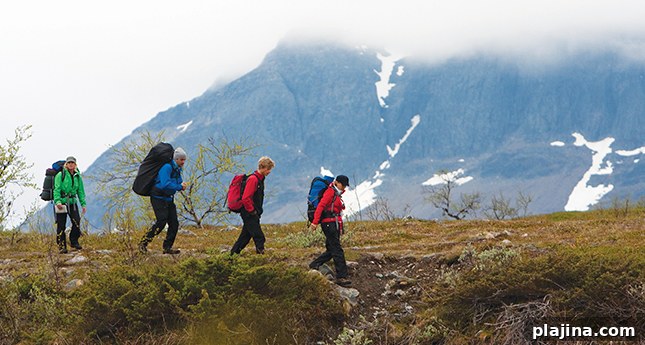
True remoteness awaits in Sarek National Park in Swedish Lapland, above the Arctic Circle. The park contains more than 200 mountains, including six of Sweden’s highest peaks, and around 100 glaciers. What it lacks is infrastructure: there are no visitor centers, no marked trails, no huts. Here you are fully reliant on your own preparation and navigation skills.
Without official paths, you follow animal tracks and natural contours: elk, wolverines, lynx and bears have worn routes through the terrain. From high ridges the panoramas are timeless and untroubled by human traces. Sarek represents wilderness distilled—remote and elemental.
If Sarek feels too raw, the Kungsleden, or King’s Trail, delivers a full northern experience with more structure. Established in the 1930s, it has become Sweden’s premier long-distance hiking and cross-country skiing route.
The traditional start is at Abisko National Park near the Norwegian border. From there the trail heads south for roughly 270 miles to Hemavan. Hiking the whole route typically takes five to six weeks, though many people tackle it in sections across multiple visits.
Parts of the Kungsleden skirt the southeastern edge of Sarek, but the trail itself is far more managed than Sarek’s interior. It’s well marked and well used; other walkers are a common sight. Crucially, a network of mountain huts and hostels offers shelter from alpine weather, making it a practical choice for independent trekkers.
In summer the Kungsleden basks in near-constant daylight; in winter the sun scarcely rises and the route is mainly traversed on skis. For most hikers the prime season is July and August, when glacial snow at higher altitudes recedes enough to allow ascents like Kebnekaise, Sweden’s highest peak. The roughly 7,000-foot climb is not technically demanding but can be physically testing. From the summit, Lapland unfolds beneath you like a vast map.
My own walk offered fewer summit panoramas. With Anders, my Swedish guide, I spent long hours beneath the dim vault of the taiga, threading a path between the tall conifers. The taiga is the world’s largest land biome; from central Sweden the forest continues across Finland and Russia all the way to the Bering Sea. We were not seeking such extremes.
Once we left the road behind, I felt disoriented. There were no obvious landmarks and no easy reference points. I had to trust Anders, who knew these woods intimately. He moved with quiet certainty.
We were tracking the wolves I had heard the night before. “It’s easier to track wolves in winter,” Anders told me. “Then you just follow the tracks in the snow.”
There was no snow now. The ground was a springy mosaic of lichen, pine needles and moss—like trudging across a vast, sagging mattress. My thighs began to ache from the effort.
We camped beside a small lake that Anders found without a map or GPS. He seemed able to read the land’s subtle contours and place us where we needed to be.
Autumn chilled the night air. Inside a tent the sounds of the forest were magnified: every owl call, every bark, every snapping twig seemed unnaturally close. Yet no wolf answered.
We double-backed and kept walking in daylight. Eventually we emerged onto a muddy logging track. Anders stopped and crouched over a fresh set of prints. “A male wolf. Very recent,” he said.
He slipped back into the trees and I followed the trail. After a short distance I paused and looked back. There, impressed into the mud, the story was clear: my footprints and a wolf’s, side by side.
Info To Go
Furudals Bruk can be booked online. Guided hiking tours of Dalarna and other regions are offered by specialist operators. The Sörmlandsleden website provides hiking information and detailed route maps. Kiruna Airport is the usual staging point for the Kungsleden, with flights from Stockholm and bus connections to Abisko. For general travel planning in Sweden consult official tourism resources.