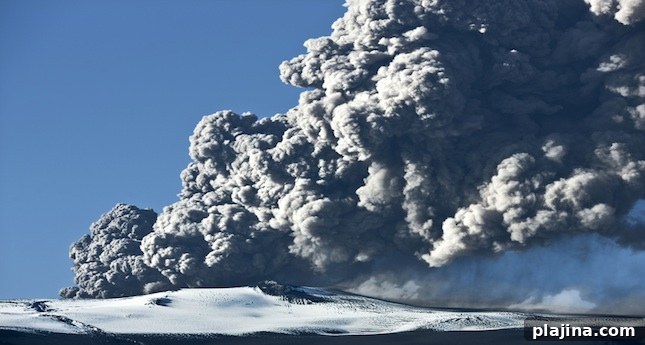
When Iceland’s Eyjafjallajökull erupted in 2010, the resulting ash cloud disrupted flights across Europe for weeks and left passengers stranded in around 20 countries. NASA is developing new satellite-based technology to prevent similar widespread disruption in the future by improving how these hazardous ash clouds are detected and mapped.
Volcanic ash poses a serious threat to aircraft: ash particles can abrade airframe surfaces, pit cockpit windows, clog sensors, and—most critically—be ingested into jet engines, where they can melt and cause engine failure. To protect flights, airlines currently reroute around suspected ash, relying on manual guidance from a global network of Volcanic Ash Advisory Centers that estimate ash cloud boundaries using a mixture of observations, models, and human judgment.
Researchers at NASA’s Goddard Space Flight Center in Maryland are advancing satellite techniques that can identify volcanic ash on atmospheric maps with greater precision. Traditional weather imagery and routine monitoring often struggle to distinguish ash from meteorological clouds, but modern satellite instruments can detect ash by analyzing its chemical and particulate signatures. This allows scientists to differentiate ash from water or ice clouds and to pinpoint the ash’s concentration and extent more reliably.
Improved remote sensing of volcanic ash has several practical benefits. More accurate detection enables better estimates of ash cloud height and movement, which in turn supports more informed decisions by aviation authorities and airlines. With clearer maps, flight planners can issue more targeted avoidance measures, potentially reducing unnecessary rerouting and limiting passenger disruptions while maintaining safety. The enhanced data also help volcanologists and meteorologists refine dispersion models, giving authorities a stronger basis for forecasting ash transport and lifetime.
For travelers, the outcome could be fewer delays and cancellations during major volcanic events, and for airlines it could mean lower operational costs tied to fuel, crew, and schedule disruptions. Beyond aviation, precise ash monitoring benefits public health and infrastructure planning in regions affected by ash fall, enabling officials to issue timely warnings and mitigation measures.
The new satellite methods represent a step toward more automated, objective, and rapid ash detection compared with the predominantly manual systems now in use. By integrating satellite-derived chemical signatures with atmospheric models and ground-based observations, agencies can produce more detailed, timely advisories for decision-makers around the world.
As the technology matures and is adopted by international monitoring networks, the global aviation system should become more resilient to volcanic hazards. While active volcanoes will remain an inevitable natural risk, better detection and mapping tools promise to minimize the disruption they cause—keeping passengers safer and air travel more reliable.