
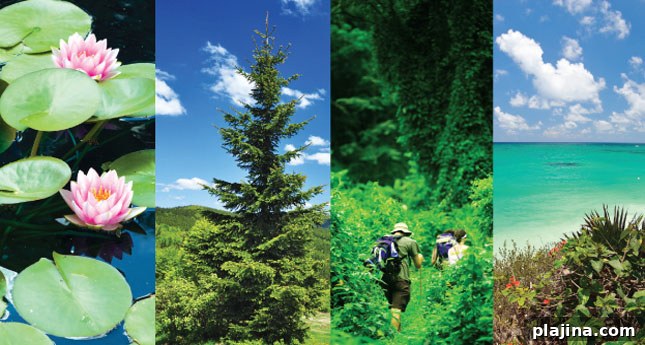
With an extraordinary command of tint and hue, nature paints the world in countless shades of green — from the brilliant tones of lily pads, spruce trees and jungles to the blue-green of Caribbean tidal pools and the subtle inner green of a cucumber. Those variations make for fine poetry about the natural world, but when “green” is invoked to describe a hotel’s sustainability practices, the meaning often becomes blurred.
If you suspect that claims of saving the planet by skipping towel changes are too good to be true, you’re right. While encouraging guests to reuse linens is a positive step, real environmental sustainability in hospitality requires far more than a tent card on a pillow. Many travelers assume sustainability is defined by the cleaners a hotel uses or whether laundry is optional. Genuine green initiatives go well beyond those measures: they have measurable, verifiable impacts and address environmental, economic and cultural dimensions.
WHAT’S IN A NAME? Effective product labeling — whether for cars, vodka or hotels — does more than convey facts; it creates emotional resonance. Research consistently shows that higher-income and better-educated consumers are more responsive to environmental messaging, and the luxury hotel sector is no exception. That creates an opening for eco-related terms to be used as marketing leverage — not necessarily to protect the planet, but to persuade travelers to choose one property over another.
“Sustainability — encompassing economic, socio-cultural and environmental impacts — is extremely difficult to communicate to consumers,” cautions Leilani C. Latimer, senior director of global sustainability initiatives for Sabre Holdings. “What resonates is ‘better.’ Travelers need to understand how sustainability improves their experience. An advanced HVAC system matters not just because it saves energy, but because it improves air quality: better sleep, higher oxygen levels and fewer respiratory issues. Farm-to-table sourcing supports local economies and farmers, but to guests it translates into fresher, tastier food. Truly sustainable businesses address people, communities, environment and economy in a holistic way.”
For travelers comparing hotels, websites can be especially confusing. Various green badges, seals and certifications proliferate, and their validity isn’t always obvious. A hotel might display a certification or seal that looks official, but it means little unless an independent, third-party organization has assessed its practices and operations.
No single mandatory international certification guarantees every hotel’s environmental claims, but respected third-party programs such as EarthCheck, Green Key and the Global Sustainable Tourism Council offer useful standards and guidance.
Green Seal’s certification, for example, examines all aspects of hotel operations and community impact, addressing waste minimization, reuse and recycling, energy efficiency, water resource management, wastewater handling and hazardous substance reduction. It also requires an environmentally sensitive purchasing policy.
“True environmental stewardship must address sustainability holistically,” says Linda Chipperfield, vice president of marketing and communications for Green Seal. “That means evaluating the full impact of practices across every area of hotel operations — protecting the environment but also the health and safety of guests and staff. Green Seal certification requires annual renewal, compliance assessment and on-site audits.”
The Federal Trade Commission has also responded to consumer confusion. After focus groups and public feedback, the FTC expanded its Green Guides to clarify environmental claims in domestic consumer markets. The updated guidance addresses seals of approval, carbon offsets, “free-of” and “non-toxic” claims, and statements about renewable energy and materials.
“Because of the confusion over certification, the FTC expanded its guidance on seals of approval,” explains Laura Koss, senior attorney for the FTC. “A green stamp can lead consumers to assume a claim has been independently verified. Yet not all certifications are independent. Marketers that use their own green seal, or a seal tied to a membership, must clearly disclose that relationship and display the disclosure prominently.”
AT FIRST GLANCE, it may seem surprising that some of the most sustainable properties operate in environmentally sensitive places. But natural beauty can be a powerful motivator for deep green practices: protecting the landscape often protects the business.
“Guests come to King Pacific Lodge in British Columbia for the natural beauty and wildlife,” says Michael Uehara, president and managing director. “We limit our environmental impact because we care about the Great Bear Rainforest and our Gitga’at hosts, but also because the area must remain pristine for our business to survive. Urban hotels may not feel that immediate connection; their incentives to adopt greener practices often come from guest pressure or long-term cost savings.”
Christina Carr, director of Norman Carr Safaris in Zambia, notes that luxury safaris may appear at odds with eco-credentials because guests often travel long distances. “Would it be better to stop long-haul flights?” she asks. “Perhaps. But tourism brings jobs and incentives for communities to protect wildlife and forests. We also plant thousands of trees through forestry initiatives, which help offset travel emissions. Responsible tourism that is high-cost and low-impact — exclusive locations, well-paid, well-trained staff — supports the conservation of wild places. Mass tourism is harmful; if people stop visiting, many of these Edens will disappear.”
Ancient fishpond at The Mauna Lani Bay Hotel and Bungalows © Mauna Lani Bay Hotel and Bungalows
On Hawaii’s Big Island, The Mauna Lani Bay Hotel and Bungalows generates one of the largest amounts of solar electricity among resorts worldwide. Its sustainable measures include using millions of gallons of brackish water each month to irrigate a drought-resistant golf course, solar-powered golf operations, sourcing produce from local farms, and protecting archaeological sites, royal fishponds, aboriginal trails and prehistoric lava formations on the property. These efforts increase cultural awareness and give guests access to the island’s heritage.
“Since Mauna Lani Bay opened nearly 30 years ago, we’ve remained committed to malama ‘aina — responsible stewardship of the land,” explains general manager Robert Grant. “We’ve long focused on maximizing local geography and climate to reduce energy demand. Awareness of sound environmental practices is growing as travelers ask more questions and sometimes base decisions on the answers.”
Chipperfield emphasizes the industry value of independent, nonprofit third-party certification.
“Uncertainty benefits no one,” she says. “It suppresses business and undermines properties that have invested in genuine improvements. Certification should be managed by an independent nonprofit, and if a facility displays a seal, it must clearly identify who granted it, the relationship, and the criteria used. Self-administered seals create confusion and are misleading. In the long run they erode public trust and harm the industry’s integrity.”
When one hotel’s chartreuse can look like another’s celadon, travelers should ask questions: Does the property measure its carbon footprint? Have its sustainability practices been independently evaluated? Color nuance is one thing; paying premium rates for a property’s self-declared green label without evidence is another.