
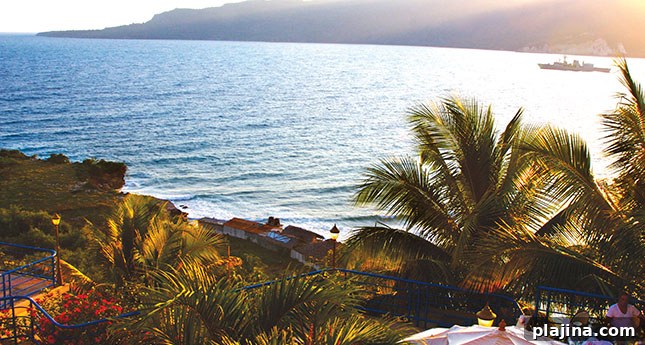
At the Cap Lamandou Hotel, one of the few properties still standing in Jacmel, giant palm fronds flutter in the evening breeze as waiters bring napkin-wrapped bottles of lager to tables of tanned visitors — Spanish, Dutch, Argentinian, Israeli, American and Japanese. Offshore, the Canadian frigate HMCS Halifax patrols the turquoise bay in slow figure-eights while its radar helps guide incoming flights carrying aid to the city.
In places like this, Jacmel — with its lush green hills and dramatic coastline — can feel far removed from Haiti’s wider troubles: a slice of Caribbean calm amid the rubble and ruin that mark the earthquake-affected zone. Yet a 10-minute drive down a rutted dirt road from the hotel, past the small one-runway airport and into the historic town center, reveals the true scale of the crisis.
Although Jacmel avoided the absolute worst of the earthquake’s destruction — Port-au-Prince and Leogane were hit far more heavily — the city of roughly 40,000 suffered severely. Current estimates place the town’s death toll at about 3,000, with tens of thousands injured and many more displaced. Approximately 7,000 people are living in a refugee camp patrolled by Sri Lankan U.N. peacekeepers and Canadian paratroopers.
My trip to Jacmel began four days after the quake. I flew into Santo Domingo, took a truck five hours south to a small port town, and boarded a Dominican Navy ship laden with supplies. I didn’t know what to expect. Up to that point, most news and relief efforts had centered on the flattened capital; Jacmel had received far less attention.
That relative neglect is nothing new for Jacmelois. A simple web search for “Haiti” returns countless accounts of coups, hurricanes and long-running hardship, most reported from the crime-ridden capital. Search major travel guides and you’re unlikely to find much about Jacmel’s pastel merchant houses, its 17th-century mansions, or the exquisite papier-mâché Carnival masks made by local artisans.
Yet Jacmel has a rich and surprising history. It was the first Caribbean city to have electric streetlights, and it is home to treasures such as Bassin Bleu — a string of natural pools and waterfalls on the mountain slopes east of town that remain a local favorite.
Walking the tent-lined streets — many residents sleep outdoors after almost nightly aftershocks — it’s easy to fixate on damaged buildings and walls with gaping holes. I often found myself pausing on a sidewalk, staring into a living room and feeling stunned by a collapsed staircase, a pair of shoes left on a rooftop, or a door torn from its frame.
Look past the destruction, however, and it’s possible to imagine what Jacmel once was and what it could become again. Twenty-five years ago, before the AIDS crisis of the 1980s and the unrest that followed the fall of Jean-Claude Duvalier, Haiti supported thriving resorts and roughly 4,000 hotel rooms. By 2008 that number had dropped below 1,000, and the earthquake destroyed many of the remaining properties, including the 30-room Peace of Mind Hotel in Jacmel, which collapsed and claimed one American life.
Still, there was cause for cautious optimism before the quake. Several hotel and development agreements suggested renewed interest in Haiti’s tourism potential. Choice Hotels planned a 32-room Comfort Inn in Jacmel, and a firm called SIMACT — the Société Immobilière, Agricole, Commerciale et Touristique — was pushing ahead with the “Belle Rive Project,” a large oceanfront development intended to revive trade and tourism.
SIMACT’s plan included a 24-acre residential community with 84 townhouses, shops, restaurants, tennis courts, pools and a movie theater. The company also proposed renovating the 120-room Cap Lamandou and reopening it within the Ascend Collection, marking a potential return of multinational hotel investment to the region.
My purpose in Jacmel was not tourism. Over the past two weeks I helped coordinate civilian flights at the regional airport, served as a liaison between the Dominican Red Cross and local hospitals to match medical teams with urgent needs, and assisted in other small but practical ways. Those tasks brought me close to the community and its immediate needs.
Yet even a travelogue can serve a purpose. As media attention fades and the emergency phase of relief winds down, many of the organizations and volunteers who saved lives and filled local hotels will move on. What remains necessary is long-term attention: to visit, to support reconstruction, and to tell others about Jacmel’s cultural and natural riches when major outlets omit them.
“Is it safe to walk around town?” a pilot from Miami asked after flying a Cessna loaded with food and medicine for a local orphanage. “That depends,” the orphanage director replied. “Are you planning to leave?”
For my part, I don’t plan to go far — at least not anytime soon.
Editor’s Note: Global Traveler contributor Patrick Adams is an independent volunteer assisting with earthquake recovery in Haiti.