
The perfect cocktail is a multisensory experience, capable of evoking an anniversary at The Ritz-Carlton or a balmy afternoon in Bangkok. While many classic cocktails trace their roots to the 1800s, contemporary mixologists worldwide reinterpret these recipes, drawing on craft spirits, local produce and the atmosphere of their bars.
At the New York Bar inside the Park Hyatt Tokyo, for example, four signature cocktails respond to the enormous paintings of New York landmarks that line the room.
The Radio City cocktail at Park Hyatt Tokyo’s New York Bar © Park Hyatt Tokyo
“The red hues of the Radio City cocktail are inspired by the music hall’s spotlights,” says assistant manager Utaro Izaki. “Our Yankee Stadium is a beer cocktail — what baseball game would be complete without it? — paired with apple juice and a touch of lemongrass to match the outfield.”
Cocktails don’t need elaborate gimmicks to be memorable. With a focus on fresh herbs and real fruit, a simple classic often becomes the standout on a menu.
I’ll never forget a mojito at a family-run restaurant in Nyaung Shwe, Myanmar, muddled with mint and limes from a garden beside the kitchen. Through an open window the sound of distant incantations mingled with the scent of rain, fixing the memory to the taste of Mandalay Rum.
A Red Snapper at The St. Regis New York’s King Cole Bar © St. Regis
The origins of the Bloody Mary are disputed. Some trace it to Harry’s New York Bar in Paris; others credit comedian George Jessel or a waitress named Mary at Chicago’s Bucket of Blood Club. What’s widely acknowledged is that French bartender Fernand Petiot refined and popularized the drink when he began serving the Red Snapper at the King Cole Bar in the St. Regis Hotel in New York in 1934.
Petiot described covering the bottom of the shaker with large dashes of salt, black pepper and cayenne, adding Worcestershire sauce, a dash of lemon juice and cracked ice—ingredients that set his version apart. Today, St. Regis properties tailor the Bloody Mary to local tastes, from beer in Beijing to tequila and chili in Texas, while the King Cole Bar still offers Petiot’s signature Red Snapper.
America’s best Manhattan this year was made not in New York but in Detroit. Travis Fourmont of Roast at The Westin Book Cadillac won the Woodford Reserve Master of the Manhattan contest with his Midnight Manhattan. He keeps the drink whiskey-forward, using two ounces of Woodford Reserve bourbon and house-made bitters, but swaps sweet vermouth for a blend of Italian amaro, Campari and cherry liqueur to let the whiskey shine.
Midnight Manhattan at The Westin Book Cadillac in Detroit © The Westin
The Margarita’s origins are equally fuzzy, with stories pointing to Margaret Sames in Acapulco, Marjorie King near Tijuana or a performance by Rita Hayworth at Agua Caliente. By the 1950s the tequila-based cocktail had become widespread across the United States. Today the Margarita appears in countless forms, from luxurious versions with edible gold to playful twists using flavored or infused spirits.
The Martini has remained an icon through changing tastes. Early gin-and-vermouth combinations appeared in mid-19th-century California, and Prohibition-era bathtub gin pushed bartenders toward a drier, more spirit-forward style. Ian Fleming’s admiration for Dukes Hotel helped cement the Martini’s legendary status; modern bartenders continue to balance vermouth, quality gin and precise garnishes to create icy, elegant versions—shaken or stirred, according to preference.
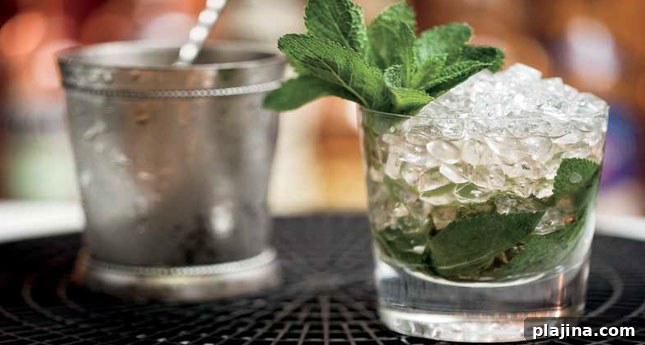
At The Ritz-Carlton New Orleans, bartender Chris McMillian honors the Mint Julep by reciting a 19th-century ode when he prepares the drink. The Mint Julep, with roots in 18th-century Virginia, became synonymous with the Kentucky Derby in 1938, and today hundreds of thousands are served during the race weekend. Bars like Louisville’s Proof on Main highlight the cane spirit by offering mint juleps made with a wide selection of Kentucky bourbons.
The Mojito evolved from an earlier Cuban drink called “El Draque,” and with the arrival of refined rum took the name Mojito, possibly linked to the Cuban seasoning mojo. Ernest Hemingway’s endorsement at La Bodeguita del Medio boosted its fame. Contemporary bars around the world stick to freshly muddled mint and good rum; Miami’s Tap Tap favors Haitian Rhum Barbancourt and traditional mortar-and-pestle preparation.
The Old-Fashioned predates the Martini and reflects a return to simplicity among today’s cocktail craftsmen. After decades of added fruit and mixers, bartenders at places like Prime Meats in Brooklyn and JBird Cocktails on the Upper East Side emphasize quality spirits, bespoke bitters and deliberate, restrained technique, restoring the Old-Fashioned’s dignity.
The Pisco Sour likely originated at Morris’ Bar in Lima in the 1920s and consists of Peruvian pisco, lime juice, syrup, egg white and bitters. Peru and Chile contest pisco’s national ownership, but the cocktail has seen a contemporary revival in Lima’s bars, where bartenders experiment with local fruits like golden berry and passion fruit. San Francisco preserves a related tradition in Pisco Punch, which mixes pineapple, pisco, lime and sugar in historic bars such as Comstock Saloon.
The Sidecar—cognac, Cointreau and lemon—may have been named for a World War I army captain’s mode of transportation and is usually traced to either the Ritz or Harry’s New York Bar in Paris. Although less prominent today, the Sidecar still appears at classic cocktail bars and has inspired modern variations that incorporate apple brandies, tropical juices and herbal liqueurs.
The Singapore Sling was created around 1915 by Ngiam Tong Boon at Raffles Hotel. The original included gin, Cherry Heering, Benedictine and fresh Sarawak pineapple juice. Over time it was simplified, but the modern Raffles recipe restores several of the original elements. Contemporary bars in Singapore often use fresh, cut-to-order fruit to recreate a bright, balanced Sling.
There are two main Tequila Sunrises: an older Arizona Biltmore version of tequila with crème de cassis, lime and soda, and the more familiar orange juice–and–grenadine variant that rose to fame in the early 1970s at the Trident in Sausalito. Both versions remain popular, and bartenders continue to riff on the concept, incorporating fresh juices, spiced tequilas and seasonal garnishes.
The Tom Collins began as a practical joke in 1874 and quickly became a standard mix of gin, lemon juice, gum syrup and soda water. Though its exact origin is unclear, the Collins family of drinks has been embraced by bartenders worldwide. London’s LAB lounge, for example, showcases creative takes such as Lychee Collins and Honey and Fig Collins, demonstrating how a simple template can yield a wide variety of refreshing, contemporary cocktails.