
A pink glow in the eastern sky announced the start of a picture-postcard morning in Puerto Vallarta. Our catamaran eased out of the calm Maritime Terminal, its bow cutting a gentle wake through the harbor as other boats rocked in its slipstream.
Outside the marina, the Pacific offered small, rolling swells as we headed northwest across Banderas Bay toward the Marietas Islands, Puerto Vallarta’s premier site for diving and snorkeling. These volcanic isles, made famous by oceanographer Jacques Cousteau, form Parque Nacional Islas Marietas, a protected wildlife sanctuary and marine preserve. In 2008 UNESCO designated the four-island archipelago the Islas Marietas Biosphere Reserve.
The waters around the islands teem with marine life: manta rays that can span 25 feet, marlin, eels, octopus and even seahorses. The rocky islets are outstanding for bird watching, with nesting colonies of dozens of aquatic and seabird species, including rare visitors such as the white-capped marine swallow and the blue-footed booby, the latter otherwise best known from the Galapagos.
We tied up to a mooring about 100 yards offshore and prepared our gear to enter the water. A cacophony of birdcalls filled the air as snorkelers splashed nearby. As I slipped into the sea, a cloud of blue-and-yellow king angelfish swirled around, curious and hopeful for a handout. We descended toward the reef and swam out toward a large rock that guards the mouth of a small cove.
Sunlight streamed down from the surface like a giant, glittering mirror, casting shafts of light that illuminated the coral below. I was focused on photographing a shy pufferfish tucked among elkhorn coral when my dive buddy grabbed my arm and pointed frantically upward. About 15 feet above us, a giant manta ray was performing loops and rolls, its vast wings propelling it with effortless grace. Snorkelers watched from the surface as the manta traced a slow, balletic arc through the blue.
The sight of the manta framed by snorkelers above was a spectacular composition, and my heart leaped as I reached for my camera. For a moment disappointment set in — my camera was set for macro instead of wide-angle — but I savored every second of the encounter until the ray glided away into the deep. Fortunately, I did manage to capture some manta images later in the trip.
Scuba and snorkeling are only part of Puerto Vallarta’s appeal. Nestled along the hills of Bahía de Banderas, one of the largest protected bays on the West Coast of the Americas, Puerto Vallarta blends old-Mexico charm with modern comforts. Its dramatic Pacific shoreline, lush tropical forests, rugged mountains and welcoming local culture make it a compelling alternative to other Mexican destinations. Whether you crave adrenaline-fueled adventure or a relaxed, scenic escape, Puerto Vallarta—known simply as PV to locals—offers a wide variety of activities.
PV’s documented history begins in 1524 when Francisco Cortés de San Buenaventura explored this stretch of coast. His landing nearly ended in conflict when several thousand Xalisco warriors, their bows and bright feathered banners flying, confronted the party. The tense standoff eventually ended peacefully, and the sight of the banners inspired the name Bahía de Banderas, or Bay of Flags.
For centuries the bay remained sparsely settled, aside from seasonal whalers. In 1851 Don Guadalupe Sánchez Torres founded Puerto de las Peñas along the Río Cuale. The town was renamed Puerto Vallarta in 1918 after Don Ignacio Luis Vallarta, governor of Jalisco. The town’s tranquil life changed dramatically in 1963 when Hollywood descended on the village for John Huston’s film Night of the Iguana, starring Ava Gardner, Deborah Kerr and Richard Burton. The high-profile affair between Burton and Elizabeth Taylor, who bought a villa nearby during filming, catapulted the town into the international spotlight.
Since then Puerto Vallarta has been a backdrop for more than two dozen films, and it continues to attract production teams and fans. Yet the destination retained much of its traditional character even as tourism grew.
Beaches are often the first impression visitors get when flying into Puerto Vallarta. More than 40 stretches of soft sand line the bay’s coastline, from secluded coves like the 100-yard Majahuitas—accessible only by boat—to expansive shores such as the five-mile Bucerías, popular with North American visitors. Mismaloya, a sensuous half-mile curve of sand immortalized in Huston’s film, remains one of the most recognizable beaches; the original movie set has been converted into a seaside restaurant.
Beyond diving and snorkeling, operators offer a full menu of ocean activities: parasailing, sea kayaking, wild dolphin swims and deep-sea fishing for marlin and sailfish. The day after our manta encounter we joined Mike’s Fishing Charters just north of the Marietas. The crew set six lines, and before we finished breakfast a shout of “Fish on!” sent everyone scrambling. We soon discovered it was a triple hookup.
Within half an hour three 25-pound dorado (mahi-mahi) were thrashing at the stern, their yellow-and-blue bodies flashing in the sun. The crew carefully removed hooks and released them, and an hour later we hooked a large sailfish. After several thrilling runs and jumps, a 120-pound sailfish came aboard. By the end of our six-hour charter we’d landed three sailfish and half a dozen dorado. Back at the hotel, the chef grilled one of our smaller catches and served it with a vibrant red salsa—an unforgettable fresh-catch dinner.
Puerto Vallarta’s warm waters also host migrating marine giants: between December and March roughly 350 Pacific humpback whales travel from Alaskan feeding grounds to mate and calve in the bay. While whale watching is possible from shore, many visitors prefer boat tours that offer closer encounters and combined options such as whale-watching with swim-with-dolphin excursions.
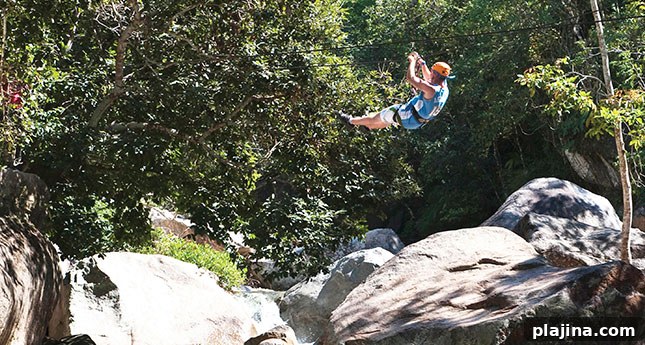
On land, the region offers equally compelling experiences. El Eden park features the waterfall and helicopter set used in Predator, plus rainforest trails, canopy walks and a network of 13 zip lines over the Mismaloya River rainforest. Other land activities include four-wheel-drive birding safaris into the mountains, sea turtle nesting tours (August to January) and guided hikes through the jungle. Cultural excursions visit remote, pre-Hispanic mountain villages such as San Andrés Coamihata—home to Huichol artisans—and the historic mining town of San Sebastián.
Golfers can choose from seven championship courses within 30 minutes of downtown, including the Vista Vallarta Golf Club with two courses designed by Jack Nicklaus and Tom Weiskopf. The region hosts world-class events and tournaments throughout the year.
Unlike many purpose-built resort towns, Puerto Vallarta evolved organically around its traditional charm rather than becoming a fully modernized tourist enclave. Development arrived slowly—the town lacked a paved airstrip and major roads until 1968—so its fusion of authentic culture, rich biodiversity, modern amenities and abundant adventure options has made Puerto Vallarta one of Mexico’s most beloved seaside destinations.
Info To Go
Major U.S. carriers operate daily flights into Gustavo Díaz Ordaz International Airport (PVR). Vallarta Adventures offers a broad range of land, air and water excursions. Mike’s Fishing Charters specializes in deep-sea fishing. The intimate Villa Premiere Hotel & Spa provides a comfortable base for exploration and relaxation.