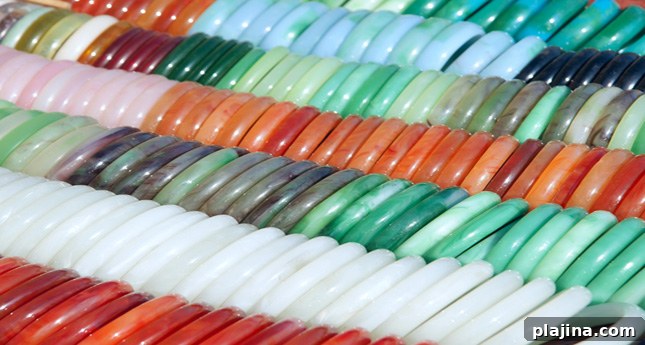
According to the Gem Institute of America, the term “jade” properly applies to two distinct gemstones: jadeite and nephrite.
Jadeite appears in a broad spectrum of colors, including black and numerous shades of green, as well as lavender, yellow, red-orange, gray and cream. Color distribution in jadeite can be even, streaked or mottled, creating a wide range of visual effects.
Nephrite is typically found in light to dark greens, brown, yellow, black, gray and white. Its hues are generally less vivid than those of jadeite, and nephrite often shows streaking or mottling as well.
The most prized jadeite color is a rich green known as imperial jade, which can resemble the hue of an emerald. For nephrite, a pure white color is the most desirable. Jadeite can range from opaque to semi-transparent; in semi-transparent pieces you can sometimes see blurred text held beneath the stone. Semi-transparency is often considered a mark of higher quality. Both jadeite and nephrite are exceptionally tough and durable minerals. Rather than being faceted like many gemstones, they are usually polished to a smooth, lustrous surface.
China remains the world’s largest center for processing and trading jade, particularly nephrite, handling much of the sourcing, cutting and polishing of these stones.
In Hong Kong, a common classification system is used to describe jadeite treatments: “A” jade refers to natural jadeite that may only have a surface wax; “B” jade denotes jadeite that has been bleached and then impregnated with polymer resin; and “C” refers to material that has been dyed and may not actually be true jadeite or nephrite.