
The Royal Dublin Golf Club owes much to the famous Captain William Bligh of the HMS Bounty. While on a mission to collect breadfruit in Tahiti to supply British colonies, Bligh also supported the construction of a protective seawall to improve Dublin’s harbor. The Great North Wall created a sandbank that became Bull Island. The Royal Dublin Golf Club owns a 160‑acre parcel on that island, home to the third‑oldest and quintessential links course in Ireland.
Bull Island is a true island with two main access points: the well‑maintained North Bull Island causeway and the older Wooden Bridge to the south. Our driver, Sean, chose the southern approach. The narrow wooden bridge could make visitors wonder if a large van would fit; Sean pushed on regardless. He scraped the roof on a chain‑hung barrier meant to deter tall vehicles, paused only briefly, then continued onward, earning amused looks from the rest of us.
On arrival the club professional, John Dwyer, greeted us warmly. When he learned Sean had used the southern entrance, he chuckled and called him “brave man.”
Since establishing its links on Bull Island in 1889, The Royal Dublin has hosted six Irish Opens. During World War I the British military commandeered the course for use as a shooting and artillery range, which left the turf and the clubhouse in poor condition. After the war, members hired renowned architect Harry Colt to rework the layout, raise tee boxes for views of Dublin, and shape the course as it stands today. Subsequent restorations have respected Colt’s original design. My group that day included Jimmy Spratt, John Ecklund and Gerry Gallagher, and we were aided by excellent caddies—Daniel, Liam, Michael and Aiden.
HOLE 4 | “FEATHER BED”
173 yards, par 3
Many holes offer recurring views of Dublin, notably the Poolbeg Chimneys—tall, red‑and‑white striped former power station stacks that sit behind and slightly left of the fourth green. Recently repainted and preserved as part of the cityscape, they are a constant landmark on the course.
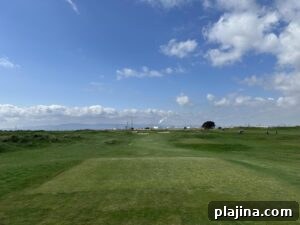
Hole 4 © Francis X. Gallagher
Jimmy handled the prevailing wind and avoided the trio of bunkers guarding the front of the green, walking away with a neat par. I played conservatively to a bailout area left of the green and chipped on for a bogey. John and Gerry tested the deep bunkers but couldn’t match Jimmy’s tidy execution.
HOLE 6 | “VALLEY”
573 yards, par 5
This long, sweeping par 5 requires attention to the drainage canals that line sections of the fairway. They can appear close to the left but also come into play on other holes across the course. A World War I era bunker sits to the right as a reminder of the British Army’s wartime occupation and is kept as a historical feature.
Play this hole well and a par or birdie is attainable. My drive rolled to the fairway and stopped just behind the old bunker. Gerry’s drive found one of the short drainage channels to the left. John and Jimmy both pushed drives into the high grass on the right. My second shot landed short of the fairway bunker about 100 yards from the green, leaving a blind approach. Guided by caddie Daniel, I aimed carefully and, in calm conditions, managed to two‑putt for par while the others took bogeys.
HOLE 10 | “MARNE”
441 yards, par 4
Named after the First Battle of the Marne in September 1914, where Allied troops halted the German advance, this hole is the course’s toughest and plays straight into the prevailing wind. Two fairway bunkers sit right and cannot be reached from the tee. Gerry encountered one on his second shot and advanced into range only to be stymied by the canal that cuts across the fairway and wraps around the right front of the green. I bounced around in the trees right of the green but avoided the water. Gorse behind and to the right further penalizes any errant shots.
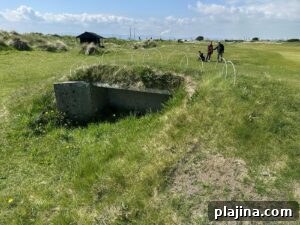
Hole 6 with World War I bunker © Francis X. Gallagher
HOLE 18 | “GARDEN”
463 yards, par 4
A fitting finishing hole requires a bit of course knowledge. This dogleg right rewards players who favor the left side off the tee to avoid a creek that crosses the landing area; short of that creek on the right lies a large out‑of‑bounds section. Jimmy misread that designation and played boldly toward the green. My tee shot drifted right but stayed clear of the water. A mid‑iron approach found the surface, then I bladed a chip into the creek. After taking a penalty drop and making the long putt, I finished with a bogey. We closed the day by thanking our caddies, enjoying a quick pint in the dining room, and returning to the mainland via the northern route off Bull Island.
THE ROYAL DUBLIN GOLF CLUB
North Bull Island Nature Reserve
Dollymount Avenue
Dublin, D03 P768, Ireland
tel 353 1 833 6346