
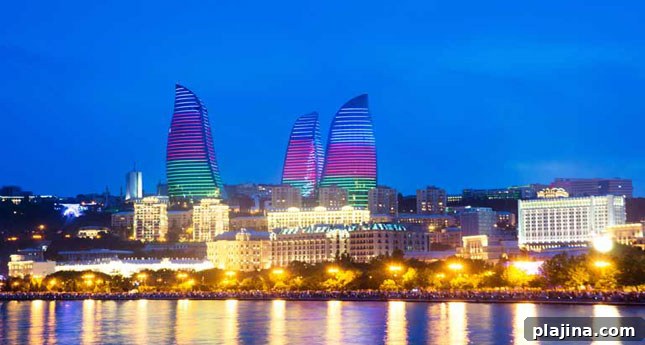
Imagine a city that survived the Soviet era, sits amid vast oil fields and has a name that echoes distant Timbuktu — now picture a modern, cosmopolitan capital with gleaming sandstone facades, broad leafy promenades and a shoreline along a sparkling inland sea. That is Baku, the capital and largest city of Azerbaijan. Located on the Absheron Peninsula at the western edge of the Caspian Sea, Baku is home to roughly 2 million people — about a quarter of the nation’s population — and features wide boulevards, distinctive contemporary architecture and a rapidly developing economy.
Oil has long been Baku’s defining engine. The region is often called the “Houston on the Caspian” and is one of the birthplaces of the modern oil industry. Natural oil seeps were used for lamps as early as the eighth century, and by the 1870s commercial exploration attracted international investors including the Rothschilds and the Nobel family. By the early 20th century, Baku’s oil fields produced nearly half of the world’s supply. Exploration later extended offshore into deepwater fields, and major projects such as the Baku-Tbilisi-Ceyhan pipeline — completed in 2006 to carry Caspian oil across Georgia to Turkey’s Mediterranean coast — are expected to generate substantial revenues over coming decades. Large fields like Azeri-Chirag-Guneshli and Shah Deniz continue to shape the city’s economic prospects.
Following independence in 1991, Azerbaijan launched gradual economic reforms. Under the presidency of Heydar Aliyev, Baku began a large-scale urban transformation that combined preservation of the historic Old City with contemporary development. Dilapidated Soviet housing blocks were removed in many areas, streets were widened, municipal services were modernized and parks were created on reclaimed landfill. A new metro system now serves the city, and many historic facades were restored or overlaid with fresh stone. While some renovations are criticized as cosmetic, the city’s revitalization — including new museums and cultural institutions — has reinforced Baku’s position as the nation’s industrial, scientific and cultural center.
With mining and hydrocarbons accounting for the vast majority of Azerbaijan’s economy, diversification remains a priority. The government is investing to spur growth in agriculture, manufacturing, telecommunications and tourism. Agriculture is the second-largest sector: thanks to a varied climate the country grows grapes, cotton, wheat and tobacco, with about 40 percent of the workforce involved in farming and half the land area used for agriculture. Reforms over the last decade have increased yields and reduced rural poverty, although farming’s share of GDP is still modest.
The banking sector has also advanced since the Soviet period, seeing privatization and restructuring that have increased competition among leading banks. Progress has been steady, though the financial system has yet to fully reflect the pace of broader economic growth.
Baku is one of the Caucasus’ principal tourist destinations. Spa and health tourism benefit from long hours of sunshine and a dry climate, while the city center offers abundant accommodation from local and international hotel brands. Luxury shopping is concentrated along Nizami Street, which hosts international fashion houses. Major events such as the 2012 Eurovision Song Contest and the 2015 European Games accelerated the expansion of English-language tourist information, improved signage and enhanced visitor services.
To support business growth, the government has streamlined procedures for starting companies, improved online tax filing and reduced administrative burdens. International reports have recognized Azerbaijan for significant regulatory reforms in recent years, improving the country’s ranking for ease of doing business.
On the political front, Azerbaijan navigates a complex regional environment. The nation lies at a geopolitical crossroads between East and West, bordering Russia, Iran and Turkey, and balancing relationships with European partners and key energy customers. Tensions with neighboring Armenia over Nagorno-Karabakh remain a major security concern following the contested conflict and the fragile 1994 ceasefire. Regional diplomacy and pipeline routes will continue to influence long-term stability and economic prospects.
Trade patterns are shifting: while commerce with Russia and other former Soviet states has diminished in relative importance, ties with Turkey, Iran, the United Arab Emirates and European Union countries have strengthened. Azerbaijan participates in regional organizations and has served as a non-permanent member of the United Nations Security Council, underlining its international role. Future prosperity will remain closely tied to global energy prices and the development of new export routes.
Things to Do in Baku
Baku’s coastal setting, sunny climate and cultural attractions make it an appealing destination. Many modern hotels now offer full-service spas and wellness programs, complementing the city’s historic sights. For prehistoric art and archaeology, drive about 30 minutes south to Gobustan, a UNESCO World Heritage site where Neolithic petroglyphs etched into rock walls depict people, animals and ritual scenes. The on-site museum provides archaeological context and displays artifacts from the region.
In the city, explore the UNESCO-listed Old City. Start with the 12th-century Maiden’s Tower, an iconic stone structure that towers over narrow lanes and historic courtyards. Wander through the Shirvanshahs’ Palace complex, fortified walls and caravanserai courtyards that recall Baku’s medieval role on trade routes.
Museums include the Museum of History, housed in the former mansion of oil magnate Zeynalabdin Taghiyev and featuring thousands of historical objects, and the R. Mustafayev State Museum of Art, which occupies elegant 19th-century palaces and showcases regional, Russian and European works alongside contemporary paintings inspired by the oil industry. The Azerbaijan Carpet Museum, with a roof designed to evoke an unfolding carpet, and the modern Baku Museum of Modern Art, which displays works by both international and Azerbaijani artists, are notable cultural stops along the seaside promenade.
Baku offers lively nightlife, especially around Fountain Square, where clubs and bars stay open into the early morning. Dining and entertainment range from traditional venues set inside restored caravanserais to contemporary lounges with panoramic city views.
Natural attractions unique to Azerbaijan include mud volcanoes near Gobustan and the region’s fire temples. The Ateshgah Fire Temple, preserved as a museum, reflects historical fire-worship traditions; nearby Yanar Dag features a continuously burning natural gas seep that produces an ever-present flame along a sandstone hillside, a striking symbol of the country’s geological richness.
Baku Info to Go
Heydar Aliyev International Airport (GYD) lies about 12 miles northeast of the city center, roughly a half-hour drive in normal traffic. Taxi fares to central Baku typically run higher than local buses; an express minibus route (No. 116) connects the airport with the city center on a frequent schedule and stops at central locations.
Baku: Just the Facts
Time Zone: GMT +5
Phone Code: Country code 994, city code 12
Entry/Exit Requirements: Visitors generally require a certified letter of invitation and must obtain visas online before travel
Official Language: Azerbaijani is spoken by the vast majority of the population
Key Industries: Oil and gas production, agriculture and tourism
Checking in with Robert Couturier
New York–based interior designer Robert Couturier has worked on an expansive residence on the Absheron Peninsula. He describes the project as a massive, limestone, Moorish-inspired house that draws architectural details from the Shirvanshahs’ Palace, with tall walls, pointed arches and stately proportions. Couturier recalls arriving when the city felt dilapidated but witnessing rapid improvements: better hotels, restored historic homes and growing craftsmanship. His advice for visitors is to explore the Old City and its museums, though he notes local cuisine varies and the climate ranges from hot, dry summers to cold, windy winters.
Where to Stay in Baku
Fairmont Baku — Located in the Flame Towers, this high-end hotel features extensive amenities including a large lobby, spa facilities and pools. Flame Towers, 1A Mehdi Huseyn.
Four Seasons Baku — A luxury hotel overlooking the esplanade and near official residences, known for elegant architecture and sea-view rooms. 1 Neftchilar Ave.
Hilton Baku — Situated on Freedom Square, the Hilton offers convenient access to the city center and panoramic views from its upper floors. 1B Azadlig Ave.
Restaurants in Baku
Karvansara Restaurant — Set in an atmospheric restored caravan inn with arched colonnades and domed stone walls, serving traditional dishes in a Silk Road ambiance.
Old City Restaurant — A cozy local favorite noted for regional specialties and a traditional interior with kilim carpets and crafts.
Zeytun Restaurant — Located on the top floor of Park Bulvar mall, offering sea views, classic Azerbaijani dishes and live music.
Explore Baku’s blend of ancient heritage and dynamic modern growth: from UNESCO-listed old quarters and prehistoric rock art to contemporary museums, lively nightlife and unique natural phenomena linked to the Caspian’s oil-rich geology.