
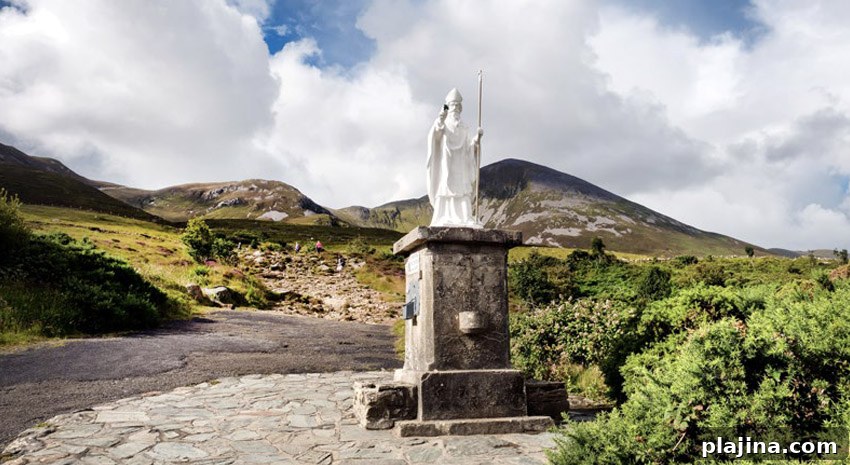
I have to confess, Croagh Patrick remains on my bucket list. Rising from Ireland’s northwest coast beside the sea in County Mayo, this stately mountain — more accurately a high hill — is one of the island’s sacred places. Tradition holds that in the year 441 St. Patrick fasted here for 40 days and 40 nights, interrupting his vigil to drive all the snakes into the sea. Today the ascent is both a pilgrimage for devout Catholics, some of whom climb barefoot or on their knees, and a popular route for hikers and locals who regularly head up for exercise.
During pilgrimage season, from April through October, the mountain can be crowded with several hundred people a day making the round trip: families with children, joggers, and pilgrims moving steadily up the path. Having summited Kilimanjaro and trekked to Everest Base Camp, I expected Croagh Patrick to be an easy outing. A tender tendon in my heel from a recent misstep worried me, but I anticipated only mild discomfort as I walked what I imagined would be a gentle trail.
That expectation proved wrong. After passing the Visitor Centre and the statue of St. Patrick and climbing a short flight of steps, the true nature of the climb became clear. Heavy traffic had eroded the path into a rough surface of loose stones and exposed rock. Footing was uncertain, and favoring my sore ankle made the route even tougher. For a small fee hikers can buy or rent a stick at the base, but I had brought the cane I’d been using for the injury. Even with that support progress was slow.
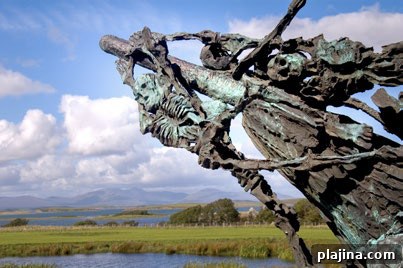
Famine Monument sculpture © VINCENT MACNAMARA | DREAMSTIME.COM
Visibility would have helped. The path angles eastward before turning back west toward the summit, but a customary mist had settled in and clouds hid Croagh Patrick’s upper reaches. The usual waypoints ahead were invisible.
The route features a series of stations. Climbers first reach a simple rest area known locally as “the toilets.” The first station is a pile of stones; pilgrims traditionally walk seven times around this cairn, which commemorates the bones of Benain, a follower of St. Patrick who, legend says, was attacked by blackbirds on that spot. The second station is the summit itself, where a small chapel can seat a few dozen worshipers and, on clear days, offers views of meadows, stone fences, and the 300 Aran Islands speckling the sea below. The most committed descend about 500 feet down the west slope to a third station, Reilig Mhuire cairn, to recite further prayers before climbing back to the summit and returning the same way.
I didn’t make it to any of those ritual stops. After more than an hour of slow progress I met others who were turning back because “the weather was worsening and the last part of the climb, to the cone, is the hardest.”
I hate quitting, and I hadn’t even passed the rest area, but slipping on loose gravel worried me. On the descent the loose surface made the route treacherous. A kind young girl on the trail offered her walking stick to help steady me; without that gesture I might have needed a rescue. Leaning on both the cane and the donated stick, I inched my way back down, taking about two hours.
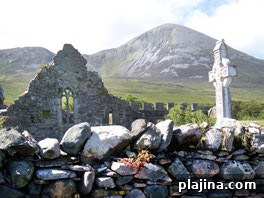
Ruins of Murrisk Abbey © TIMOTHY KIRK | DREAMSTIME.COM
I’ve promised myself I’ll return. Beyond completing this item on my list, the region offers plenty to explore. At the mountain’s base the evocative Famine Monument recalls the coffin ships that carried emigrants to America. Nearby the stone ruins of Murrisk Abbey stand on the site of St. Patrick’s church, the remnant of a once-grand window framing the past.
For outdoor enthusiasts the Great Western Greenway, a converted rail trail, runs 26 miles from Achill Island to the riverside town of Westport. Westport itself is full of character: streets lined with vintage façades, shops selling hand-knit sweaters and local souvenirs, and Westport House, where guided tours of 30 period rooms reveal the lifestyle of earlier gentry.
Westport’s harbor hotels provide spa treatments, dining, and dozens of atmospheric pubs. Local tour operators can arrange trips to nearby Clare Island to see the castle associated with the 16th-century leader Grace O’Malley, as well as activities like fishing, cycling, kayaking, and heritage walks. I’m already looking forward to returning next spring, when I plan to try Croagh Patrick again and finally reach the summit.